Follow Us for Free:


About the episode
“Perimenopause likes to really throw us through a loop, and things that might have previously been stable no longer feel so predictable.” – Vanessa Weiland, NP, HT, MSCP
Even with the expanding conversation on perimenopause, our clients and patients with chronic illness are still being left out. The one-size-fits-all approach doesn’t address those with hypermobility syndromes, mast cell activation syndrome, dysautonomia, or complex chronic illness. In perimenopause, conditions you’ve dealt with for years can change significantly. Symptoms that were manageable for years suddenly become more intense, pain patterns shift, sleep becomes less reliable, and many women find themselves wondering whether this is “just perimenopause” or something else entirely.
What makes this phase especially challenging is that hormones don’t operate in isolation. Estrogen, progesterone, connective tissue health, immune function, mast cells, autonomic regulation, sleep, and stress physiology interact simultaneously. Myopically looking at menopause through the lens of hot flashes and hormone replacement therapy makes us miss the much more complex reality facing women who are already navigating chronic health conditions. For these patients, finding stability often requires a more personalized and layered approach.
In today’s episode, I’m joined by Vanessa Weiland, a nurse practitioner, menopause specialist, and founder of Phases Clinic, known online as Bendy Menopause. Vanessa shares her journey with hypermobility and chronic pain and explains why perimenopause can be such a pivotal transition for women with connective tissue disorders and related conditions. We discuss the relationship between hormones, mast cells, and the nervous system, why standard menopause protocols don’t always work for this population, how progesterone, estrogen, and testosterone can affect symptoms differently, practical strategies for building a supportive clinical team, the overlap between hypermobility, long Covid, trauma, chronic pain, and neurodiversity, why small, individualized changes over time are often the key to helping these patients feel better, and more.
Enjoy the episode, and let’s innovate and integrate together!
Highlights
- Vanessa’s transition into menopause care and what she discovered about the gaps in medical training
- The surprising overlap between hypermobility, endometriosis, chronic pain, neurodiversity, mast cell activation, dysautonomia, and long COVID
- Why hormonal changes during perimenopause and menopause can create unique challenges for people with hypermobility
- The role hormones play in connective tissue health, pain, sleep, cognition, and stability
- The growing overlap between long COVID symptoms and the perimenopausal experience for many women
- Treatment strategies for mast cell activation
- Why nervous system regulation is a critical part of managing immune activation and symptom flares
- How to build a multidisciplinary care team for hypermobility and related complex conditions
- Why standard menopause treatment protocols often fall short for people with hypermobility and chronic illness
Learn more about Vanessa Weiland, NP, HT, MSCP
About Vanessa Weiland, NP, HT, MSCP
Vanessa Weiland, NP, HT, MSCP is a board-certified Adult-Gerontology Primary Care Nurse Practitioner, Certified Advanced Clinical Hypnotherapist, and Menopause Society Certified Practitioner. She is the founder of PHASES Clinic in Washington State, where she specializes in menopause medicine, sexual health, and complex chronic illness — with particular focus on patients with hypermobility, MCAS, and dysautonomia.
Learn more about The Integrative Women’s Health Institute’s Programs
- Perimenopause and Menopause Certificate Program
- The Integrative Women’s Health Membership
- Endometriosis Certificate Program
Ready to revolutionize your career and grow your practice?
- Integrative Women’s Health Institute on Instagram | @integrativewomenshealth
- Integrative Women’s Health Institute on YouTube
Click here for a full transcript of the episode.
Dr. Jessica Drummond 00:00:03 Hi and welcome to the Integrative Women’s Health Podcast. I’m your host, Doctor Jessica Drummond, and I am so thrilled to have you here. As we dive into today’s episode, as always innovating and integrating in the world of women’s health. And just as a reminder, the content in this podcast episode is no substitute for medical advice, diagnosis, or treatment from your medical or licensed health care team. While myself and many of my guests are licensed healthcare professionals, we are not your licensed healthcare professionals, so you want to get advice on your unique circumstances. Diagnostic recommendations treatment recommendations from your home medical team. Enjoy the episode. Let’s innovate and integrate together. Hi everyone. Welcome back to the Integrative Women’s Health Podcast. I’m your host, Doctor Jessica Drummond, and I’m thrilled to be here with you today with Vanessa Wyland aka everywhere on the internet, bendy menopause. And I’m gonna hop over and share with you a little bit more about Vanessa’s background. She is a nurse practitioner, board certified in Adult Gerontology, Primary Care Medicine Certified Advanced Clinical Hypnotherapist.
Dr. Jessica Drummond 00:01:35 So like many of us, she transcends from traditional clinical medicine to a little more woo woo and nervous system regulation and all of that which we love. We talk about trauma in this episode and the impact on MCAS. She is a Menopause Society certified practitioner. She’s the founder of the Phases Clinic in Washington state, where she specializes in menopause medicine, sexual health, and complex chronic illness, with a particular focus on patients with hypermobility, MCAS and dysautonomia. Her website is Phases Clinical and like I said, you can find her on social media at Bendy Menopause. I want you to think about in this episode, all of these clients with chronic issues that we deal with day in and day out in our practices, and how sometimes even the conversation on perimenopause is failing them a little bit because there’s a little bit of a one size fits all conversation about HRT in menopause and perimenopause without thinking about the immune system, the reactivity of mast cells, how that impacts the collagen of people who have genetic or genetic and triggered hypermobility syndrome disorders.
Dr. Jessica Drummond 00:02:54 And as clinicians and coaches, we need to help our clients become stable in a lot of different ways with using really unique toolboxes, and this idea of patients making small changes one at a time and really supporting people over time. So let’s get into the episode with Vanessa, and we’ll chat on the other side about how you can apply this right now in your practice. Hi and welcome, Vanessa. I’m here, everyone with Vanessa Wyland, and we are going to talk all about perimenopause and menopause in bendy bodies. Those of us with a variety of hypermobility, everything from HDS to any other hypermobility disorders. So welcome, Vanessa.
Vanessa Weiland 00:03:55 Thanks so much for having me. This is my one of my favorite things to talk about, although there’s very little research, which I’m sure will come up once or twice.
Dr. Jessica Drummond 00:04:02 Yeah, I think this is one of the challenges in for 25 years now, I’ve worked in primarily in women’s and pelvic health, but often at the intersection of things like endometriosis, MCAS Potts, HDS now long Covid and perimenopause and puberty and pregnancy.
Dr. Jessica Drummond 00:04:23 And some of it depends a little bit how old I’ve been and who I attract. But we’re talking a lot about perimenopause now. So tell us a little bit of your story and how you came to do this work before we dive into some of the Naughtier stuff?
Vanessa Weiland 00:04:40 Yeah. So my background, I’m an adult gerontology nurse practitioner, and I had a similar experience to many of us where I had very little training on menopause specific care or sexual medicine care, and I went to a good school, so I didn’t really question that was not adequate training. And then my previous job Before opening my clinic, I was doing home health, so I was listening to a podcast all the time and some were just fun, but some were medical and a menopause specialist came on one of them and was talking about some tricky cases she’s had where it wasn’t the clear cut, hot flashes and night sweats and vaginal dryness. It’s predominantly brain fog or changes in mood. I’m just sitting here in my car, shaking because I was so frustrated that I would have been like all the other providers that these patients had seen who had no idea, did not put the dots together.
Vanessa Weiland 00:05:26 That was related to hormonal changes. And I too will go through. I’ll have those hormonal changes. So I was mad for myself, right? That as a primary care educated nurse practitioner, I knew next to nothing as much as the next person. So is our health care providers is a lot of times the blind leading the blind. So I went back for additional training and menopause specific care, how to prescribe hormone therapy safely, and just got more and more passionate about it, and ultimately decided to open a clinic. And so running in the background of all this is my personal history, where I’ve had chronic pain since I was a teenager, and on the patient experience similar experiences to perimenopause, where one provider might be actually mean dismissive gaslighting. I’ve experienced that, but more often it’s providers that were perfectly nice and well-meaning, but had no idea what’s going on with me, and so they weren’t really able to get me in the right direction. And so I think maybe that personal experience is part of why I really what what really drew me to this career menopause and menopause care.
Vanessa Weiland 00:06:30 So in any case, of course, it all comes back to the social media algorithm. And I don’t know how they got me, but they figured out that I was bendy. And so they put on a physical therapist saying if you have XYZ and the other you might have hypermobility spectrum disorder or hypermobility syndrome. And once again, my jaw is hitting the floor because it explains so much. So I was able to find a specialist here in Washington state and have the official diagnosis of hypermobility syndrome. And you probably know that it doesn’t necessarily change. There’s not like we have one medication that cures that, right? It’s more of like with that knowledge in mind, what kind of treatment can we modalities can we bring in. And it’s very you often need to bring in multiple things. Maybe some supplements here, physical therapy there. But you want your physical therapist to know about hypermobility, strength training, the all the lifestyle things. That’s where I’ve been growing a lot just in the last year or two is, in a self-serving way, bringing more about how to manage hypermobility.
Vanessa Weiland 00:07:32 But like you said, there’s a surprising amount of overlap between those two areas of specialty things like endometriosis, pelvic floor disorders, chronic pain. Neurodiversity seems to be mixed into somehow long Covid and mast cell activation and dysautonomia. It’s all lining up and people who have those underlying issues. Perimenopause likes to really throw us through a loop, and things that might have previously been stable no longer feel so predictable.
Dr. Jessica Drummond 00:08:02 Yeah, absolutely. So why do hypermobility, Ehlers-Danlos syndrome patients, or hypermobility spectrum disorders patients experience perimenopause or menopause and menopause differently from a perspective of the connective tissue, the nervous system, the immune system and mast cell component. What research do we have so far and your experience?
Vanessa Weiland 00:08:27 Yeah. So you just mentioned what’s commonly called the triad. So people who have hypermobility like to run alongside people who have easily stimulated fat cells. So those are immune cells that live in the connective tissue as well as nervous system issues. So frequently people have dysautonomia. And of course the nervous you have nerves that run through the connective tissue also.
Vanessa Weiland 00:08:49 So it makes sense that they would run together and with nervous system issues, that might also be where the neurodiversity comes in. But all of those except for, I guess, ADHD, are female predominant diagnoses, and for all of them the symptoms often onset is around puberty, which was the case for me and also for all of them. Most people will report changes in their symptoms throughout the whole cycle. So although we don’t have really clear cut evidence of which hormone is doing what here and why it’s causing issues in the stability of symptoms, I was very clear that symptomatically that’s happening. We just don’t have the underlying biology of it all figured out quite yet. With perimenopause, those menstrual cycles that even if you knew you had good days and bad days, at least it was fairly predictable. Now, in perimenopause, that piece is out the window. It’s a lot higher highs, lower lows. Estrogen can actually flare mast cells. So some people might notice worse symptoms around ovulation. The next person might be really impacted by low progesterone around their when they menstruate.
Vanessa Weiland 00:09:53 So individually. It’s also very a wide variety of what makes people feel better and worse.
Dr. Jessica Drummond 00:09:58 Yeah. And I was just going to say recently in our practice, probably in the last year or so, we’ve been having some of these kinds of patients track their menstrual cycles more daily in perimenopause, using something like a mirror or like urinary sticks, which are actually tracking the hormonal metabolites. But what’s so interesting is the extreme variability day to day of estrogen levels of progesterone levels. And sometimes that’s helpful to just see visually that people feel crazy that, like you said, for a couple of decades, they were able to at least have some predictability over their symptoms. Or I was like, oh, okay, I get it. I’m about to start my period or whatever, but now it just feels so hard to wrap your hands around it, and I think that can be just helpful for people to see as a place of knowing, okay, this is coming from somewhere, and sometimes we can actually see a correlation between symptoms and variability, which unless you’re tracking every day, which is hard to do long term sustainably, but it’s maybe for a little while it can be helpful.
Dr. Jessica Drummond 00:11:15 It gives you that reassurance that it’s like, oh, I haven’t just lost the plot of that ability to control my symptoms.
Vanessa Weiland 00:11:22 Yeah, I and even if you don’t have access to those kits that you’re testing your urine or your spit daily, you can get a lot of information just based on when you’re menstruating and even things like changing temperature where you are. I have a lot of patients that have a hormonal IUD or even a history of hysterectomy. So yeah, it can be so much harder to figure out where you are in your cycle. Imagine assuming you stop your ovaries if you aren’t mystery. So either a kit or just a symptom tracking app can really help you figure out those correlations because it’s not always obvious.
Dr. Jessica Drummond 00:11:55 Yeah. And absolutely, we’ve been using it in women who still have their ovaries, but or maybe 38, 42, 45 even, you know, in the perimenopause, but sometimes quite early perimenopause, maybe even in their 30s, but maybe they had a hysterectomy for another reason. Cancer had no meiosis.
Dr. Jessica Drummond 00:12:16 And it can just be helpful to see like there’s still this sort of menstrual activity happening in the ovaries, even if it’s not regular and consistent. So the hormonal mechanisms that matter most for this population, we have the progesterone impact on sleep and pain. And these are the areas where we at least have a little bit of research. Estrogens role in connective tissue and cognition and testosterone role. And like muscle tension strength, stability. I’m always walking around with my pelvic floor model like put your vaginal estrogen and testosterone. What are your thoughts on the known hormonal impacts, particularly on connective tissue or those immune and neural neuronal tissues that are embedded within the connective tissue?
Vanessa Weiland 00:13:05 Yeah, I’ll try to take them one at a time. So progesterone that is produced when you ovulate. So a lot of times early perimenopause is specifically impacted by low progesterone even before you have low estrogen symptoms. And as far as the good things for hypermobility it seems to help with your pain tolerance. But as far as the bad things for hypermobility, when it’s high, it can cause more laxity.
Vanessa Weiland 00:13:31 So it seems like majority of my patients, since we’re if you’re in menopause or menopause, you’re on the older side and a lot of us have lost a lot. We have stiffness making up for some of the laxity in our joints. So it seems like for the most part, progesterone outweigh the good, outweighs the bad with it. But that’s always a caveat that I give to people. And yeah, it does tend to help with sleep and anxiety even in the average person. But some people, especially those with a history of premenstrual symptoms, PMS, PMDD, or maybe postpartum anxiety and depression might be especially sensitive to the ups and downs with progesterone. And so some people have what we call progesterone intolerance. It doesn’t mean you can’t use it, but you might need to think about the dose or a form even more closely. And estrogen, that is when you have a dominant follicle that’s making the estrogen. And so as that’s as you run out of eggs and your your ovaries, basically you stop making the dominant follicle.
Vanessa Weiland 00:14:31 And so that’s stereotypical menopause symptoms hot flashes night sweats fashion and dryness. But when it comes to your connective tissue we know that it helps reduce inflammation in the joint. It’s important for collagen synthesis. And majority of time adding on estrogen can be helpful for pain. Helpful for support, but actually the muscles. Oh, I forgot to say this for progesterone, but the mast cells have estrogen receptors on them and it tends to make them release histamine. People who have mast cell activation syndrome might actually have more symptoms around ovulation. It doesn’t mean you can’t use estrogen. It just means maybe starting at a lower dose and making even smaller steps and increasing the dose, or maybe really optimizing your mast cells stabilizing before you bring estrogen on board. And I forgot to say, progesterone seems to mostly stabilize myself. So I often start there and then add estrogen.
Dr. Jessica Drummond 00:15:25 Same. We’ve done the same thing for also for women with endometriosis. And I think there’s some real benefit. The mast cell issue is huge, but just helping women sleep a little bit better first.
Dr. Jessica Drummond 00:15:40 And we do see because I think you and I work with a similar population of sensitivity, and the nurse practitioner who works with us that we might have to start. There can be this rebound. Hyperactivity for people that have that progesterone sensitivity, but maybe 50mg at first. This is why we often do one hormone at a time. And I completely agree with your sequence mast cell stabilization first, then a little progesterone, then maybe a more therapeutic dose of progesterone than estrogen. I think that’s so important clinically. Yeah.
Vanessa Weiland 00:16:17 And so lastly the testosterone, it doesn’t drop dramatically or go through the ups and downs like estrogen and progesterone do and perimenopause. But it does peak around our 20s and just slowly decrease from there. So almost coincidentally, in your 40s or on your 40s, it might be about half what it was at the peak. And that’s a really interesting question for more clinical research. Not much has been done on that piece. We know that it’s important for your bone health, your muscle health. I think a lot of my patients find it’s helpful for their overall energy levels, but it’s mostly been studied really around libido.
Vanessa Weiland 00:16:51 And so that’s another interesting area because like I mentioned, these are all female predominant medical issues. And there’s actually been some, I will call it anecdotally where people who are trans and of their trans masculine and they take testosterone, they often find that their pots and MCA’s and Oedipus and pain get better. And trans women who are taking estrogen often find that their pots and editors and symptoms get worse. And that’s like in the realm of Reddit. So there hasn’t been great research on it. But I was at the Ehlers-Danlos Society symposium last year, and I saw a couple studies looking at whether not necessarily testosterone levels are different, but maybe that whole androgen signaling pathway is one area of difference in the EDS population versus the general population. So yeah, that if I ever get tricked into doing a PhD, I can almost guarantee that’s what I’ll be spending.
Dr. Jessica Drummond 00:17:49 And bring in a party, because I think what will be so interesting about that is then you can layer on strength training and see if also the benefit of testosterone to the myofascial system and the brain signaling.
Dr. Jessica Drummond 00:18:03 You get this like synergistic improvement would be my hypothesis. We have no data at this point.
Vanessa Weiland 00:18:10 Yeah. That’s another good point, is that there’s a little bit of research that people who have at least hypermobility, Ehlers-Danlos syndrome, I think all of them are more prone to osteoporosis. And we know that estrogen is super important for bone health, but for just drawing and testosterone are important as well.
Dr. Jessica Drummond 00:18:26 Yeah, absolutely. So before we move to the next question, just selfishly so I am a person who’s been living with long Covid and didn’t know I was hyper mobile until that trigger. So any thoughts on two things what you like, what has been most effective for you in in practice in terms of mast cell stabilization, because I’ve done a lot of things and could probably do a whole episode on that. But also your thoughts about virally triggered, even hypermobility. I think one thing that’s really interesting was at the Editors Summit last week at University of Virginia. There was a speaker, I believe, from Medical University of South Carolina.
Dr. Jessica Drummond 00:19:08 Doctor Norris, I believe, was his name, talking about how we’re just really understanding more and more how a lot of these complex chronic illness issues, not just quote unquote, long Covid, which is really related to all of this, are potentially virally or bacterial triggered.
Vanessa Weiland 00:19:28 Yeah. So I’ll just back up a little bit. The mast cells are a part of your immune system. They live inside your connective tissue. And their first line of defense, if they think that there’s some threat coming into contact with your connective tissue, they spit out a bunch of inflammatory cytokines and histamine to try to kill the threat there. So it’s not really the specific antigen antibody type response that we have in other parts of the immune system. It’s a little bit more. I don’t like that snow. I don’t like that temperature.
Dr. Jessica Drummond 00:19:58 Right. The initial reaction. Yeah.
Vanessa Weiland 00:20:00 Yeah obviously we need that. Yeah. If it becomes more active than necessary, then you might have even more histamine and inflammation in all your connective tissues.
Vanessa Weiland 00:20:10 So that can cause things like flushing and hives in your skin in your digestive tract. It can cause stomach upset, IBS type symptoms, food intolerances. It can even impact your mucosa in the vagina or urethra. It can cause brain fog.
Dr. Jessica Drummond 00:20:27 So pain. Yeah.
Vanessa Weiland 00:20:30 And so we know that a whole bunch of things can trip those mast cells into being what we call hyperactive. And that’s the underpinnings of mast cell activation disorder. And so that might be a trigger like some sort of immune illness that could even be History of trauma can make themselves more active. And it makes sense if you’re in this fight or flight mode in your nervous system, that your immune system is also ready to fight off all the predators. And so what’s starting to formulate around hyper mobile Ehlers-Danlos syndrome, as opposed to the more clear genetic collagen disorders the subtypes, is that maybe it’s actually starting with that immune immune system response. And since the mast cells live inside the connective tissue, maybe that inflammation is what’s catching up the connective tissue and impacting its integrity.
Vanessa Weiland 00:21:18 And if you have long Covid in your 40s, it’s harder to have hypermobility show up at that age versus as a kid. So that doesn’t mean that it’s not impacting the integrity of your joints and tendons and even skin. So yeah, once again, that scenario for more research. But it does seem like some of the genetic markers that are getting pulled out. Nothing’s so clear yet, but might be more have to do with the immune system versus actual connective tissue.
Dr. Jessica Drummond 00:21:47 I think this is so interesting, because I do think it’s really interesting that the conversation on perimenopause in general has really exploded at the same time that approximately 40% to 45% of women in perimenopause and menopause have long Covid, whether they know it or not. I am starting to think these are potentially the same thing. Or I turned up the volume version for a huge number of women because like you said, and this was an interesting question at the Editors Summit last week. One of the nurse practitioners there was saying, I have all these patients with hypermobility who they have hot flashes, night sweats, and they’re not really responding to the hormone therapy.
Dr. Jessica Drummond 00:22:35 So I think MCAS. I think long Covid, and we know from the Mount Sinai data that 80% of women, 80% of people with long Covid who have it don’t know it. So I just think that is a really interesting conversation, because we know that this cumulative effect of illness, that this in this five year period, I just don’t think all of a sudden everyone’s perimenopause has gotten worse.
Vanessa Weiland 00:23:00 Yeah. That in that same talk you were just talking about, he mentions how it seems like perhaps hypermobility editor’s is similar to a lot of autoimmune diseases, where maybe the genetics are actually distributed almost evenly across the population. But if you have a trigger, then you might go on to have the disease versus if you don’t have the trigger, you might never develop the disease. So that kind of points to that. If Covid is a big trigger for people. That could be one reason that we’re seeing a lot of changes. But I think it’s really hard to say because there’s also more of this conversation happening.
Vanessa Weiland 00:23:34 And I don’t know about you. I asked my mom how her perimenopause was and she’s like, oh, I don’t know. I don’t think I had any symptoms. And I’m like, I remember you throwing a shoe at the door so hard. The heel lodged into the door is perfectly lining up.
Dr. Jessica Drummond 00:23:48 I think that’s absolutely fair. I don’t have yeah, I don’t have any particularly challenging memories of my mom’s perimenopause time. I’d have to think about it, but I agree. I definitely think just like everything in women’s health, there are a category of women who, whether they had a viral virus or a bacterial infection or what, just were completely gaslit just due to the perimenopausal shifts, in the same way that they were gaslit at that time. And even now for things like chronic pain or chronic fatigue and me, CFS, endometriosis, painful bladder syndrome like 100% there could happen. And so I think that’s one of the things that makes this challenging, is that all of these things could be true at the same time.
Dr. Jessica Drummond 00:24:36 So it’s good that we’re talking about them, because I think it helps air the possibilities because I think for any given woman it could be a few of these things. It could be one of them or a dominant. And that that does help drive what her best sort of treatment strategies will be as well.
Vanessa Weiland 00:24:54 Yeah. And I don’t think I answered your question about what I do for muscle activation from the treatment side. Yeah. So like I mentioned, there’s really some interesting data around like history of trauma and of course a lot of different chronic illnesses but including muscle activation. So anything that helps to calm the nervous system is going to be helpful here. So that’s a nice non medication option. But the standard go to for mast cell activation syndrome is antihistamines. And that’s to block the action of that histamine that’s being spilled out all the time. So there’s two types of antihistamines. There’s the H1 blockers that we think of anti allergy medications or Allegra all of those. And there’s also H2 blockers. Those are a heartburn medicine.
Vanessa Weiland 00:25:36 So that’s Zantac or Pepcid. And I’m sure you’ve seen on TikTok there’s this trend about Pepcid saved my PMS. So that probably has to do with this to mean. But it’s actually, if you can tolerate it, trying to get up to four times the standard dose, that’s where people don’t necessarily push it. And then beyond that, there’s some supplements that can help. Vitamin C is a really good natural mast cell stabilizer quercetin we use oftentimes I mentioned that progesterone seems to stabilize mast cells. So that’s often part of my plan. And then moving over to prescription medications, things like Crommelin Monty Lucas low dose naltrexone maybe GLP. There’s so much area for research here. But as for anybody that’s listening that doesn’t want to go to the prescription route, yeah, there’s a lot of things to try first.
Dr. Jessica Drummond 00:26:25 Absolutely. Excellent. And I think the piece about the nervous system is sometimes underutilized. I think all of it is important. And sometimes these are like a powerful positive feedback loop. You get a little bit of stability from one tool, then you get a little bit more from another one.
Dr. Jessica Drummond 00:26:42 And I think that’s one of the places where the nervous system regulation can be very well integrated in all different ways. And I like talking about that. I think there’s we have to be mindful because for some people that feels like, oh, we’re saying this is all in your head. But the reality is there’s some really clear science about how the nervous system activates the immune system. And so it’s not just, oh, go do yoga, but it’s like there are powerful strategies for shifting into the parasympathetic activation that calm, that signaling to the immune system. And when utilized, it’s actually quite empowering because you can bring it in moments of stress to help reduce like a mass of flare or something like that.
Vanessa Weiland 00:27:29 I totally agree, it’s one of the hardest things that I have to counsel on is that difference between it’s all in your head in a dismissive ways versus like, your brain has a lot of control over this. How cool is that? And there’s things you can actually do to calm your brain down and have that top down impact.
Vanessa Weiland 00:27:45 And I agree, and I’m annoyed that a walk in the forest can actually help my cell activation. Like, that’s that sounds so annoying. But there’s some truth to it in the research actually backs it up. So I’m sorry guys. Walking the forest really does help.
Dr. Jessica Drummond 00:28:03 It does. I’m less annoyed the older I get, because the more I think actually all I really want to do is walk in the forest. So yeah. So let’s talk about building the right clinical team. This is obviously a complex chronic condition that requires a team approach. How do you help your clients and patients build a strong team?
Vanessa Weiland 00:28:26 Yeah, the Ehlers-Danlos society does keep a list of clinicians that have gone through their training. And they’re really multi.
Dr. Jessica Drummond 00:28:35 Disciplinary.
Vanessa Weiland 00:28:36 Multicultural. Yeah. Multidisciplinary Physical therapist, occupational therapist, geneticists, primary care folks. So I really think that’s the major underlying thing. Whoever he is, that they at least have some rudimentary knowledge of editors and don’t dismiss it right off the bat. But those are all potential team members, as well as maybe surgical options for certain things, particularly when you have blood vessel issues, which is more common with Ehlers-Danlos syndrome or certain surgeries related to a anomia and Potts.
Vanessa Weiland 00:29:12 I’m slowly building up that list of referrals around the Seattle area of people I can safely refer to, and then ultimately, sometimes people end up traveling to see that one person that really specializes in this thing across the country. It’s really tricky.
Dr. Jessica Drummond 00:29:27 Yeah, that that’s hard in the same way as endometriosis. But one of the other talks that I thought was so enlightening was a neurosurgeon in Maryland who has also trained a few people. I think he’s been doing this for many decades, but talking about stability of cervical cranial instability, and that’s the kind of thing that’s so delicate that you want someone who’s done hundreds or thousands of these surgeries. You don’t want to be just a wonderful and maybe very skilled neurosurgeon, but someone who’s very specialized in this, I think, is really important. Not only that, because of the mast cell issues, there can be sensitivities to anything from the metals that are put in to the anesthesia. And so having a team when you’re talking about surgery, who’s really mindful of those risks is so important.
Vanessa Weiland 00:30:18 Yeah. And I know there’s a mast cell society I’m sorry I don’t remember the name off the top of my head, but they also have a list of providers.
Dr. Jessica Drummond 00:30:26 Good. Okay.
Vanessa Weiland 00:30:27 And then once you find one specialist in this area, they often know people. So it might be a little bit of a domino effect if you can find one good person. But I think that Ehlers-Danlos society is most effective for probably finding physical therapists, and I personally have had chronic pain since I was a teenager. I saw a lot of physical therapists, as you can imagine, and the hyper mobile joints was never mentioned as anything except a positive oh wow, look how far you move your shoulder. Only until I finally saw someone who specialized in hypermobility. She’s like, you can do that. What if we stopped at 80% for you, which is 100% for the normal population? So what a revelation.
Dr. Jessica Drummond 00:31:07 Yeah, I think that’s really important because it is true that similar to how your lack of menopause care in a standard nurse practitioner curriculum, there isn’t really.
Dr. Jessica Drummond 00:31:19 At least I was in physical therapy graduate school more than 25 years ago, but we really didn’t talk about that. As you said, it’s like you’re mostly working on improving mobility, mobility. It wasn’t to say that we didn’t talk about stability of joints, but not at the level. First of all, we just didn’t have nearly even the research or understanding or conversation about heads. I do think hypermobility disorders have been actually improved in terms of our communication, even research into collaborative, multidisciplinary and or collaborations. Just by social media, really. And that’s new. That’s ten, 15 years old. All right. So why do standard menopause protocols often fail in this population? And in what ways are there some ways that we can specifically help in menopause for people that are more hyper mobile?
Vanessa Weiland 00:32:16 Yeah, I think so often when people try one regimen and they feel worse, they give up really fast. And provider doesn’t have a deep set of tools of trading things out, trying a different formulation. Going back to square one, then people will come to me thinking, oh, I can’t take estrogen or any of the hormones because they’ve had a negative experience in the past.
Vanessa Weiland 00:32:40 So sometimes you’re lucky and you have a really straightforward reaction to this. Most common regimens for hormone therapy and you’re just off to the races. But I think that’s rare for everybody and especially rare for people who have sensitive nervous systems and chronic illness and chronic pain. Having someone with that depth of knowledge, I think, can be really helpful. And I think it’s more and more rare that your primary care team wouldn’t be willing to continue prescribing whatever is discovered as your magical concoction. So I think even just temporarily seeing a menopause specialist can be helpful for that.
Dr. Jessica Drummond 00:33:17 Yeah, I think that’s a really important point, because sometimes they’re a little bit hard to find or out of reach, or more expensive or private pay, depending on which system where you live in the world. And once you do figure it out, yes, it might need a little bit of updating over time, but by and large it can be pretty stable for years, which I do think is really valuable. My personal experience when I first tried estrogen, I was a couple of years into my long Covid journey and I didn’t really even know.
Dr. Jessica Drummond 00:33:49 There’s so much about long Covid that we’ve learned in the last two and a half years that I didn’t know for the first three years of being sick and taking estrogen immediately gave me deep, throbbing pain, redness everywhere in my body. But when I started again after stabilizing the mast cells, dramatic improvement in many different things. So I think that and as we talked about a little bit earlier, with fine tuning progesterone and doing things in a certain order, I think it’s really helpful to just be working with a practitioner like yourself who has that patience to just adjust over time, integrate with nervous system regulation and support. Think about all of the stressors and sleep, because usually we can find something. It just might take a few months.
Vanessa Weiland 00:34:42 Yeah, it’s funny, I think a lot of providers really try to avoid us people with hypermobility because they’re like, they can’t be fixed. There’s not one thing to fix them. And I love us because who with chronic pain and chronic illness isn’t used to trial and error and not always responding to things the way other people do.
Vanessa Weiland 00:35:00 So I find that as long as I set that expectation that it’s going to take a little bit of time, they’re really willing to work with me. And there’s a lot more patience than maybe people who are used to just taking one pill and being done. So I love you guys. True.
Dr. Jessica Drummond 00:35:13 Yes. Excellent. Thank you so much, Vanessa. Is there anything else you’d like to share with our community? And where can people find you if they want to learn more?
Vanessa Weiland 00:35:22 So my handle is bendy menopause everywhere. And I put out a weekly newsletter. And that’s all about these topics. So I try to think about different things every week that will help the most people. And yeah, you can find it in my link in bio if you want to join the newsletter. Of course, there’s no cost to that. And I love having questions directly from the community too, so I can think about how to help more people.
Dr. Jessica Drummond 00:35:45 I love it. Thank you so much for being here and for your time, and I hope to see you on social media.
Vanessa Weiland 00:35:52 See you over there.
Dr. Jessica Drummond 00:35:53 Bye bye. I loved that conversation with Vanessa. First of all, go follow her everywhere at bendy menopause. And I want you to think about in your practice, when someone doesn’t sort of fit the standard of care, how do you help them navigate that? How do you help them think about what do we need to shift? How do we need to think more globally? What could be my root cause that’s a little bit different from the average person, because I think one of our superpowers, when working with clients who don’t fit the mold, which, by the way, it’s just more often than not literally, especially in perimenopause and menopause, that’s 87% of the time. So this is the norm. And so I want you to think about how are you using your health coaching communication skills. If you don’t have those yet join us in the Perimenopause Menopause Certificate program. These communications tools and skills are essential. How are you thinking about their lifestyle, their resources, their level of support, their history of trauma, and how are you helping them navigate that need for patience as they make small changes in their health over time and have, you know, some challenges, some setbacks? I think really the people who master this, you’re never going to have a problem with having a healthy, thriving practice because it’s so rare for people to feel fully heard, fully supported over time.
Dr. Jessica Drummond 00:37:36 So collaborate with people in other disciplines and just get really comfortable with the uncertainty and the need for patience among people that do struggle with not being the textbook case. Because at the end of the day, that’s most of us. I’ll see you here next week. Thanks so much.
Multiple Speakers 00:38:00 Thank you so much for joining me today for this episode of the Integrative Women’s Health Podcast. Please share this episode with a colleague and if you loved it, hit that subscribe or follow button on your favorite podcast streaming service so that we can do even more to make this podcast better for you and your clients. Let’s innovate and integrate in the world of women’s health.
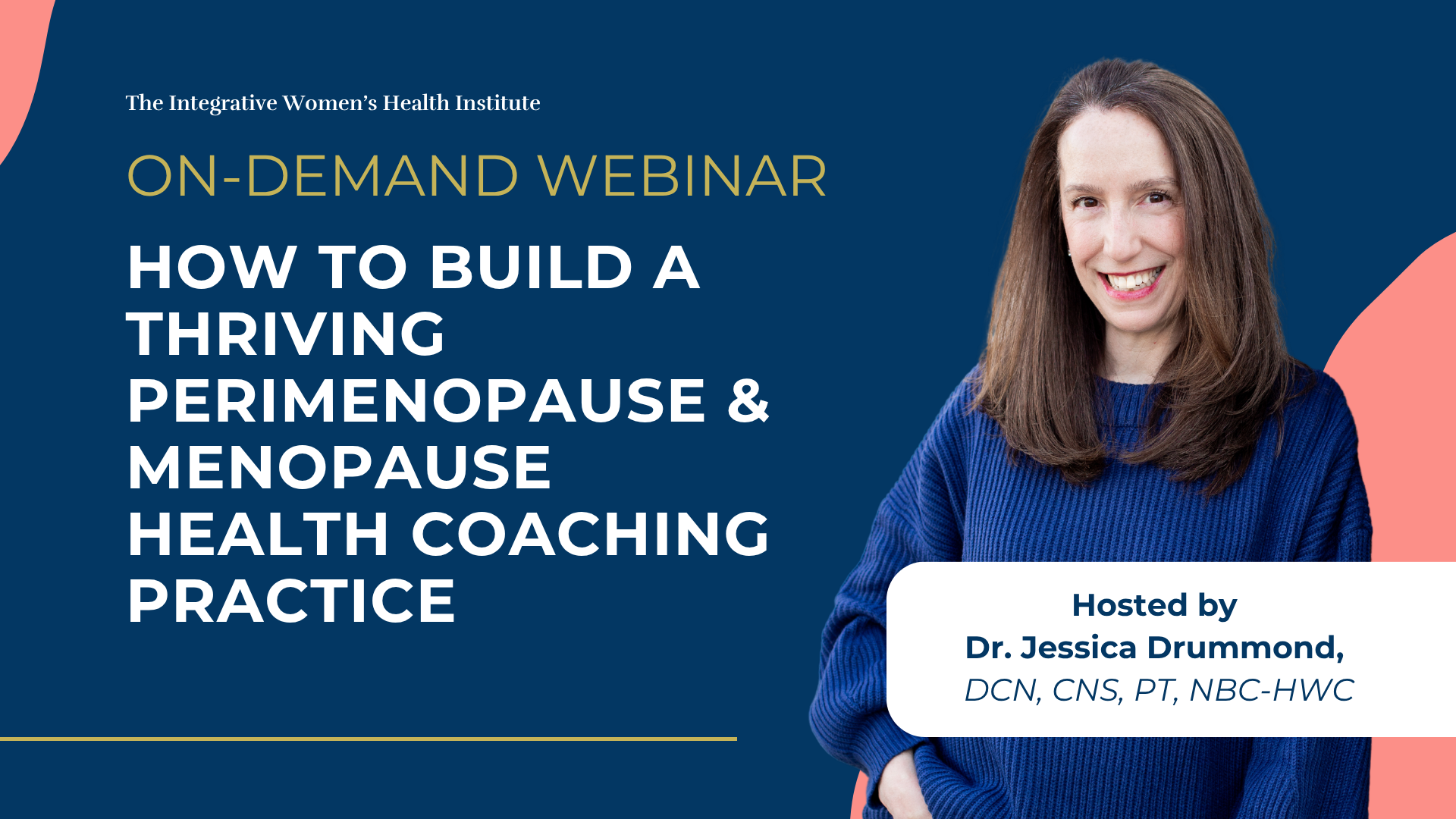
Join Dr. Jessica Drummond to learn proven strategies to confidently address perimenopause, menopause, and chronic conditions while growing a profitable and impactful practice.
Discover proven strategies to attract high-value clients, deliver transformational results, and position yourself as a sought-after expert in this rapidly growing field.

Dr. Jessica Drummond
Founder & CEO
The Integrative Women’s Health Institute
At the Integrative Women’s Health Institute, we’ve dedicated 17 years to crafting evidence-driven, cutting-edge programs that empower practitioners like you to address the complexities of women’s health.
Dr. Jessica Drummond’s unique approach focuses on functional nutrition, lifestyle medicine, movement therapies, nervous system dysregulation, trauma, and mindset – essential elements often overlooked in traditional health education.
In addition, your training will be fully evidence based, personalized, and nuanced (this is not a cookie cutter approach) in functional nutrition, exercise, recovery, cellular health, and all other lifestyle medicine tools.
You’ll learn to support your clients with cutting edge tools safely and effectively.