Follow Us for Free:


About the episode
“The microbiome world is moving from supplementation towards ecosystem restoration.” – Danielle Arnold
For a long time, the functional medicine approach to gut health focused on getting rid of what shouldn’t be there. It was all about finding the overgrowth, using antimicrobials, adding probiotics, and rebuilding. Those tools are still useful, but our understanding of the microbiome has become much more sophisticated. Now, we can think about restoring the gut’s ecosystem, including the keystone species that help create an environment where beneficial bacteria can thrive, and opportunistic bacteria have a much harder time taking over.
With the complex clients we see as women’s health practitioners, this shift becomes especially important. Someone with endometriosis, histamine intolerance, MCAS, long COVID, metabolic dysfunction, or significant digestive symptoms may not be able to jump straight into eating 45 grams of fiber a day. Sometimes we have to work in a very specific order, supporting digestion, reducing overgrowth, rebuilding beneficial species, and then gradually giving those microbes the fibers and polyphenols they need. The goal is not simply a better stool test. It’s a more resilient gut ecosystem that can better support the immune system, nervous system, hormone health, and the rest of the body.
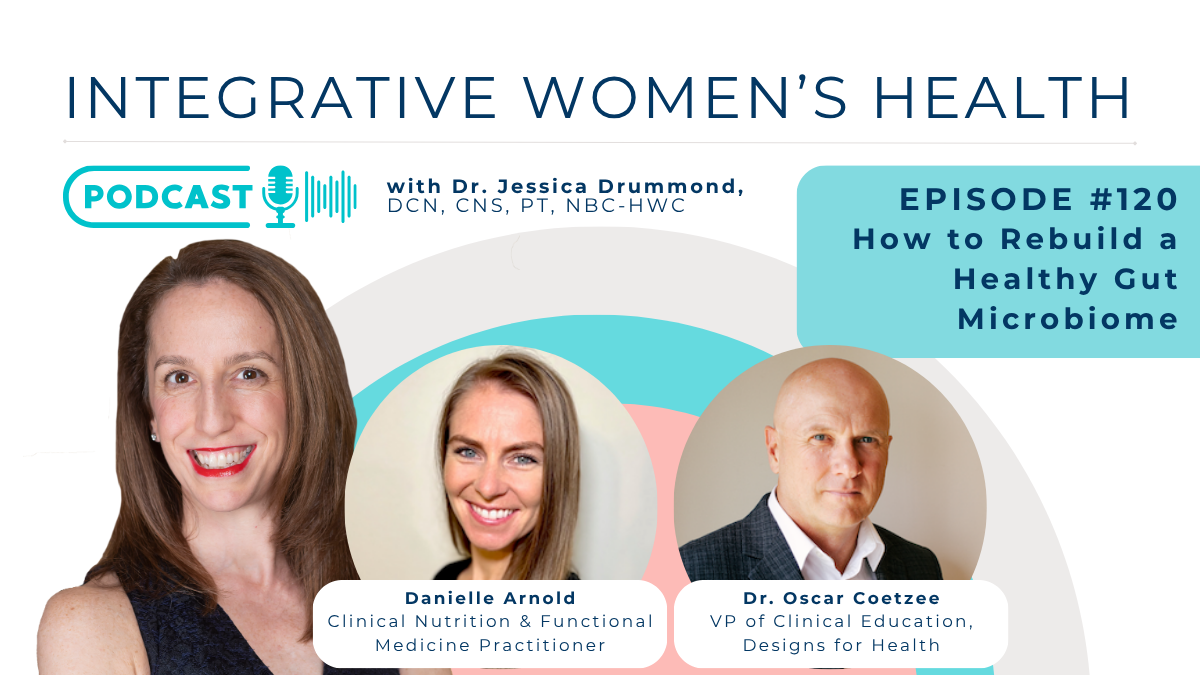
In today’s episode, I’m joined by Dr. Oscar Coetzee and Danielle Arnold, CNS, from Designs for Health for a wonderfully nerdy conversation about what we now know about rebuilding the gut microbiome. We talk about new research on keystone species like Akkermansia, Faecalibacterium, and Roseburia, how these microbes work together, when antimicrobials may still be useful, why the order of treatment matters for sensitive clients, histamine and hormone health, H. pylori, digestive function, fiber and polyphenols, stool testing, how better gut microbiome support can become part of our clinical thinking, and more.
Enjoy the episode, and let’s innovate and integrate together!
Join Dr. Jessica Drummond to learn proven strategies to confidently address perimenopause, menopause, and chronic conditions while growing a profitable and impactful practice.
Discover proven strategies to attract high-value clients, deliver transformational results, and position yourself as a sought-after expert in this rapidly growing field.
Highlights
- Why gut health strategies are shifting from getting rid of problematic microbes to rebuilding the gut ecosystem
- Newly available keystone strains that could change how practitioners approach microbiome restoration
- How keystone species like Akkermansia, Faecalibacterium prausnitzii, and Roseburia work together in the gut
- How to introduce new microbes and prebiotics for sensitive patients who may struggle with standard protocols
- The connection between gut-derived histamine, hormones, and conditions like PMDD
- How Oscar and Danielle use stool testing to guide individualized gut health protocols
- Danielle’s approach to addressing low-grade H. pylori when it appears alongside other gut issues
- What current research is revealing about new commensal strains and their potential clinical applications
- How combining hormone and gut testing can provide new insights into fertility challenges
- How modern diets, antibiotics, and food additives may contribute to the loss of important keystone species
Learn more about Designs for Health
- Designs for Health Website | DesignsForHealth.com
- Designs for Health on Instagram @designsforhealth
- Designs for Health on YouTube
About Dr. Oscar Coetzee
Dr. Oscar Coetzee has over 25 years of experience in psychology and nutrition and is currently serving as the VP of Clinical Education and Practitioner Support at Designs for Health. His academic credentials include faculty positions at Georgetown Medical School, Notre Dame University, and the University of Bridgeport. Born and raised in South Africa, Dr. Oscar’s educational background includes bachelor’s degrees in criminology and psychology, master’s degrees in Psychology and Human Nutrition, a PhD in Holistic Nutrition, and a Doctorate of Clinical Nutrition. Dr. Oscar is recognized as a pioneer in nutritional science, focusing on metabolic syndrome, intestinal permeability, type 2 diabetes, sports performance, and chronic inflammatory diseases. His work is motivated by a profound commitment to revolutionizing patient care through integrated health strategies.
About Danielle Arnold, CNS
Danielle Arnold is a Clinical Nutrition and Functional Medicine Practitioner dedicated to holistic wellness and personalized care. She is an Adjunct Professor at Purdue Global, where she teaches clinical nutrition and mentors practitioners pursuing CNS licensure through the CNS Alliance’s supervisorship program. With a strong background in functional medicine, Danielle has served as a Clinical Support Specialist at Designs for Health, training healthcare providers in test interpretation and patient care. At the Natural Healthcare Center, she created tailored nutrition plans for clients facing chronic conditions like cancer and autoimmune diseases. She also co-founded The Source Functional Nutrition, counseling individuals seeking integrative health solutions. Danielle’s global reach extends to her collaboration with CARE Oncology, where she focuses on nutrition and wellness strategies for cancer patients. Additionally, she teaches oncology nutrition cooking classes at the New Mexico Cancer Center, helping patients nourish their bodies during treatment and recovery.
Learn more about The Integrative Women’s Health Institute’s Programs
Ready to revolutionize your career and grow your practice?
- Integrative Women’s Health Institute on Instagram | @integrativewomenshealth
- Integrative Women’s Health Institute on YouTube
Click here for a full transcript of the episode.
Dr Jessica Drummond 00:00:03 Hi and welcome to the Integrative Women’s Health Podcast. I’m your host, Doctor Jessica Drummond, and I am so thrilled to have you here. As we dive into today’s episode, as always innovating and integrating in the world of women’s health. And just as a reminder, the content in this podcast episode is no substitute for medical advice, diagnosis, or treatment from your medical or licensed health care team. While myself and many of my guests are licensed healthcare professionals, we are not your licensed healthcare professionals, so you want to get advice on your unique circumstances. Diagnostic recommendations treatment recommendations from your home medical team. Enjoy the episode. Let’s innovate and integrate together.
Dr. Jessica Drummond 00:01:02 Hi and welcome back, everyone to the Integrative Women’s Health Podcast. I’m your host, Doctor Jessica Drummond. And today I have a very special treat for you. So a lot of times we’re like, oh, supplements. There’s a lot of different brands. Who cares? There’s a million different supplements, but some of them from specific companies who really dive into doing the work.
Dr. Jessica Drummond 00:01:24 And there are quite a few of those. But compared to the entire, you know, multibillion dollar supplement industry, almost trillion dollar supplement industry, most supplements are absolute junk. But that’s just the truth. But every once in a while, something comes along with really strong evidence base with the company being committed to doing research, even though, you know, that can be very expensive, and there’s limitations to the kind of financial recoup that certain nutraceutical companies can get compared to what pharmaceutical companies can get. So I want to introduce you today to Dr. Oscar Coetzee and Danielle Arnold of Designs for health. We’re specifically going to be talking about some of the research that they’re doing on beneficial keystone species in the gut microbiome, and how some of these are just really new to the market, even to be available, because the technology and prebiotics and probiotics has really evolved in the last decade. So, Oscar, I know very well he and I did our doctorate degree together in clinical nutrition. Gosh, we graduated almost ten years ago.
Dr. Jessica Drummond 00:02:42 So it’s been a while. Everyone’s deep in their work and and Oscar has, like me, a lot of experience clinically even before he did that degree. And in fact, let me Quickly read you their bios because they’re both so impressive. Dr. Oscar Coetzee has over 25 years of experience in psychology and nutrition, and is currently serving as the vice president of clinical education and practitioner support at designs for health. His academic credentials include faculty positions at Georgetown Medical School, Notre Dame University, and the University of Bridgeport. He was born and raised in South Africa. What you’ll hear in his accent and his educational background includes bachelor’s degrees in criminology and psychology, master’s degrees in psychology and human nutrition, PhD in Holistic Nutrition, and a Doctorate of Clinical Nutrition, which the program we did together. Doctor Oscar is recognized as a pioneer in nutritional science, focusing on metabolic syndrome. Intestinal permeability. Type two diabetes. Sports performance and chronic inflammatory diseases. His work is motivated by a profound commitment to revolutionizing patient care through integrated health strategies, and Danielle Arnold is a clinical, nutrition and functional medicine practitioner dedicated to holistic wellness and personalized care.
Dr. Jessica Drummond 00:04:15 She is an adjunct professor at Purdue Global, where she teaches clinical nutrition and mentors practitioners pursuing the CNS license through the CNS Alliance’s Supervisor Ship program. With a strong background in functional medicine. Danielle has served as a Clinical support specialist at designs for Health training, health care providers, and test interpretation and patient care at the Natural Health Care Center. She creates tailored nutrition plans for clients facing chronic conditions like cancer and autoimmune diseases. She also co-founded the source Functional Nutrition counseling individuals seeking integrative health solutions, and her global reach extends to her collaboration with Care Oncology. So we’re going to talk about a lot of different applications of utilizing strategies to remodel the gut microbiome across all kinds of health issues. And this is a wonderfully nerdy conversation, from women’s health to brain health and mental health to oncology to immune health, chronic pain, endometriosis, you’re going to get a lot out of this. So in this episode, I want you to really get out of pen and paper and grab at least 1 or 2 clinical pearls. Think about your most challenging clients and how you can utilize gut microbiome remodeling to help rebuild any number of their health vulnerabilities.
Dr. Jessica Drummond 00:05:57 That’s what you’re going to be taking notes on in this episode. And I’ll see you on the other side.
Dr Jessica Drummond 00:06:07 Hi, and.
Dr. Jessica Drummond 00:06:07 Welcome back, everyone, to the Integrative Women’s Health Podcast. I’m your host, Doctor Jessica Drummond, and I’m here with Dr. Oscar Coetzee and Danielle Arnold from designs for health. And we’re going to talk a lot about how to optimize and improve the composition of the gut microbiome for women’s health and in the context of midlife. So welcome to you both.
Multiple Speakers 00:06:32 Thanks for having us. Thank you for having us.
Dr. Jessica Drummond 00:06:34 So for those of us who have been practicing in nutrition and functional medicine and functional nutrition and even fitness and exercise medicine for a long time, there was a bit of a perspective that if there was an issue with gut health. One of the things we had to think about was like more antimicrobials, whether that was from a pharmaceutical perspective or even a nutraceutical or herb perspective. How has your thinking at designs for health really evolved on how to better optimize the resilience of the gut microbiome?
Dr. Oscar Coetzee 00:07:10 Okay, so I’ll start with that one, I think.
Dr. Oscar Coetzee 00:07:12 You know, as practitioners, even 7 to 10 years ago, my opinion on working with a gut to slightly different to what it is now, because there’s technology now that enables us to get microbes to the gut that we couldn’t do in the past. You know, if I’m talking about the specific anaerobic keystone strains. So that’s completely shifted the mindset. I don’t want people to think that I’m not believing that probiotics in the traditional sense of the word, the the more aerobic strains or the strains that we used to use and, you know, standard probiotics aren’t effective. I think they are. But you need to consistently take them right because they transient. So as soon as you stop taking them, they won’t have the benefit. But there’s huge amounts of literature, as you know, Jessica, on the mental health connection to to probiotics and, and even the vaginal microbiome to probiotics. However, you got to consistently expose your body to that particular strain. In addition to that, most of these strains are generally from non-human subjects, right.
Dr. Oscar Coetzee 00:08:13 They normally made from, you know, dairy sources or fermentation or something to that effect. Whereas these new strains are more coming from human donors. And when you have that capacity, you have intellect. I feel in the microbiome that far supersedes something that is coming from a non-human donor. And in addition to that, what you said earlier about this approach that we used to have is to kill off and then regrow. What we’re starting to see clinically in some of the research and stuff that we’re doing, is that if you install these strains and they populate or in graft, they tend to crowd out these opportunistic strains. So it’s a completely different dimension on how to work with opportunistic bacterial overgrowth or potentially even pathogenic bacterial overgrowth by more of a crowding out thing rather than a killing thing. And that makes more sense, because the environment that these these microbes create creates a very hospitable environment for the anaerobes. But it doesn’t really do well with the the aerobic strains where most of the pathogens and the opportunistic bacteria lie.
Dr. Jessica Drummond 00:09:25 I see so what are some of these keystone strains that we do have that we can now actually use, as I’m assuming, supplements like oral tools that we can use to help essentially rebuild the composition of the gut microbiome by this slow and steady crowding out. And then is it something that people would generally take for three months, six months, a year? Not for like the rest of their lives? What’s the what are the strains and what’s the time frame?
Danielle Arnold 00:09:54 Yeah. So the, the strains that we have that we’ve extracted, like Doctor Pezzullo said from a human donor is the mucin aphylla bacterium present CI or F prow and Rosebery and then two other different forms of Bifidobacterium that work with the cross feeding and everything like that. So because they come from the human donor, they grew up together. They have the sense of community, they work well off of each other. They kind of work as a team. So they do have the potential to engrafted, which means that you only need to take them from for like three months or something like that.
Danielle Arnold 00:10:30 And I think that’s where like the microbiome world is moving from, is like this supplementation towards that ecosystem restoration, which you were kind of alluding to, and that’s how we do it. It’s from from these teams of bacteria that have kind of grown up together. So after after about three months, we have seen in the research that they do in graft and you don’t need to take them forever.
Dr. Oscar Coetzee 00:10:53 What I would say to that is like anything else, right? If you have a seed and you have fertilizer and you go put it in a garden, you still have to water the garden, right? And you still have to go put more nitrogen in there somehow at some point. So the notion that these anaerobes, you can just take them and be on a fast through diet and take proton pump inhibitors and antibiotics and it’s not going to affect them. It’s not true. Right. It’s literally you can get them engrafted and they can be very hospitable to your environment. If you eat more fiber and more polyphenols and you kind of change your lifestyle.
Dr. Oscar Coetzee 00:11:25 So we’re not taking away the traditional approach to what we all do. You know, as people to clean up people’s diets and have them eat more fiber and more colors and more vibrancy. That’s still the case. But the difference here is that when you give them the fertilizer and the soil and the water, they will stay.
Dr. Jessica Drummond 00:11:42 Yeah. Yeah. And how is this in this kind of cluster of keystone species? You know, Ackerman, we know has a lot of data around metabolic health. I love that we now have a tool for fecal bacteria and presidency. I didn’t even know that until just now. Which is great, because that has actually been shown to help the immune system even better, fight Covid. So there is some Irish research that looked at a strong composition of gut microbiota that actually helps be more Covid resistant. So I’m a really strong supporter of that. And we do find very, very low levels of fecal bacteria in Prosinecki and people with long Covid. And then the third one you said rose birria, which, you know, again, there weren’t a lot of sources for that.
Dr. Jessica Drummond 00:12:30 And it’s very important for creating some of the short chain fatty acids and, you know, healing of the lining of the intestine. So if how did those species work with, like, spore based species like Bacillus subtilis or things like that, which we sometimes can also use to rebuild these communities of keystone species like those three and specifically.
Danielle Arnold 00:12:58 Yeah. Yeah. So spore based, they can work really well together. I like spore based when I’m going in blind to a like if I don’t know someone’s levels, I’ll use some spore based products just because they have quorum sensing and quorum sensing that the quorum sensing that they use is like, they kind of sense that this population needs a little bit more nourishing. This one’s kind of out of hand. So so it has this intelligence to it that can bring the populations back into a good place. So like I said, I like to use that one blind. But yeah, like you said, Roseboro fatality bacteria never existed in a probiotic before. This is the first probiotic that has had, both of those strains in there.
Dr. Jessica Drummond 00:13:43 That’s great. And so you were saying, Oscar, you know, the other thing you mentioned, Danielle, is like there’s a lot of co coordination among the waste products of one of these types of species feeding the others. And also they all eat food and I mean fiber and polyphenol. So talk a little bit about that.
Dr. Oscar Coetzee 00:14:04 Yeah. So these strains weren’t just grabbed out of the sky. You know, there was three, 4 or 5 years of research. And originally, you know, some of this research was originated trying to get something to replace fecal microbial transplantation. So FMT they want to get something to people that are more immunocompromised. And some people with CF that didn’t respond well to FMT. They wanted to create something like that. So originally I think it was 33 to 39 strains that they used in some of this research. And, you know, years and years of figuring out how they work together by using these very complex things called robo gut and bioreactors and artificial intelligence to figure out exactly how these communities work together.
Dr. Oscar Coetzee 00:14:44 They finally came up with these particular strains and put it into clinical trial. And, you know, Danny has a little bit more insight in that. But the clinical trial basically indicated that this microbial ecosystem therapeutic, which is a non yucky version of FMT, we outperformed for some of the patients with Cedars. But the problem is that when you have 33 to 39 strains it’s extremely expensive. Right. So what they did further down the line is like okay, wait a minute. You know, if we want to get into the nutraceutical space and into the chronic disease space, which ones of these 33 to 39 strains have the biggest power and punch? And that’s how they came out with these five strains. Right. So these five strains are very interactive. And like like Danny was saying, we the first company to have Frow and and Roseberry In a product, and I don’t think anybody else is going to have it. You know, for a while. But here’s the funny thing, right? If you take, for instance, Rose Berea.
Dr. Oscar Coetzee 00:15:40 So Rose Berea is a very unique form of bacteria. It has a little flagella. So a little tail, and then that tail touches the epithelial cell and triggers toll like receptor five that then drives hypoxia inducible factor. So Rose Berea is really the bacteria in the group. That’s the one that’s saying, hey, I’m going to take all the oxygen out of here. So all of you guys can be extremely happy right. So that’s just one. Apart from the fact that people like you said low Rosebery is involved with type two diabetes, ulcerative colitis, IBS, you name it, right? The EF Pro is another interesting one. So the F Pro is a butyrate producer. So is Rose Berea. But the F Pro is more the one that likes to work on the pH. So the F Pro comes in there and works with the differences of the pH so that, you know, there’s slight differences in the pH of Roseberry and and F. And this one seems to be kind of like the regulator of that category.
Dr. Oscar Coetzee 00:16:33 But you know what I found the most interesting when I was doing a deep dive into the literature, is that fecal bacteria, profanity is actually also the producer of shaky mic acid. And I never knew that. Right. So the shaky mic acid, as you know, is the stimulator of the pathway that makes aromatic amino acids like tryptophan, tyrosine and phenylalanine. There’s a tie in to EF brow and major depressive disorder.
Dr. Jessica Drummond 00:17:00 And then nervous system. Right. Because essentially you lack building of neurotransmitters because you lack amino acids of the brain.
Dr. Oscar Coetzee 00:17:08 And other strains. The Ackerman’s do we know about the Akamatsu? Right. That’s kind of the mother of all of them. And this one, you know, like you said, there’s all the metabolic criteria. But the most incredible thing about Akamatsu is the fact that it literally helps us to produce more of our own scowls. Right. Like, I mean, it’s literally rejuvenating. Rejuvenating some of our intestinal cells. Now, the other two that we haven’t mentioned completely yet would be Bifidobacterium longer.
Dr. Oscar Coetzee 00:17:34 Lots of research on mental health, as you know. And then Bifidobacterium adolescents and the adolescent strain is another very unique exo polysaccharide design. It literally grabs starches and ferments them. So the way I explain this to the layperson is like, you have a chef in the one that’s kind of fermenting the food for all of them to eat. You have the one that’s regulating the zip codes for the pH. You have the one that’s regulating the environment of crime with the hypoxia.
Multiple Speakers 00:18:02 Inducible.
Dr. Oscar Coetzee 00:18:02 Factor.
Dr. Jessica Drummond 00:18:03 Yeah.
Dr. Oscar Coetzee 00:18:03 So they all work together. And then what you said, you know, the one makes acetate. The other one uses the acetate the one producing lactate. The other one uses the lactate. So it’s just this unique intrinsic communication system that this community is like if you put them in a bowl, they’re going to play, you know, and they know how to play.
Dr. Jessica Drummond 00:18:24 Yeah, I love this. So now we’re thinking about reestablishing the foundational microbiome of the gut, the keystone species, and the environment in which they’re living.
Dr. Jessica Drummond 00:18:36 Like making it a little bit more hypoxic so you have less pathogenic and overgrowth of aerobic bacteria, and also changing the pH and shifting the food supply. And when we talk a little bit about the water and the fertilizer, you know, let’s circle back to if we’re helping someone re-establish these microbes. What other. Like obviously we want to just simply give them more vegetables. But some of these patients, especially with gut issues or MCAS, I see a ton of patients with MCAS these days. So they’re very, very sensitive to a lot of foods and a lot of environmental factors. And they may even be sensitive to these microbes. So we might have to start with really slow Doses. Are there any tools you have to kind of help with those more sensitive patients?
Danielle Arnold 00:19:31 I always find that the sensitive patients typically have you move too quickly with them, with that support, that you know, the fertilizer. And when you’re talking about that, you’re I’m assuming you’re talking about like prebiotics and prebiotics.
Dr. Jessica Drummond 00:19:46 Yeah.
Danielle Arnold 00:19:47 Like fibers and things like that.
Dr. Jessica Drummond 00:19:48 Because ideally we would give them big Mediterranean salads and whatnot. But a lot of times they can’t digest that much fiber or even which fibers are a little bit gentler or which prebiotics are a little bit more gentler. Things like that.
Danielle Arnold 00:20:04 Yeah. So I’ve noticed in my practice that if I like, I see hundreds of GI maps and GI spotlights as well too. So I’ve noticed a pattern in what I see that if they don’t have enough good bacteria like the faculty, the rose, Berea, the acontia, some of that bacteria that breaks down those fibers And they have overgrowth of bad bacteria. When you push the prebiotics too early. You’re feeding the wrong populations and they’re causing the bloating and they’re causing the distension. And that person that came to see you because maybe their wife was like, hey, you need to go see a nutritionist because you’re not listening to me. I can’t help you or or whatever. And they come to see us and we tried to low hanging fruit. We try like eat more colors, eat the Mediterranean diet.
Danielle Arnold 00:20:49 And they just feel terrible. And they’re like, I can’t do this anymore. I’m going back to my fast food diet and I’ll deal with my wife. And, you know, however that goes when I see those tests, I usually see that pattern where it’s like low bacteria that breaks down that fiber, and high bacteria that likes to cause, you know, purification and bloating and all those things of those fibers. So I typically will do a removal phase first and then come back and restore and then feed, at the same time. So I think it’s all about order of operations when it comes to those types of people.
Dr. Jessica Drummond 00:21:23 And so you mean like. Removal of the fast food, for example. And just.
Danielle Arnold 00:21:27 Oh, thanks for the chance to clarify removal of the bad bacteria. That’s terrifying.
Dr. Jessica Drummond 00:21:32 So you actually would almost like start with these beneficial bacteria to to ingest the environment, to clean it up first, then prebiotics.
Danielle Arnold 00:21:42 I’ll usually like layer on the the like a dysbiosis protocol plus digestive enzymes and then transition into layering and the good bacteria that can further crowd those guys out.
Dr. Jessica Drummond 00:21:55 Okay. So in some cases you might start with a low dose of antimicrobials or something to just create a better environment to start with. Exactly.
Multiple Speakers 00:22:04 Yeah.
Dr. Oscar Coetzee 00:22:04 I’ve I’ve had interesting discussions with several practitioners, you know, on this topic recently and, stumbled upon a really brilliant medical doctor that actually with these cases, what she does is she does a butyrate Depository as the initial phase. And then she gets into, you know all the pre and probiotics. So sometimes you know Danny and I have hypothesized and and that’s kind of obviously the industry that we’re in about maybe sometimes using a butyrate agent as an initial instigator before you get to the higher fiber, so that you can create the environment where these guys could be better adhering to. But in saying all that and, you know, Jessica, as a clinician, it’s all case by case, right? Sometimes you have a bloating and people can immediately take an anaerobic and sometimes they just can’t. But I will definitely say to you that as a general rule, what I’ve seen people do okay with this, even at the highest stages of what people might perceive or status, small intestinal bell overgrowth.
Dr. Oscar Coetzee 00:23:09 Because remember, generally those kinds of conditions are, disproportionate or changed pH throughout the the the digestive tract.
Multiple Speakers 00:23:21 Yeah.
Dr. Oscar Coetzee 00:23:21 If you remember that these guys are actually more of the pH regulators, then, you know, theoretically, you can argue that maybe it’s important to take it in the initial phases, but it’s all trial and error. Look, I mean, when I’m in clinical practice and I have a person, I don’t stick everybody on complete commensal immediately in day one, sometimes they put a person on complete commensal. You know what it’s like. You get an email or a text saying, hey, I’m all bloated. You go say, hey, take it every second day, or take it with food. Let’s reduce the obnoxious healing process, right? so that’s kind of where the individual clinician is still going to have to trial and error this. But my theory on this is you need to get the pH back to what it’s supposed to be, and then you’ll have a lot less displacement of bacteria to different areas where they create this bloating and reaction.
Danielle Arnold 00:24:11 Yeah, and that’s a good point because the how Oscar said that the flagella of the rose barium act on the toll like receptor five. Butyrate also drives beta oxidation, which steals oxygen. So when you take the butyrate, it’s like a bridge until you can get that pH and the oxygen level to a good environment for the the good guys to come back and then drive down, you know, make it uncomfortable for those opportunistic bacteria.
Dr. Jessica Drummond 00:24:38 Yeah. And I think this makes a lot of sense in the context of, you know, a lot of our clients that have histamine issues, whether they’re if they’re MCAS driven, we want to stabilize the MCAS first, but we’re seeing more of this kind of as a hot topic on social media with PMDD, other like PMS symptoms, but certainly related to perimenopause, to hot flashes to, you know, long Covid presentations that they’re one of the, like kind of quick fixes or or accessible fixes to kind of get the reactivity down is that people are taking consistently H1 and H2 blockers.
Dr. Jessica Drummond 00:25:19 Now, as a, you know, a kind of an assessment tool, I think that’s a valuable thing. It like helps us to see is histamine driving some of these symptoms. But it’s not a long term strategy because of exactly what you just talked about. Then we lower stomach acid. Then we make it harder to digest proteins to harder to break down proteins. And so I think when we’re when those of us in practice are seeing people that are like, well, you know, my PMDD got so much better because I took Pepcid for the last year, but maybe now it’s not working so well or they’re having secondary gut issues. I think that’s where we want to go back to this kind of a strategy. But in a in a systematic kind of like you said, it’s always trial and error on an individual case.
Danielle Arnold 00:26:11 Yeah. And I’ve noticed that people with the histamine type connection to their hormones. you can ask them questions like, did you have these? My like some of them have migraines and things like that.
Danielle Arnold 00:26:23 Did you have these migraines when you were pregnant? and they’re like, you know what? Actually, I didn’t have migraines when I was pregnant. And the reason that they didn’t have migraines when they were pregnant is because the placenta makes, I think, 500 times more Dow enzyme when you are pregnant. So then they’re then it’s just clearing out all these histamines as, as they’re pregnant. So yeah. So when you when you can kind of make that connection okay. Histamine has always been an issue. Now where is the histamine issue coming from. And a lot of times it’s gut derived. A lot of times it’s histamine producing bacteria. And they’ve never checked out their gut. And when you find that they have, histamine producing bacteria above and beyond what their enzymatic capacity is to clear out those histamines with their Dao enzyme, sometimes we’ve had people within 48 hours. I think we just published a case study on, people with IBS like symptoms, which are connected also to histamines. taking a Dow enzyme. And within 48 hours, for the first time, they’ve been able to not have alternating diarrhea, constipation issues.
Dr. Jessica Drummond 00:27:28 Yeah, that makes sense. And they may genetically also have an Snip. You know. So. Yeah. Well that’s great, I think. So those are some other tools we can use to support this transition for sure. If we think about, you know, testing to try to decide maybe a little bit of these orders of operation, what are some of the things you guys are looking at on some of the stool tests to guide, maybe the prioritization of therapy and that sort of thing?
Dr. Oscar Coetzee 00:27:59 Well, a couple of things. Obviously, you know, we, we, we want to look at, what we would classify as digestive dysbiosis as a start. right? I think a lot of people overlook that by looking at elastase one and the adequate, you know, are the digestive enzymes protease, amylase and lipase effectively working clinically. We want to generally see it over 500. Even though these stool tests, you know, rate 200 is normal. Generally speaking, if a person has elastase over 500, you have very little dysbiosis from digestive function.
Dr. Oscar Coetzee 00:28:34 I think a lot of overlooked issues from the bile sequestering standpoint, you know, that could play a huge role. So those are two major ones that I would normally look at. And I think a lot of times people, you know, have these internal self-diagnosis that sometimes it’s just basically just not really digesting and breaking things down. While you have little low stomach acid hypochlorite states could could play a role after that. And this is just me, right? Clinically, I would go into looking at the opportunistic bacterial overgrowth because those are normally high histamine producers. Most of them, they’re high LPs producers, lipopolysaccharide producers. so I kind of look at the level of overgrowth there. And then when you see the level of overgrowth there, generally you can go straight to the anaerobes and they’re going to be low. You’re very seldom going to find all your anaerobic strains of bacteria and massive amounts of opportunistic overgrowth. There’s always a connection. I’m not saying it’s never going to be like that, but as a general rule, you know, those are generally the patterns that that we see.
Dr. Oscar Coetzee 00:29:37 we see a reasonable amount of low level H. Pylori nowadays as well, which is also gram negative. And, you know, I’m starting to to really dig into, even if it’s not over the threshold to take that into consideration, because it can, you know, sequester iron and create some states of anemia that can affect the thyroid. So, you know, all those little nuances are what we’re looking at. But I wanted to just share with your viewers we have a reasonably good relationship with partnership with Diagnostic Solutions Lab. So we were able to look at some of the data that they pulled. So when we created this probiotic, we wanted to know what is the general status on the GI maps that you guys looking at from a standpoint of what’s low. And this is what came back. And 17,000 tests were evaluated. Right. And 65% people were low in Mantia, 35% people were low in F per hour, and about 10 to 15% people were low in rose area. That’s significant. You know, if you’re taking consideration those microbes and I always call them accessory organ systems rather than microbes, because I feel like we’re more like a a hormone or a liver or a kidney, you know, than really a bunch of strains of bacteria.
Dr. Oscar Coetzee 00:30:51 But, you know, that’s just my way of of looking at it. And do you have any other inputs?
Danielle Arnold 00:30:56 No, I love that. I always start with I mean, I always find that it’s connected to digestion because I always try to explain to practitioners why digestion is so important to the microbiome. I always give this analogy of like feeding stray cats, like you’re feeding stray cats and you’re like, I don’t know why these cats won’t go away. They just like, won’t go away. And that’s like, you know, if you’re not digesting your food, you’re feeding this bad bacteria all these food scraps and they’re just sticking around. So if you start with healthy digestion, you kind of starve them. It’s kind of like an anti candida diet. You’re trying to starve Candida of all of the sugars and things that it likes. Same thing with those opportunists. You’re trying to starve it of those food scraps that you’re not breaking down.
Dr. Jessica Drummond 00:31:42 Yeah. And so starving it plus really modifying the environment to be more hypoxic to have better pH for the beneficial bacteria.
Dr. Jessica Drummond 00:31:53 I think that’s where we really start to see. And having the fibers and the polyphenols that feed the beneficial bacteria, we start to really get an environment Shift. Oscar, what are some of your strategies for addressing even the low grade H pylori?
Dr. Oscar Coetzee 00:32:08 That’s more a Danny question. She’s my H pylori expert.
Multiple Speakers 00:32:11 Okay, I agree. Yeah.
Dr. Oscar Coetzee 00:32:12 Obviously, you know, for low level we we have a great product at designs for health that we use. But I’ll have her give you the the the dig deep insights there.
Dr. Jessica Drummond 00:32:22 Yeah. Because that’s one of those things that I think clinically I sometimes just don’t give enough attention to. So I’m.
Multiple Speakers 00:32:28 Sorry it.
Dr. Oscar Coetzee 00:32:29 Makes a difference because remember it’s also a gram negative. Right. So it’s also an LPs producer.
Dr. Jessica Drummond 00:32:33 Yeah. Which I think is more and more important now that we have so many people living with chronic inflammation.
Multiple Speakers 00:32:38 Exactly.
Danielle Arnold 00:32:39 Yeah, yeah. Oscar calls me d pylori sometimes, like when I first was working with them because I was so obsessed with it.
Danielle Arnold 00:32:46 but, it’s like like Oscar said, it’s a gram negative. Plus, it’s also a histamine producer as well too. So it can also drive some of those histamine symptoms as well too. And I find it’s always upstream of the downstream. so whenever I see it, what I typically see with pylori is that it causes mucosal atrophy. Who’s in the who’s that mucosal community? Akerman Sia for Carly bacterium and Rosaria one of those three are typically low. You usually have Bacillus Enterococcus Staphylococcus Streptococcus high which tells you of low stomach acid. elastase is usually impacted. Secretory IGA is usually like on high alert or it’s like been on high alert and it’s really low. And then you usually have, you know, some high inulin as well to within that pattern of H. Pylori. And so typically what I do is I treat H. Pylori first if I see H. Pylori and Candida together, I’m treating them together because they usually share the same biofilm. So I’m usually using something like flor mice’s works pretty good with both of those or SB lardy and then gastro and HP has mastic gum in it.
Danielle Arnold 00:33:57 Sometimes I’ll add extra mastic on it. If I feel like it’s pretty high above the reference range, I’ll also use some GI shield. The ammunition in our IGA shield actually has some binding capacity to towards it. zinc carnitine inactivates urease production, which is the enzyme that kind of drives the stomach acid low on H. Pylori. And urease is usually what they’re testing with a breath test for, H. Pylori. So zinc carnitine drives that kind of inactivates the urease production. So I’ll do that. Some sulforaphane through like broccoli sprouts. make sure you change your toothbrush because you can infect yourself. some of those things are and, and like, you know, cleaning your water bottle every night to make sure you’re not re infecting yourself. It can be very, shared between the household. So it’s really hard to get rid of because you do a GM app on one person that’s really struggling. Someone else might have also high H pylori because they share the same fork or whatever, and they pass it back and forth to each other.
Danielle Arnold 00:35:02 But they might not be as impacted as as their partner, and they don’t know that they have it and they just keep re infecting each other. So just making sure that sometimes treating the whole household, if we can at the same time.
Dr. Jessica Drummond 00:35:17 Yeah, that makes a lot of sense.
Multiple Speakers 00:35:18 Excellent.
Danielle Arnold 00:35:19 And then high nickel foods too. I also try to remove some of those as well.
Dr. Jessica Drummond 00:35:23 Okay, great. So anything else that you guys are now up to and sort of in terms of like research we should be watching for or new tools you have, especially in the women’s health space.
Dr. Oscar Coetzee 00:35:36 Well, I’ll tell you about the research. and they Danni can talk to you about the test that we just launched for, for women’s health. so currently on this particular complete commensal strain, we have several, prospective N of ones and a larger group going on in K series trials. So we have one patient on CDF that’s been on it now. So we’re waiting just for the post test results. We put all of them on 12 weeks.
Dr. Oscar Coetzee 00:36:03 We have a Crohn’s patient. I’ve had a very permeable patient that had no success on any other forms of treatment. And then we have an entire case series on our other anaerobic strain, which is called anaerobic, the PKK, which is a major butyrate producer. And it’s really highly associated with food sensitivities and allergies. So I’ll be able to share some of those data points with you probably within the next two months. And then we’ll get those published as well. So there’s and then in addition to that we’re in the final stages. We just got IRB approval to do a randomized control trial on the complete commensal. So once we’re done with these in of one and of four you know prospective case series studies, we’re going to go into, you know, some of the other ones now in the in the interim, you know, patient Symptomology. Some people say they haven’t felt anything. Some people have had massive improvement in gut and bowel function and skin conditions. But what we really interested in is to see the data and how it’s really moving these microbes.
Dr. Oscar Coetzee 00:37:07 Right. Because Symptomology is important to understand, but we need more empirical.
Dr. Jessica Drummond 00:37:15 Like mechanistic.
Dr. Oscar Coetzee 00:37:16 Information to validate the engagement and the growth. You know, of this because once that’s there, then, you know, we can further investigate maybe why that person Symptomology isn’t clearing up. Maybe it’s something correlated or indirectly related. But what I know and what I see clinically, if you have these strains present in your body at high levels and they’re interacting with each other, your chances of being in a chronic disease state is significantly less.
Multiple Speakers 00:37:45 Yeah. That’s great.
Danielle Arnold 00:37:46 And as far as the female things that we have going on that we’re launching or that we launched at designs for health is we have a hormone spotlight. So it’s kind of it’s kind of a little bit like the Dutch. It’s a urine metabolite. test over 24 hours, five point test. check your car and check how you’re metabolizing estrogen, your progesterone levels with oral supplementation as well to those are, markers that we have on our tests that other tests don’t have.
Danielle Arnold 00:38:13 And then, you know, how are your androgens doing? I’ve actually used this, and I’m planning on publishing a case study on it. I just want to make sure everything goes well. But, I had a a patient that was having trouble getting pregnant, and we used a combination of the annatto. Have you heard of annatto? Where you can, pee every, every day on a stick and put it into your phone.
Dr. Jessica Drummond 00:38:36 Like a, like a mirror or something.
Multiple Speakers 00:38:38 Like that? Yeah, yeah, it’s exactly like mirror.
Danielle Arnold 00:38:39 Yep. Exactly. So Anita and Mirror are kind of competitors, but. Yeah. so we used an Anita kind of tracked where her estrogens were doing throughout her entire cycle. We used a hormone spotlight, and then we also used a GI spotlight so we could see that she had estrogen dominance. Where was that estrogen dominance coming from? We did a GI spotlight. We saw that there was a lot of histamine producing bacteria. histamines and estrogens go hand in hand. They help.
Danielle Arnold 00:39:09 They both drive each other in this vicious cycle. So we were able to do like fix the gut, drive down those histamine producing bacteria. Also, address some of the issues that we saw on the hormone spotlight where they had just high estrogen dominance that was disrupting the luteal phase. And then we just kept checking in with Anita and we said, all right, it’s time to go. Let’s let’s try to make a baby. And it actually worked out after we had gotten those estrogen levels in a good and a good place.
Dr. Jessica Drummond 00:39:40 And did you use these commensal strains to help with the histamine rebalancing at all?
Danielle Arnold 00:39:45 We we did not. We just used standard dysbiosis protocols. His suggestion. his studies as well too.
Dr. Jessica Drummond 00:39:55 Yeah. So things like quercetin and, you know, that sort of thing.
Multiple Speakers 00:39:58 Exactly.
Dr. Jessica Drummond 00:40:00 Yeah. Excellent. Well, I love that. And I think there’s more and more conversation. I’m planning to give a talk at the Indo Summit next year in 2027, kind of looking at this neuro immune impact on endometriosis, which sometimes is estrogen dominant.
Dr. Jessica Drummond 00:40:16 Not always, but certainly there’s a histamine component or an MCAS component in many of these cases and also a lot of LPs. Well, dysbiosis, intestinal permeability and systemic LPs, because so often the endometriosis is actually growing on the bowel. So I do think there’s a lot of overlap with everything we’ve talked about in this sort of neuro immune inflammatory gut. You know, you really can’t separate out these systems when we’re talking about so many of the women’s health conditions, because it all lives kind of in the abdominal pelvic region.
Dr. Oscar Coetzee 00:40:52 Yeah. And these, these, these microbes, especially if Brown rose, Berea and Akron Mantia clearly the literature is extremely strong on them and the suppression of any kind of cytokine, interleukin six, you know, tumor glucose factor after interleukin one, they, they they all seem to have a negating effect on that level of inflammation. So it’s a systemic healing agent, in my opinion for that.
Multiple Speakers 00:41:17 Yeah.
Dr. Jessica Drummond 00:41:18 That’s I think it’s so important. And I think more and more as we deal with these chronic illness states, but they’re so common in our perimenopausal women.
Dr. Jessica Drummond 00:41:27 The data shows about 87% are living with something that we can’t just put hormones on top of that without reestablishing a better, you know, gut microbiome integration and gut microbiome integration with the immune system and the nervous system as you were talking about, like making sure we get amino acids to the brain. And I think it’s a really important place to always circle back to was do we have these foundational keystone species? Are they talking to each other? Are they being fed. And that really impacts so many other systems. So thank you so much.
Multiple Speakers 00:42:03 Yeah.
Dr. Oscar Coetzee 00:42:03 The only thing I would add to that is my people might want to know why are we low in these species if they so important to us. Right. I mean they they’re intrinsically part of our evolution. So why don’t we have them. And it’s modern lifestyle proton pump inhibitors, antibiotics, macro isolated diet. Like if a person is on a very unique selected diet. And I’m not saying this is a bad or a good thing, you know, for certain conditions, but even high quality ketogenic diets could create lack of these guys because of lack of diversity.
Dr. Oscar Coetzee 00:42:35 A carnivore diet is 100% associated to this alcohol intake, artificial sweetener intake. You know all the things that we know in the interesting one that stood out to me when we looked in the research of what’s depleting us is this very unique thing called resistant starch type. For now, we know that resistant starch is literally the fear of this. And this is what the the adolescent is bites into to ferment. However, there’s something called resistant starch type four, which is a chemically formulated form of fiber that we find in all these processed foods. And this chemically formed fiber that you can get in your A, you know, your Cheerios is high fiber is literally destroying these microbes. It’s not it’s.
Multiple Speakers 00:43:16 Not. Oh my goodness.
Dr. Oscar Coetzee 00:43:17 So it’s pretty powerful and straightforward. So any human on a standard American diet, eating a high fiber food from a processed package, it’s knocking these guys out cold.
Multiple Speakers 00:43:28 Wow.
Dr. Jessica Drummond 00:43:28 And really, they are the foundation of all of this. You know, I think that’s the thing to keep remembering.
Dr. Jessica Drummond 00:43:34 Like we need these keystone species, all of them, to be functioning at their highest level for every other system of function, for mental health to be optimized, for reproductive health, to be optimized for immune health. And, you know, that’s really interesting that we we can even target a very specific additive. But of course it’s all of these other things as well. So, you know, that doesn’t really surprise me at all.
Dr. Oscar Coetzee 00:44:01 Yeah. I mean, just taking consideration as we know what 16g is the average intake of fiber in this country. And when you really think about what you need to feed these guys, you probably need to be at about 40 to 60 and you’re not going to get the average individual there. That’s why you are asking about research. One thing I forgot to tell you is we’re actually looking into specifically which polyphenols forms of fiber are actually feeding these individual strengths. So we don’t want to just say, hey, you know, resistance starch is good for all three of them.
Dr. Oscar Coetzee 00:44:35 It might be but might not be. You know, we don’t know. So we’re literally trying to isolate and look at a little bit. So we’re working with a couple of laboratories and some really smart people on trying to see what is triggering these individuals, because where we would like to be in a year is, hey, if you’re taking if Brown made sure that you’re eating these reds and these greens and, you know, just being hypothetical now or or Ackerman likes purples and whites, you don’t we don’t know. You know, but certainly at this point the mix clearly seems to work. But why not try and define exactly on a medical level or a clinical intervention level if you really low, if you really want to give you the right fertilizer. I don’t want to give you generalized things. If I know that I can give you something that’s really exciting.
Dr. Jessica Drummond 00:45:20 Yeah. And I think that is actually important science, because we have so many people with things like really debilitating Crohn’s. And you see where that becomes so, so important.
Dr. Jessica Drummond 00:45:30 You’re really right at the source, you know. And in the meantime, we’ll take a wide variety of prebiotic fibers and colorful fruits and vegetables and resistant starches. And. From whole foods, or from supplements that, you know, have been designed in this way. Because I think most Americans, most people are going to need prebiotic supplements or fiber supplements at some level to I mean, we have our clients trying to get to 45. That’s sort of the the goal, but 40 to 60g of fiber is a ton, especially because so many people, especially in the world of endometriosis and even the metabolic syndrome related to perimenopause, are on GLP ones. And so we do find a real benefit in a lot of these kinds of categories of patients. But to eat 60g of fiber a day with a very slow gut, it’s going.
Multiple Speakers 00:46:29 To be.
Dr. Oscar Coetzee 00:46:29 Going to work, right.
Multiple Speakers 00:46:30 Or.
Dr. Oscar Coetzee 00:46:31 It’s not going to be an immediate resolve to that and totally understandable. You know, it’s very easy on paper to say, hey, you know, ancestrally people used to eat.
Dr. Oscar Coetzee 00:46:39 Ironically, 100 to 150g of fiber today. But it’s because they were starving, so they needed to stay in a state of satiety by chewing on bark. Right. But that’s not what we do anymore. But I do believe that literally to enforce engagement and growth of these guys. I think your number at 45 is a very, very sensible number. But like you say, who’s going to eat that in, in our patient base, maybe us as practitioners because we’re a little different. You know, we try and get there. But even you know for us it’s not the easiest thing in the world to get to 45g. So I’m 100% in agreement. Nutraceutical is your only solution, at this point, to throw something in a smoothie or throw something on a salad or something.
Multiple Speakers 00:47:20 Mix it in yogurt or whatever. Yeah.
Dr. Oscar Coetzee 00:47:22 Realistic way that you can get your fiber numbers up.
Multiple Speakers 00:47:25 Yeah, absolutely.
Dr. Jessica Drummond 00:47:27 Well, thank you both for being here today. This is really informative. I think this is a very important conversation to continue to have because as we’ve all known, you know, Oscar and I graduated in the DQN program almost ten years ago now and have been doing this for almost 30 years.
Dr. Jessica Drummond 00:47:45 Health really does start in the gut.
Dr. Oscar Coetzee 00:47:48 So certainly.
Multiple Speakers 00:47:49 Does.
Dr. Jessica Drummond 00:47:49 So thank you so much. And where can people find out more about the work that you’re doing, the research you’re doing and anything else they’re curious.
Multiple Speakers 00:47:57 About.
Dr. Oscar Coetzee 00:47:57 Can go straight to the website. you know, most of the people listening are practitioners. So, you know, if they don’t have a practitioner account doesn’t cost you anything, sign up for it. And you get vast amounts of the education material just by signing up as a, as a, as an account holder. So, you know, we have hundreds of hours of, of, of material of education on this as well as, you know, go in there and go look at our previous webinars. We’re consistently doing webinars on the involvement of this product. We will be doing several more on the results of our research, you know, coming up shortly for a company. We’ve literally probably from any product that I’ve ever been with in this company, this is the one that I feel really is the single bullet.
Dr. Oscar Coetzee 00:48:41 If there is a single bullet, you know, to get somebody on base for just about every chronic condition. but yeah, I mean, just go to designs for health comm. you can reach me at my first initial. Last name at designs for health comm and and Danny D Arnold at designs for health comm. So, you know, we’re we’re happy to receive emails and questions.
Multiple Speakers 00:49:01 Excellent.
Dr. Jessica Drummond 00:49:02 Thank you so much. All right. Thanks so much for being here to both of you. And I’ll see all of you next week.
Dr Jessica Drummond 00:49:12 What a wonderfully nerdy conversation.
Dr. Jessica Drummond 00:49:14 I really hope you enjoyed that and that you jotted down in your little notebook, or you just kept in your brain. If you were listening to this episode on a walk, 1 or 2 really powerful clinical pearls about how we can use some, really targeted, skillful strategies to optimize the functioning of the gut microbiome. Modern life. As Oscar mentioned, so many aspects of modern life, from fiber being added to processed foods to alcohol to stress, to overtraining, to under exercising, to eating a processed food diet, to pollutants and chemicals, our modern environment is designed to destroy the gut microbiome, which really is the cornerstone of when we think about root cause health.
Dr. Jessica Drummond 00:50:10 These keystone species are the cornerstone of whole person health. So write down 1 or 2 clinical pearls and think about even for your next client who’s dealing with chronic pain or headaches or mental health issues that you may not immediately think of the gut microbiome. Go back to your training. Go back to, you know, maybe certain modules in our courses, and think about these new tools that are really being built in an evidence forward way for you to use in your practice. All right. Thanks so much for being here. Guys I’ll see you next time.
Dr Jessica Drummond 00:50:55 Thank you so much for joining me today for this episode of the Integrative Women’s Health Podcast. Please share this episode with a colleague and if you loved it, hit that subscribe or follow button on your favorite podcast streaming service so that we can do even more to make this podcast better for you and your clients. Let’s innovate and integrate in the world of women’s health.

Dr. Jessica Drummond
Founder & CEO
The Integrative Women’s Health Institute
At the Integrative Women’s Health Institute, we’ve dedicated 20 years to crafting evidence-driven, cutting-edge programs that empower practitioners like you to address the complexities of women’s health.
Dr. Jessica Drummond’s unique approach focuses on functional nutrition, lifestyle medicine, movement therapies, nervous system dysregulation, trauma, and mindset – essential elements often overlooked in traditional health education.
In addition, your training will be fully evidence-based, personalized, and nuanced (this is not a cookie-cutter approach) in functional nutrition, exercise, recovery, cellular health, and all other lifestyle medicine tools.
You’ll learn to support your clients with cutting-edge tools safely and effectively.