Follow Us for Free:


About the episode
“Most of the time it’s going to be about rebuilding the components of the microbiome rather than eliminating and killing things.” – Kiran Krishnan
When you’re working with women who have complex chronic illnesses, gut health is often an important part of the picture. But for years, so much of the approach to the microbiome has focused on eliminating pathogens, restricting foods, and trying to get rid of whatever might be causing symptoms. Unfortunately, for patients who are already dealing with MCAS, histamine intolerance, or multiple sensitivities, that can leave them with fewer and fewer things they can tolerate.
As women’s health practitioners, looking at the whole person and how the microbiome interacts with the immune system, nervous system, and hormonal health, particularly during perimenopause, can help us to tailor the way we help our clients and patients. The goal isn’t simply to suppress symptoms or find the right probiotic. It’s to get to the underlying root causes and develop individualized strategies that help our patients participate more fully in their lives.
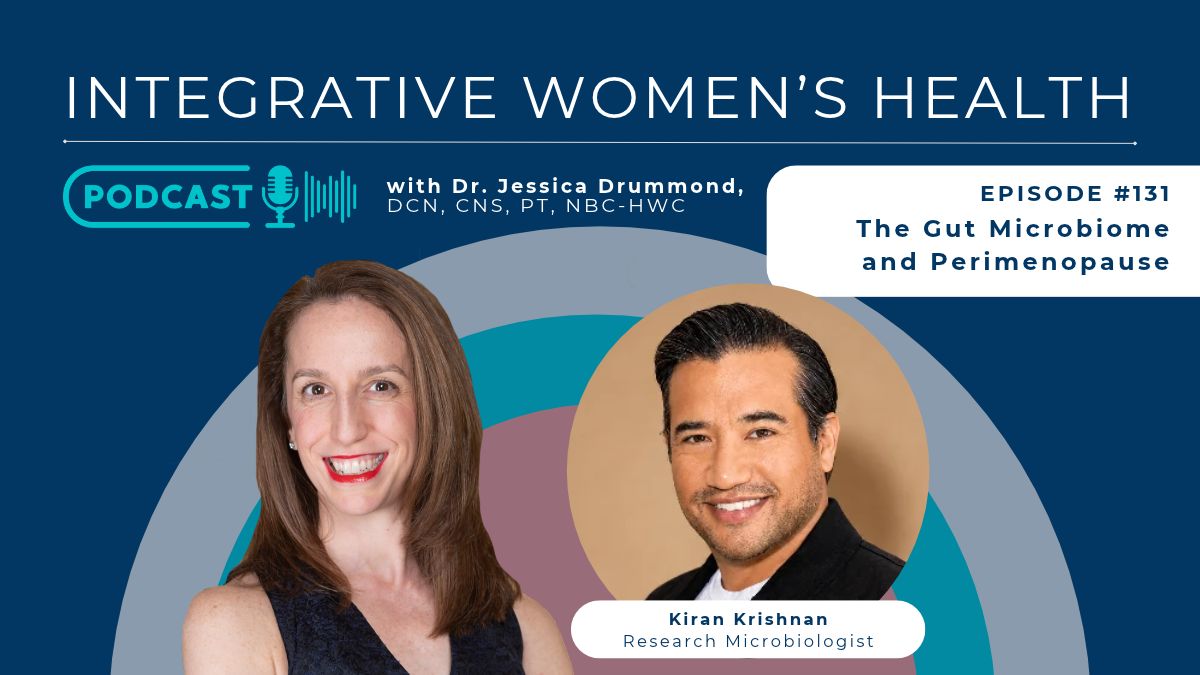
In today’s episode, I’m joined by research microbiologist and educator Kiran Krishnan to explore the relationship between the gut microbiome, inflammation, and women’s health. We discuss why probiotic strains and dosing matter, how to approach microbiome support in highly sensitive patients, the importance of rebuilding beneficial microbial functions, how declining estrogen may affect gut barrier function and inflammatory responses, and more.
Enjoy the episode, and let’s innovate and integrate together!
Join Dr. Jessica Drummond to learn proven strategies to confidently address perimenopause, menopause, and chronic conditions while growing a profitable and impactful practice.
Discover proven strategies to attract high-value clients, deliver transformational results, and position yourself as a sought-after expert in this rapidly growing field.
Highlights
- The challenges of designing affordable, clinically relevant research to evaluate supplement effectiveness
- Why probiotic strain specificity, mechanisms of action, and survivability matter when choosing supplements
- How the Human Genome Project and the hygiene hypothesis influence our understanding of our microbiome
- What makes spore-based probiotics different and why they may be useful in certain clinical situations
- Strategies for introducing probiotics gradually in sensitive patients, including those with MCAS
- The role of commensal bacteria and short-chain fatty acids in supporting immune regulation and tolerance
- How microbiome health may influence susceptibility to infections and the body’s ability to recover
- How estrogen changes during perimenopause may affect the gut microbiome and digestive health
- The potential connection between perimenopause-related microbiome changes and increased vulnerability to infections
- Why clinicians need to take a nuanced, individualized approach when interpreting and applying microbiome research
Learn more about Kiran Krishnan & The Biome Learning Center
- Kiran Krishnan’s Website | BiomeLearningCenter.com
- Kiran Krishnan on Website | @biomelc
- Join The Biome Learning Center on Circle for free
About Kiran Krishnan
Kiran Krishnan is a research microbiologist and a health and wellness expert who aims to make complex information understandable to all. He has founded and scaled a number of successful health and supplement companies over the last 20 years, including co-founding and leading Microbiome Labs, the preeminent microbiome therapeutics-focused brand among healthcare professionals. He is currently a co-founder and partner in 4 other companies that aim to revolutionize wellness care. He has designed and conducted over 60 human clinical trials and has publications in peer-reviewed scientific journals, has published chapters in scientific textbooks/references books, has global patents and is a sought-after speaker on human health and the microbiome.
Learn more about The Integrative Women’s Health Institute’s Programs
Ready to revolutionize your career and grow your practice?
- Integrative Women’s Health Institute on Instagram | @integrativewomenshealth
- Integrative Women’s Health Institute on YouTube
Click here for a full transcript of the episode.
Jessica Drummond 00:00:03 Hi and welcome to the Integrative Women’s Health Podcast. I’m your host, Doctor Jessica Drummond, and I am so thrilled to have you here. As we dive into today’s episode, as always innovating and integrating in the world of women’s health. And just as a reminder, the content in this podcast episode is no substitute for medical advice, diagnosis, or treatment from your medical or licensed health care team. While myself and many of my guests are licensed healthcare professionals, we are not your licensed healthcare professionals, so you want to get advice on your unique circumstances. Diagnostic recommendations treatment recommendations from your home medical team. Enjoy the episode. Let’s innovate and integrate together. Hi, and welcome back to the Integrative Women’s Health Podcast. I’m your host, Doctor Jessica Drummond, and I’m thrilled today to introduce you to a new friend and colleague of mine, Kieran Krishnan. He is the founder of Microbiome Labs. He is also the current founder and educator at the Biome Learning Center. And let me just read you his bio. He’s a research biologist and we’re going to get into the history of his career in the episode.
Jessica Drummond 00:01:31 But he’s a research microbiologist and health and wellness expert who aims to make complex information understandable to all. And I think that’s where he’s really found a role in translating the complexity of basic microbiology science research into clinically applicable strategies, tools, education and understanding. He’s founded and scaled a number of successful health and wellness supplement companies over the last 20 years, including co-founding Microbiome Labs, which is and continues to be the preeminent microbiome therapeutics company. Though he no longer owns it. He’s currently a co-founder and partner in four other companies that aim to revolutionize wellness care. He’s designed and conducted over 60 human clinical trials and has publications and peer reviewed scientific journals, has published chapters and scientific textbooks. He has patients all over the world. He’s a sought after speaker on the human health implications of the gut microbiome and the microbiome, and all of the other mucosal tissues, which we do talk about a bit more in this episode as well. You can find him at Biome Biome Learning Center or follow them on Instagram at Biome LLC.
Jessica Drummond 00:02:52 So we’re going to have some really nerdy conversations in this episode. I want you to get out a piece of paper and a pen. I want you to take notes. I want you to not just AI. Transcribed this. I want you to find some important clinical pearls that you can use for your own health, and that you can use for your patients and clients. And I also want you to mark your calendar, because here at the Integrative Women’s Health Institute, we are hosting Karen for a deep dive workshop webinar where we can all get clinically nerdy together on gut microbiome health during his workshop, which is going to be December 7th of this year. And we’ll also send a replay. I’m sure we’ll have recordings if you’re listening to this after December 7th, Instagram, DM me and we can make sure we can help you get access to it, because I really feel like our education here at the Integrative Women’s Health Institute and the Biome Learning Center. Perspectives are very equivalent. We really have the same commitment to root cause healing.
Jessica Drummond 00:04:06 We have a very holistic minded perspective and the the piece of that puzzle that resides in the microbiome in any mucosal tissue, but certainly in the gut and the colon is a really important piece of understanding for helping our clients who are so sick, often for so long, to start slowly expanding resilience. And that is my ultimate clinical perspective. It’s not about finding the tool that immediately suppresses symptoms, although doing that is very important and it’s a part of the story. But to slowly increase resilience so that people can have tolerance for bigger and more challenging life goals, whether that’s a fitness performance, life goal, whether that’s pregnancy, whether that’s travel, whether that’s eating new foods, whether that’s postpartum recovery. I mean, there are so many different definitions of someone’s like most expansive life for someone that might be starting a farm, starting a business, you know, making their house beautiful and being an artist, like it’s so unique to the client. But that resilience quite literally starts in the gut, because resilience is about mitigation of inflammation, tolerance to more things in the environment, recovery from inflammation.
Jessica Drummond 00:05:42 And as we’re going to talk about scientifically, the gut microbiome is a really important piece of that story. It’s not the whole story, which is why it’s not the only thing. We need you here. I would just defer that. But it’s it’s a really important part of the story for building that resilience to having a bigger, sometimes more stressful, even if it’s in a good way, life. But the story about ten, 15 years ago was like a void, a void, a void, a void. And I think we want to change our mindset on that story to slow, supported, deeply supported expansion at the same time as we’re mitigating risk for individuals who need risk mitigation, mitigation, which is, quite frankly, all of us at various times in our lives. So it’s it’s that’s the real kind of driving perspective here at the Integrative Women’s Health Institute. And I love to introduce you to educators and clinicians and practitioners who take that perspective and then teach us some of the nitty gritty of their part of that perspective.
Jessica Drummond 00:06:54 So let’s get into it. Get out your notebook. Get out your pen, close some distractions. You’re going to learn something really valuable today. Or at least take this conversation on a walk with you out in nature. And I hope there’s some really valuable things that land for you and all the questions you come up with. Write down and we’ll chat about it on our upcoming workshop. I’ll see you there. Hi and welcome back, everyone to the Integrative Women’s Health Podcast. I’m your host, Doctor Jessica Drummond, and I’m here with my new friend Karen Krishnan. And I wanted to introduce you to him because I really think he is one of the best educators on the gut microbiome and the interactions between the gut microbiome and other physiologic systems that we see so often in our complex chronic illness clients. And it’s one of those areas that is a really big needle mover in terms of getting to quote unquote, root cause healing. So welcome, Karen.
Kiran Krishnan 00:08:05 Thank you so much for having me. This is a pleasure to be here.
Jessica Drummond 00:08:08 Thanks. So let’s start with your background. I know as far as I’m aware, you’re not a clinician. You came through this as a scientist. So tell me what got you so interested in the gut microbiome?
Kiran Krishnan 00:08:23 Yeah, I’ve always seen myself in in a position where I would bridge the clinical gap. Right. Or that’s been the way I’ve always seen things. So I’m megalomaniacal in my thinking, to be honest. Right. So I’m always thinking about very big picture things and how to solve very big problems. And I was on in the university academic based research track. I love the research part of it, especially basic science research. It’s so foundational to everything we know. But there is a problem that there is a translational gap between what’s happening in academia and then what actually impacts people, right? Because academics are very good at research, and they and they do a career of 30, 40, 50 years of just non-stop research. And every study leads to more questions and then more grants and all that.
Kiran Krishnan 00:09:14 And we need to do that. So that needs to happen. The problem is they’re also not focused on taking that information and translating it to application. Right.
Jessica Drummond 00:09:26 Yeah.
Kiran Krishnan 00:09:26 Sometimes you get companies that come along and do that. You can license technologies and all that from universities. You see this happening more in the tech space and not as much in the biological space. But given that I was in that space and I’m always thinking about what are the big problems that we can solve based on things we know and information that we can derive. I saw myself fitting in this space of bridging that translational gap to taking active, innovative science into application. And so it made complete sense to me to sit in that middle and play that role in an emerging field, which was the field of the microbiome. Right. And what was clear from the very beginning of microbiome science was that, number one, that it should be very important to clinicians, right? Because it really tells the story of the whole patient, right.
Kiran Krishnan 00:10:17 All of the years and decades and centuries that we’ve been looking at people and disease processes and all that, not understanding that there was this complex ecosystem that is driving so much of it. Right. We’re not looking at the whole person, and we’re missing gigantic components of what’s actually driving dysfunction in these individuals or function in those individuals. Right. And so I think for clinicians, it becomes really important to understand microbiome science. Academics are on a amazing freight train of research, but very little of it is actually being translated across. I can see myself playing that role, and I did about 15 years ago, and so I decided to to jump in that middle and play that role. And I figured that’s one of the ways in which I will contribute to health and wellness and medicine and create some human impact is because I understand the science at the academic level, and I can appreciate all the clinical impact. My mom’s a medical doctor. My dad was an engineer, so I got both aspects of it, and it just became a perfect fit for me to do that, to play that role.
Kiran Krishnan 00:11:21 And surprisingly, there were very few people that were playing that role that can bridge the two to to any degree. So it fit right in and it was perfect. And of course, that’s one of the reasons I founded Microbiome Labs as well.
Jessica Drummond 00:11:34 So was Microbiome Labs your first company?
Kiran Krishnan 00:11:37 No, actually it was my third company. So my very first company was a clinical research organization, so I. I designed and ran clinical trials for supplement companies. So again my thinking of if I run into a problem, oh this problem needs a solution. So I was a user of supplements just when I was doing research and other work and all that. But when something interesting came out, I’d go to the local GNC and I talked to the people there, and I’d ask them questions about the product and about research on the product and all that. And they often had very little research. And it, of course, became quite apparent that there’s not a lot of research in many of the supplement products, certainly not on the retail shelf.
Kiran Krishnan 00:12:17 And I finally got Ahold of some people within the supplement companies that had some say in it. And the number one complaint was that it’s too expensive to do trials. Right. The most trials are designed, RCTs are designed on the pharma model. And there’s two glaring issues there. Number one, you can’t study a disease endpoint in a clinical trial on a supplement. Right. So if I had a supplement, for example, that that lowered blood pressure and it really did it well. Right. And that’s an important thing. I actually can’t technically study it for blood pressure because according to the FDA, we studied blood pressure or hypertension, which is a disease, and you use a supplement to study it, then you are working with an unauthorized drug. Right. So you have to get an you have to get an indie from the FDA in order to study it in hypertension. So then okay, then some companies who do want to do research, they will study it in hypertension, but then they won’t say anything about it because then you can’t go out and say anything about it because then you’re violating FDA to shade laws and so on.
Kiran Krishnan 00:13:23 So then that makes it complicated. And then in order to follow the RCT model for pharma, you need huge numbers of people. Right. Blood pressure is a perfect example of that. Because if you want to do a real good blood pressure study on a product or a compound. You need literally thousands of people because there’s so much variation in blood pressure, right? How much coffee do they drink that morning? How stressed were they come into the office? Do they have white coat syndrome like all of those things. And so you need more and more people to statistically make it more accurate. The data. But I looked at them and said, okay, why study blood pressure at all? Because that’s an endpoint we can’t talk about. And technically you’re not supposed to study. Why don’t we study the mechanisms that lead to blood pressure. So looking at angiotensin function right. Vascular dilation all of those things. And those are structure function alterations which is exactly how supplements are categorized. They are foods and nutrients that alter the normal structure and function of the body.
Kiran Krishnan 00:14:24 And so I started designing smarter trials with a much smaller number of people. Because some of these other things that you’re studying, these mechanistic things don’t have much of a placebo effect. And so we can do it with 30 people. We can do it 25 people. So my whole goal there was to be able to provide supplement companies with good, smart, affordable research that they can talk about in the marketplace. And that’s actually how I got into the world of supplements and nutrition and things like that in the first place.
Jessica Drummond 00:14:56 And then you built Microbiome Labs around the idea that specific probiotics, I think back when you started Microbiome Labs, the conversation about even the gut microbiome and probiotics was very general. It was, oh, we just need more diversity. Probiotics is like, just take probiotics. Nobody was really thinking about which actual bacteria. And I think this is one of the things that’s still a challenge because we have so many sort of wellness people talking about things on Instagram or TikTok. That’s just like a quick soundbite and it’s oh, my bloating felt better when I took probiotics, but that’s a one person kind of perspective.
Jessica Drummond 00:15:45 We don’t know which probiotic. We don’t know which actual bacterial substance. We don’t know if that’s substance in that supplement actually makes it to the gut, or if it’s burned up in the stomach, if you will, and burned up or just degraded. So when you thought about building a supplement line that actually of pre and probiotics and other gut microbiome support, how did you start thinking about that, knowing that there were some very specific mechanisms that had been tested in some of these valuable studies, even if they weren’t as large as the farmer studies, farmer studies, they were showing impact to changes in physiologic mechanism.
Kiran Krishnan 00:16:29 Yeah. And you bring up lots of really important things as to why I even got into the probiotic or supplement space. I started studying the microbiome early, fairly early on around 2009 2010, as some of the emerging researchers coming out, those were when some of the first papers started coming out. But they were very early things and very kind of big scale ideas. There was nothing mechanistic, nothing specific that we could really grab onto.
Kiran Krishnan 00:16:56 But clearly it was an emerging science that was going to be very important because it it answered a question that came up actually, when I was still at University of Iowa. One of the labs at University of Iowa was part of the Human Genome Project. I had a chance to rotate through that lab. That was biochemistry lab. And what was so interesting about the Human Genome Project was that the assumption was that we were going to end up having around 250,000 or more genes as humans, right? Because we’re super complex creatures at that point. The Drosophila, the fruit flies genome was fully sequenced and realized in earthworms and things like that. And all of these little low order creatures had 15, 20,000 genes. So the idea is that humans are at least ten times more sophisticated than them. Right. Because we look at what all the things we do. And then once the human genome was sequence, well, we come to find out was so much of it is just kind of nonsense code. Right. And may or may not do anything, but they don’t code for protein.
Kiran Krishnan 00:17:58 And ultimately we have about 20 to 22,000 functional genes. Right. And that left a massive gap in the understanding of human biology because an earthworm has almost 30,000 genes. Right, right. Which has 22,000 genes. Right. Like how in the world are we so sophisticated if we are not any more sophisticated than a earthworm is in our own genetics? And that’s that was really the impetus for the Human Microbiome Project, because the idea is that maybe we house microbes that provide us genetic capability. And that was, of course, my area. It became my area of interest as well. Now, at the same time I was being interviewed, I was working in food safety as well, and I was as a microbiologist. And what I was being interviewed for was this US News and World Report. Some one of the writers somehow got Ahold of me, I think recommended sharing through friends or something, and they were doing an article on the hygiene hypothesis, and they wanted a microbiologist perspective on how many bad bacteria that were and so on.
Kiran Krishnan 00:19:04 And I didn’t know that number off the top of my head. So I dug into the research a little bit. And when I come to find out in digging into the research is probably at best, around 1% of all bacteria that have been discovered are directly pathogenic to humans, right? Which means 99% or more are either benign or beneficial. And we’ve got bacteria everywhere, and we put a lot of focus on the 1%, with very little focus on the 99%. And as a result of that, between that the missing genomes, the Human Microbiome Project kicking off to me, that was like, oh my God. This is an area of pioneering science because what we’re going to discover is a massive treasure trove of genes and proteins and chemistry that’s happening in our body, that’s facilitating our functionality as humans that we don’t understand anything about just yet. Right. So that’s where my mind was as I’m looking into probiotics, because the concept of probiotics, to me were microbes that had very specific genetic capability to alter pathways and or micro environments in our gut.
Kiran Krishnan 00:20:14 But we had to understand what those capabilities were, what those genes were. They could turn on. And how does that translate in sequence to physiological change in the human right. Because what you were describing at the time, and unfortunately still large parts of the market have this view, is that it’s just a numbers game. We just got to load the system with good bacteria, and it’s just a balance between good and bad. And and so a probiotic with 80 billion CFU is definitely better than one with 5 billion because it has way more good bacteria right. This probiotic with 20 strains is way better than this with five strains because it has more good bacteria. But that’s completely the opposite of what’s actually happening in the system. In fact, most of those bacteria can be inflammatory in the system.
Jessica Drummond 00:21:07 Even the beneficial.
Kiran Krishnan 00:21:08 Even.
Jessica Drummond 00:21:09 Good bugs.
Kiran Krishnan 00:21:10 Exactly. What’s thought of as good bugs. Now, they’re not pathogenic in any way. But the thing is, the body can easily see them as a foreign invasion, right? Bacterial components are generally supposed to alert the immune system, especially ones that can bind to things like toll, like receptor four that’s going to upregulate inflammatory mechanisms in the gut.
Kiran Krishnan 00:21:32 And every practitioner I talk to has experienced this. I’m sure you have as well, where you’ve got that patient, that MCAS patient, that Sibo patient that you can’t give the same probiotics to, that you give to any other people without that issue, because it’s going to make them worse. Yet it’s going to make them.
Jessica Drummond 00:21:49 Feel all the.
Kiran Krishnan 00:21:49 Time. Right. Yeah. And so you think, wait a minute. These are all good bacteria. Why are they feeling worse about it? Because it’s increasing inflammation in them and in most other people. In the other people, they just don’t feel it as much because they don’t have these amazing sensitivities like histamine intolerance, MCAS and so on where they’re super, super sensitive to any change going on. Right. So when I was looking at probiotics, my my view was threefold. Number one was we have to be incredibly deliberate about the species and subspecies that we choose because we have to review the genetics of the organism to understand what genes it has, what it can turn on, and as a result, what it’s going to do in the gut.
Kiran Krishnan 00:22:32 Right. Is it going to influence the other bacteria, your immune system, your metabolic system, your tight junctions? What is it doing? Number two, you have to have some rationale that it’s somewhat natural for this organism to be in your system, right. If it’s not it could be immunologically inflammatory. Right. Because if it’s a type of strain that your body has never seen in the doses that your body has never seen, it’s going to look at it and go, I don’t know what this is and.
Jessica Drummond 00:23:01 What is it?
Kiran Krishnan 00:23:02 Yeah. It’s going to kick it off. Right. So there has to be some historical exposure to this kind of strain of that kind of level. This is one of the problems with it. You take a load of lacto and buffalo strains that are that that could be beneficial in one way or the other, but then you combine them all together in a non-specific way, and just increase the load. That load itself can look very unusual to the body. Right. So we wanted to make sure that we were working with something that was tolerant.
Kiran Krishnan 00:23:32 And then the last part was if survivability was important, meaning if it was important for the microbe to be alive in the gut in order to conduct its function, then it has to have a mechanism to survive through the gastric system. Right. And the first thing I did in the probiotic space was I took 40 of the top selling probiotics, and I ran them through gastric models in the lab. And what I found was that 100% of them got completely decimated in the gastric model. Right? So none of them are surviving through the digestive tract, or particularly the stomach and the upper part of the GI. So what you’re getting when you’re taking most of them is, are huge numbers of bacterial debris. And that debris can be inflammatory and create problems. Now there are plenty of bacteria if you study them that do work when they’re dead. Right. And in fact work better when they’re dead because of the post biotic component. But people weren’t looking at that. They’re just throwing things together and trying to get to a number of CFS and number of strains, because the idea was, let’s flood the system with good stuff.
Kiran Krishnan 00:24:34 Right. So we brought a 4 billion CFU in a sea where the average probiotic was 30 or 35 billion CF use, and we had four strains in an in a sorry, five strains in an environment where most companies are going for 15, 20 different strains. At that point, there was one product with a trillion CFU that had gone that high. They’d gone from 800 billion to 1 trillion. And these were Bacillus endospores, and nobody had heard of them. But yet they’re the most ubiquitous and natural probiotics there are. They just didn’t fit the existing marketing mold.
Jessica Drummond 00:25:10 That’s really interesting. So when you did some of your testing, because even with some of the Microbiome Labs products that are low amounts of bifida or like a one strain of Bacillus subtilis, very often. With my MCAS patients, we might use like a tiny amount even less, or maybe none at all, just starting with prebiotics because of that sensitivity. In the research, did you do any testing in that population or were you? And of course, in our population here in this community, we have people with endometriosis, long Covid, a lot, almost chronic pain syndromes, Me, CFS, there’s almost all of the people are sensitive.
Jessica Drummond 00:26:04 So was were those populations included in the research or over the last 15 years, have you just learned clinically because your perspective in the microbiome training is essentially the same as mine, that we clean up the composition of the gut microbiome with small, slow additive changes, rather than the restrictive model that was popular about ten, 15 years ago. But I think even because there’s so much sensitivity now in the population, they come to me restricted. And then we’re like, where do we begin with those very sensitive people as their research on it? Or is this more from clinical awareness of the last decade or so?
Kiran Krishnan 00:26:47 Yeah, it’s very much around the empirical evidence and working on cases specifically. Right. So I had a massive advantage in that my co-founder, Tom Bain, is a functional medicine clinician and Microbiome Labs. And so when we first developed the mega spore and the spore based probiotics. So this was quite a bit of a departure from other probiotics out there. The first thousand people to take the product were his patients, and we worked it very carefully in terms of looking at categories of patients, how they responded, working, making adjustments to doses and seeing what whether its there were perimenopausal women, what was the average response if there was someone with MCAS, if they were a 70 year old male.
Kiran Krishnan 00:27:35 We had all of these categorizations and we started to understand when you use a probiotic that actually makes changes in the gut microbiome. What are some of those changes and how do different patients respond to those changes? Right. This is actually where we came up with that titration dosing that we started, for example with MCAS patients or histamine tolerant patients. We always recommended people start with a quarter of a capsule as little as that, mixing it in food and food that they tolerate, and doing that and bumping it up by an additional quarter every two weeks and every time you.
Jessica Drummond 00:28:14 Maybe and maybe even combining it with something like IG 2000 or something like that. So you either have kind of a gentle binder and also quiet that basically quiet an autoimmune response.
Kiran Krishnan 00:28:30 Yeah, it’s more often than not we saw it as like a Westheimer response. It’s a die off response because the spores are very good about going in there and starting to target dysfunctional organisms, and they take up space, and then organisms fight for position, and then they may release toxins as a result of that fight.
Kiran Krishnan 00:28:49 They’re trying to beat each other up, if you will. And so that melee of of activity in a very sensitive patient can be realized as intolerance and so on. Right. But we want it to work people past the idea of intolerance, because what we didn’t want them to do, because we know intellectually, scientifically that these are good for them and they’re making good changes, right? But so many other things that they encounter because they don’t tolerate it, then they avoid it. Yeah, right. Because the big because the goal was always around avoidance. And so we wanted to find methodologies to work them through what they perceived as intolerance, so we can get them to the other side where this is where the benefits are starting to be realized. So we had hundreds and hundreds of those kind of cases. And then we also worked very closely with clinicians in the Chicagoland area that Tom was very close with. And then I had clinicians because I was doing clinical research in my first company, the CRO company.
Kiran Krishnan 00:29:55 So I had partnered with doctors who had patients. That’s where I would recruit patients for the clinical trials. So we had access to people and we had access to patients. And we were very methodical about what how people responded and then what were the adjustments we could make in order to make it better tolerated and get them to the other side of it? And with MCAS and histamine intolerance and all that, we also started bringing this cell danger response element into it and understanding that there’s a there’s a psychological component to it as well. So just factoring in all of those variables and trying to get people to the other side.
Jessica Drummond 00:30:34 Yeah. Okay. So I think that’s really valuable to know that even in your research, you could you could recognize that there are these subpopulations and that the more and that’s how we teach in our perimenopause menopause certificate program that like most of the women in that transitional stage, the data shows about between 77 and 87%, depending on which studies you’re looking at, have some one or more of these sensitivities.
Jessica Drummond 00:31:04 So we have to start with this sort of gentler approach while unraveling the nervous system reactivity of are that hurt. Avoid avoid. And so what I like about your microbiome clinical sciences program that how you teach about that is very similar. So as you were putting together that program specifically going deep with the gut microbiome, what were some of the topics that you felt like clinicians really need to understand in terms of those interface reactions between the gut microbiome and the immune system, or the gut microbiome and the nervous system, or any other physiologic integration of the gut microbiome with other physiologic systems, because we can’t really think about the gut microbiome just off on its side, like it’s always communicating with other physiologic systems.
Kiran Krishnan 00:32:00 That’s a really important question I think. So I can start at the what I would call the 15,000 foot level and then dig in a little bit deeper on the important thing. Important themes that I really wanted clinicians to understand, right. So at the highest level, the really important element that I wanted clinicians to understand was grasping the idea of the terrain concept.
Kiran Krishnan 00:32:23 Right. So this comes back to the old battle between Louis Pasteur and Anton Kemp. Back in the 1800s. Right. So it was a germ theory versus a terrain theory. Now, both of them were right to some degree, and both of them also made mistakes. So not that Antoine Camp was all correct and Louis Pasteur was all wrong and correct, but they had rival rivalries around the theories around what made humans sick. And once you discovered bacteria, what was their role? Louis Pasteur was very much focused on the agent, which is the infectious agent. And if the infectious agent was present, you were going to be ill and then you were going to be sick. So then the goal was about targeting the infectious agent, Wright.
Jessica Drummond 00:33:06 Mostly. His research is mostly specifically bacteria. Right?
Kiran Krishnan 00:33:10 Right. Quite, quite a bit bacteria. That’s why he’s considered the father of. Microbiology. Right. And he went on to to make amazing discoveries and all that. And I don’t want to throw shade, if you will, on Louis Pasteur.
Kiran Krishnan 00:33:21 But. But that was his focus now. Antoine Bergkamp was a rival who had this idea that it’s not just the agent, that the terrain that the agent is in matters right, and how the agent acts. It depends on the terrain that that it’s in. And that’s a really important concept because and we all know this, right? So we all know this innately. For example, I grew up in South India. And if you came to visit me in South India when I was growing up and you ate the street food, you’d be in the hospital, right, for with typhoid or something very exotic. Right. And yet I’d be completely fine. We’re both exposed to the exact same agent, but have very different responses based on our terrain. Right. And so that’s a very that everyone can relate to that kind of example. Same thing with you think. Look at allergies. If you look at an allergen as an agent that can drive dysfunction or inflammation. Take a peanut protein. Right. So many of us, most of us can consume gobs of peanuts and peanut protein.
Kiran Krishnan 00:34:24 Be fine. There is an individual that will get a speck of peanut protein and they could die from it. Right. And that’s all based on how their terrain responds to it. The biggest level of understanding that’s important is that the terrain matters ultimately. And then the terrain is based on missing functions, not the presence of dysfunctional organisms. Right. Okay. So one of the things I’ve always tried to explain to clinicians is when you look at a patient and that their gut is driving, is playing a role either in driving conditions or at least making conditions worse that they’re dealing with, right? More often than not, it’s not the presence of a dysfunctional organism or pathogen that’s creating the problem. It’s the absence of important foundational functions. And that that pathogen may be there, but it’s often there because the commensal aren’t strong enough to compete with it. Right? But even in the world of functional medicine and holistic health, when the microbiome science started hitting clinical practice, we dove into this pathogen centric view of a symbiotic gut.
Kiran Krishnan 00:35:39 And that was often that, to me, is also being driven by the types of tests that clinicians use, right? So if you use like a GI map, for example, it’s a very pathogen centric test. It’s just telling you all the bad things that are high in the individual. Right. And I don’t know how they come up with the arbitrary high and low, but it’s just like, oh, this is red. And you look at your patient, you go, Holy crap, they’re full of pathogens. Which means that we gotta kill all this stuff. And it’s those bad things that are causing the issue that my patient is feeling. But that’s not actually true. In fact, it’s questionable whether those things are elevated to begin with. Number two, what is the rest of the microbiome look like? Right. Because the presence of a pathogen is immaterial. It’s what is the rest of the context of the microbiome that dictates whether they’re pathogens even doing anything. And then more often than not, it’s the absence of key functions from the commensal that is driving the problem.
Kiran Krishnan 00:36:34 It’s the poor short chain fatty acid production. Right? Poor your lithium production, a poor expression of tight junction proteins. Poor production of tryptophan. Like all of these mechanisms that influence numerous systems are not being activated because our commensal are not at a place where their prevalence or functionality is being realized. Right. So it shifts the mindset from the kill and reseed and kill and reseed, because the problem is the pathogens and the bad bugs too. Okay, let’s nurture and let’s build rebuild. Right? And it’s the lack of building that is not allowing them to get better. It’s not the absence of killing things. So that is the 300 zero foot view. And then when you get a little bit deeper, what you start to see is what is it specifically mechanistically about the microbiome that’s causing this immune dysfunction that you’re seeing on the patient. Right. Like how does a microbiome actually create that problem. And then as a result of knowing that then how do you fix the microbiome. Right. As a like a couple examples to give.
Kiran Krishnan 00:37:46 One is if you have patients with lots of hyper sensitivities or food sensitivities, autoimmune issues and all that, clearly they have a loss of oral tolerance and a loss of aural tolerance. Meaning. Meaning that their fox p3 t rag mechanisms are underperforming, right? It’s not some pathogen making toxins and making their immune system go haywire. It’s their immune system is haywire because it’s missing signals from the microbiome that upregulates IL ten and Treg. When you have adequate IL ten and T, your immune system doesn’t go haywire because you’ve got a regulatory component of your immune system that is dampening and shutting down all the dysfunctional responses, including the response to the food antigens and your own tissue and so on. Right. And so it’s not about suppressing the immune system or trying to find the bugs that are creating havoc and driving that. It’s about what do we need to do to upregulate the Treg? The IL ten, the Fox P3 positive mechanisms. And those are the roles of the commensal. Right. And increasing diversity within certain categories of microbes.
Kiran Krishnan 00:38:55 reducing gram negatives by competing with them. With gram positive Arabs, that becomes the terrain shift that alters how the immune system function works, right? And so that kind of connection mentality occurs in the metabolism and the immune system, in hormone clearance and hormone metabolism, in the gut brain axis and all that. It’s being able to dig in, look at the most upstream driver from the microbiome of this problem. Right. And what is it about the terrain within the with the microbiome that could be causing this problem, and then adjusting that component of the terrain. And most of the time it’s going to be about rebuilding the component of the microbiome rather than eliminating and killing things.
Jessica Drummond 00:39:42 We know that repeatedly getting infected with Covid, but certainly getting infected with other microbes. And I do think there’s some differences between viruses and bacteria that we might want to get into. Although I know we don’t have time to get too nerdy about it, but having is. I guess my real question to you is I totally agree that the terrain matters.
Jessica Drummond 00:40:07 And I think what we were talking about at the very beginning of this part of the conversation is that the pathogen exposure matters as well. So what do you think is the place, as people, particularly who are quite vulnerable, who are dealing with MCAS, who have low levels of commensal, who have poor function, who have other immune vulnerabilities in both lowering exposure risks. So things like ventilation, Hepa filters, masking, handwashing and using antivirals or antibacterial. How can we use all three of those approaches to help people build as much resilience as possible?
Kiran Krishnan 00:40:48 Yeah, that’s a really important question. And in fact, Covid is a very good example of the terrain being so critically important, right? And I’ll explain that. But to give you an overview to answer the question, the way I think about it is the terrain can play two roles, right? So looking at modulating the terrain and being terrain focus has two roles. One is preventative. Right. Because your terrain dictates your vulnerabilities, right? Number two, when you are in a vulnerable state, meaning you are have an acute infection and so on, modulating the terrain can can improve the recovery from that infection.
Kiran Krishnan 00:41:28 In fact, most infections and similar issues biologically will destroy the terrain even further. Right? So it becomes very important in order to recover from that acute problem, that you are still focused on the terrain. But in the case of really sensitive people who already have a compromised terrain, then they absolutely have to be very cognizant of the agent from a couple of perspectives. Number one is the exposure level. And then hopefully there’s tools to deal with the agent should they become infected. Right. Covid is a is a good example where all these people were doing ivermectin and all these other things. Of course there were you know, the treatments for Covid were never great. I think to me, supportive treatments were probably the best still for that particular virus. But let me go back and talk about why Covid was such a fantastic example of terrain biology being the utmost critical thing when your body is exposed to something. Right. So we all got exposed to this new agent at relatively the same time. Right. So nobody had built immunity towards it.
Kiran Krishnan 00:42:32 Nobody had tolerance and all that. But if you took a 40 year old and we now have amazing epidemiological data on this, if you took a 40 year old who was Non-diabetic and a 40 year old who was diabetic and everything else about them being equal, like body weight and all that. The 40 year old with diabetes had ten times increased risk of hospitalization and death from being exposed to that agent. Right. Then the question becomes why? Right? Is it the blood sugar management issue? To some small degree, yes. Right. But what the research ad at University College Cork, by Liam Mahoney and his group has shown that it is the gut microbiome signature of a diabetic that actually makes that individual more vulnerable to a new infectious agent. Right. This is also partly why a diabetic is much more susceptible to dementia, to Alzheimer’s, to cardiovascular disease, to joint disease, to rheumatoid arthritis, virtually every chronic condition if you have diabetes. Right. Especially if your insulin resistance has gone that far where you are confirmed to have diabetes, your A1 sees over 6.5.
Kiran Krishnan 00:43:48 You’re dependent to some degree on insulin, right? You have significantly higher risk two x to four x of other chronic conditions now. Yes, the blood sugar management issue plays a role because you have more glycation, more advanced glycation end products, which are going to drive more oxidative damage and inflammation throughout the body. But there is a microbiome signature that is also a characteristic signature of all those other conditions. And that microbiome signature of a diabetic is they have very high levels of gram negative facultative arrows. Right. What does that mean if the audience members don’t aren’t familiar with that? Is that. And this is especially in the large bowel. In the large bowel where you have your highest concentration of microbes, what you really want are gram positive aerobic anaerobic bacteria right. These are non LPs bearing. So they don’t have endotoxins. And they’re very high fermenters, right? They can utilize our complex carbon sources like that come in from resistant starches and so on. And then they produce things like short chain fatty acids, butyrate, propane and acetate.
Kiran Krishnan 00:44:58 All of these things that are really important for the host. Now as your microbiome shifts and you start to replace those obligate and those obligate anaerobes that are gram positive with more gram negative facultative bacteria, these are bacteria that can both live in an oxygen environment and a non oxygen environment. All of those gram positive important bacteria only can live in a non oxygen environment. Right. And the way they do that and this is an important thing for clinicians to understand is that we want our colon to be anaerobic. Right. But how do you make it anaerobic. We’re breathing in oxygen. We’re in an oxygen rich environment. So how do you get this organ to have no oxygen in it? It’s the production of butyrate that actually does it. Right. So when you have certain positive facultative anaerobes producing butyrate, and then your colonic cells use butyrate as a primary fuel. They actually go through a process of beta oxidation, and that beta oxidation for their metabolism sucks up all of the oxygen in the colon, and it dramatically reduces the oxygen tension that is the most healthy version of your colon.
Kiran Krishnan 00:46:09 Very low oxygen tension. Very high fermenting capability. High diversity, especially among gram positive bacteria. A diabetic has almost the opposite. They have high oxygen tension. They have high gram negatives and they have low fermented capability. And that is actually what’s driving their diabetes. There was a study called the Cordial Prep study 480 68 patients over 60 months. These are pre diabetics. And they were looking at all of the risk factors that that confirmed that pushed them from prediabetes to diabetes. The one risk factor they found that was really driving it was the amount of LPs that was leaking from their gut into their circulation and intrahepatic circulation, and that LPs damages the pancreas and creates stress on the pancreas and their islet cells. Right. So now you start to become and it creates stress on the liver, which then creates insulin sensitivity. So that individual is also highly compromised in how their microbiome communicates with their immune system. Right. It is the job of the immune of the microbiome to tell the immune system when to respond.
Kiran Krishnan 00:47:24 Right. So there is a response a tolerance threshold. Right. And this was actually funny enough, discovered in 2020 right. When Covid came out, there was this was a nine year long study. There was some preliminary work that was done about nine years before 2020. And then the more profound studies, and the results came out in 2020 as we were trying to figure out how do you how does your body appropriately respond to a virus? Right. What this study showed was that when a new infectious agent, like a virus, comes into your system and your immune system has never seen it, so there’s no memory, there’s nothing. Right?
Jessica Drummond 00:47:59 No memory. B cells, T cells and B cells.
Kiran Krishnan 00:48:01 Yeah. Exactly. Yeah. There’s no immunoglobulins or anything like that. The decision for your immune system to even respond to that agent comes from signals from the microbiome in the local space where the infectious agent comes in. The threshold for response is dictated by the microbiome. Right. So why would that be right? And you might think why would we outsource the signal to go.
Kiran Krishnan 00:48:27 Yeah. Respond to that to our microbiome rather than our own immune system. That’s because our system is covered in microbes. Right. And so if the immune system responded every time it saw a microbe, we would be sick 24/7. Yeah, because we are loaded with trillions and trillions of microbes, right? And so the microbiome, the friendly part of the microbiome, is the one that dictates to the immune system when you actually start to respond to a new infectious agent. And the way it does it is by shooting off pro-inflammatory mediators. These are chemokines, right. And these chemokines attract the immune system to the local area where you find this new infectious agent. And then the microbiome goes, hey, you got to pay attention to this, right. And then the immune system goes to work. So in someone with a healthy microbiome, when they saw Covid right, when their system saw Covid, the local microbes, whether it’s in the lungs, in the gut or other areas that you got infected, the locus knows exactly anywhere in the soft tissue in the mucosa.
Kiran Krishnan 00:49:28 Right. Because virtually every infectious agent, unless it breaks through the skin, it enters a mucosal tissue. Right. And in the mucosal tissues loaded with microbes from your microbiome. And so the moment the agent comes in. The microbes in the region go. That’s not right. That’s something new. And it fires off chemokines, which are pro-inflammatory mediators. Think of them as flares to get the attention of the immune system to that area. Because the immune system can’t be everywhere at all times. It’s circulating. Right. And so you need a chemokine to attract the immune system. Now in that individual that’s diabetic, that has that kind of dysfunctional microbiome. When the infectious agent comes in, their microbiome is not signaling the immune system. Right. It’s not telling the immune system there’s an infectious agent here. So the virus then has ample time to infect lots of cells, make lots of copies of itself, and then have a much more profound load by the time the immune system accidentally bumps into it. Then the immune system goes, Holy cow! This is a massive issue, and then recruits all of these really strong innate immune actors.
Kiran Krishnan 00:50:33 And that led to the cytokine storm and things like that people saw. Right? So the reason one person didn’t get the cytokine storm and another did, is because their microbiome was communicating to the immune system about the presence of this agent. And Liam Mahoney and his group did this profiling of people that ended up in a hospital or dead from from Covid exposure, just from looking at their microbiome, nothing else, not their age or anything else. And then they got it so good that they could look at individuals microbiome without knowing anything about their infection status, and predict almost a 98% accuracy whether they got hospitalized long Covid and or succumb to the infection just by looking at their microbiome. Right? So that’s the terrain dictating how that agent affects us.
Jessica Drummond 00:51:23 That’s really important because I think what we also saw that and we are still seeing that. So I think there’s two important points of what’s going on currently that women in perimenopause are at a 45% increased risk of getting long Covid with each infection, which makes a lot of sense through the lens of blood sugar dysregulation or diabetic signatures, because as you have an estrogen decline, you are more vulnerable in the exact same way as people who are pre-diabetic.
Jessica Drummond 00:51:57 And so that just simply by being a woman in your 40s, that is in that hormonal transition, if you have not already been supplementing with supplemental estrogen and hormone therapies or you can’t for some reason, there is that window of vulnerability. And the other thing that we talked about a bit earlier is we also know that repeat infections are cumulative. So let’s say someone had a mild response initially. We’re able to fully clear the virus did not end up with long Covid, but that mild infection dysregulated the gut microbiome signature. Then you’re set up for that in your next encounter with that infection or any other. And so this is why I think of Covid infections as injuries, more like concussion, if you will, because cumulatively they’re not always cause if you have multiple concussions over time, the injury gets bigger unless you fully recover from each injury and any other kind of orthopedic injury. We can think of that as well. And so anytime you get a mild infection of any kind, there should be a commitment to recovery that I think is important.
Jessica Drummond 00:53:15 And we have to note that there’s always going to be some percentage of the population that can’t be recovering because they’re like undergoing chemo or they, you know, just had a baby or they’re perimenopausal and they don’t know it, or they just ran a marathon. Like, whatever. There are people that are always going to be vulnerable. So that’s where that risk mitigation, lowering the viral load, things like that becomes very important as well, for sure.
Kiran Krishnan 00:53:43 And I do want to mention something important about perimenopausal women because you bring up an important point, right? So if you look at what’s happening to women in that transition stage, you are increasing insulin resistance. You’re increasing joint pain. So, for example, if you look at women and men between the ages of 40 and 55, women report ten times higher with higher frequency, new onset of musculoskeletal pain, right, and new joint disease issues and all that. So women are degenerating faster. At that stage. Cardiovascular risk catches up to men at that point.
Kiran Krishnan 00:54:16 Weight gain increases of course, depression, anxiety and all that stuff. Part of the question is why is that? What is the most upstream driver? And you touched on the diabetes or the insulin resistance type of confirmation. A lot of that is driven by what is actually specifically changing in their microbiome because of lowering estrogen levels. Right. So estrogen, when you bind estrogen receptors on the lining of the gut, it increases the expression of tight junction proteins. Right. So women. Estrogen has a very strong effect on maintaining integrity of the barrier. Right. Which means that whatever’s sitting up there in the mucosa, in the mucus layer doesn’t translocate through in the intestinal epithelium itself. And and then estrogen is also an anti-inflammatory and has that benefit to it. So as estrogen declines you start expressing less tight junction proteins. You start seeing more gaps in between the intestinal epithelial cells, which means more LPs from that mucus layer can leak through. And that causes an inflammatory response where your immune cells see it coming through and then recruits more immune cells to the region.
Kiran Krishnan 00:55:27 Right. So now women are seeing an increase in inflammation in their lining of their gut. The problem with that is not only does it make the gut more leaky, but it actually changes the microbiome. This is one thing about inflammation that is really interesting. And advanced research has shown this that inflammation is not just damaging to our own tissues. Inflammation actually acts like an antimicrobial. And there are certain types of bacteria that grow better in an inflammatory condition than others. And in fact, what you start to see is more of those gram negative bacteria proliferating in that inflammatory state. So what’s actually happening with women is that their guts are becoming leak here. But even more profoundly, their microbiome is changing. They’re starting to see an increased number of gram negative bacteria, both in the small and the large bowel, thereby making them more susceptible to all of the things we talked about. Right. And that increase in gram negatives means more LPs, means more endotoxin that drives a joint degeneration. The insulin resistance, the cardiovascular risk, the brain, the gut brain issues all of that, right.
Kiran Krishnan 00:56:39 So again, it comes back to that most upstream terrain shift that’s occurring. And it becomes really poignant to think about their terrain and go, okay, how do we modulate that terrain and start to bring it back towards what it used to be when there were 30, for example?
Jessica Drummond 00:56:55 Yeah, absolutely. I know we can continue to talk about this for several more hours, but both of us unfortunately have places to be. Fortunately, you’re coming back to speak to our community. December 7th. We’re having we’re hosting a workshop and we’re collaborating together on our perimenopause certificate program and your Microbiome Clinical Science certificate program for our next cohort of new perimenopause clinical students and health coaching students, because I completely agree that this is one of those really needle moving pieces in helping people build resilience in an environment that always is going to be challenging to the system. This nervous system regulation, mitigation, recovery strategies, just nourishment strategies. There’s many layers, but this is a really big one. And so I appreciate your deep commitment to the science and then actually helping to translate it into the clinical.
Jessica Drummond 00:58:07 And even though it can’t be done in a quick sound bite. I think we’ve probably learned a few important things in this podcast episode.
Kiran Krishnan 00:58:15 Thank you so much for having me. I think it’s so critically important, and I really appreciate your dedication to going after the the, the most upstream root causes and recognition, that layer of the microbiome becomes a very important component to to deal with. For especially clinicians that are focused on functional medicine and holistic approaches, because the whole purpose of that type of medicine is to go after the root cause and treat the whole patient. And so I’m very excited to come back on the 7th of December and workshop this a little bit with your community on how you look at the terrain biology, how do you consider the microbiome from a clinical perspective, and how do you find the most upstream root cause driver from the microbiome in the problem that you’re dealing with? I’m excited about it. It’ll be fun.
Jessica Drummond 00:59:00 It’s going to be great. And in the meantime, if people want to follow your work or learn more about the work that you’re doing now, where should they go?
Kiran Krishnan 00:59:09 Yeah, there’s a couple places.
Kiran Krishnan 00:59:10 So on Instagram my handle is Karen biome, key and biome. I try to post a lot or someone posts a lot. Fortunately, I don’t have to do it anymore because it’s such a pain in the butt and I’m terrible at doing it. And there’s a lot of clips and information, all that from all my interviews, but then also at the biome, like so that’s a biome learning center. It’s WW biome L is in learning, C is in center com. We have a free circle community. There’s lots of resources on there. So you can join the circle community where we put out a lot of good information and answer a lot of questions. Connect the dots for people. There’s consumers in there, and practitioners as well as practitioners get exposure to consumers who are looking for gut centric practitioners. So that’s a also good resource place. And oh, and when they sign up for the circle community, you’ll get a few guides that we’ve created around building a resilient gut around endotoxin and leaky gut and a couple other things.
Jessica Drummond 01:00:04 Excellent. Thank you so much for being here today, and I look forward to continuing the conversation.
Kiran Krishnan 01:00:10 Thank you so much.
Jessica Drummond 01:00:15 I’m so grateful to Karen for joining us today. I do think he brings a wealth of scientific inquiry. Scientific curiosity. The value of basic science research. And then how important it is for those of us who have kind of one foot in science, one foot in clinical. And yet we also have platforms that we can create, whether it’s through things like podcasts like this or Instagram feeds or other public facing platforms, blogs, Substack, writing books, translating this information in nuanced ways is what the public really needs. There are an excess of voices oversimplifying this information on the internet, and that’s actually doing some important harm. As clinicians, as certified wellness professionals, as coaches, as fitness professionals. One of our jobs is translating the nuance of science, that there’s not one very specific way to do anything. We always have to take the individual. There are risks there vulnerabilities, their resources, their goals, their expansive vision of life, and then the implementation of what we can do to help support their healing.
Jessica Drummond 01:01:44 These are nuanced, personalized strategies and supported healing relationships. And so talking about these on long form and short form content is part of our role. And it can be hard to do because it doesn’t fit very easily in 30s sound bites. But that is a way to start the conversation, and I think we can do it responsibly. And so think about how in your practice you can be one of those voices. You can create a platform where nuance, where detail is a value that it’s not about a quick fix, and it’s not about just one size fits all protocol. Because you’ve seen this conversation, it literally we got to segment people and to an extent each individual is their own segment. So I hope you took down a lot of clinical pearls about the gut microbiome, about the mucosal lining of the large intestine, of gram negative and gram positive bacteria of LPs of inflammation, inflammatory cytokines, like there’s a lot of meat in this conversation. So I hope you took some notes and you also had a lot of questions.
Jessica Drummond 01:03:07 Bubble up. Bring them to our workshop December 7th and I’ll see you there. Have a great rest of your day and I’ll see you next week.
Multiple Speakers 01:03:18 Thank you so much for joining me today for this episode of the Integrative Women’s Health Podcast. Please share this episode with a colleague and if you loved it, hit that subscribe or follow button on your favorite podcast streaming service so that we can do even more to make this podcast better for you and your clients. Let’s innovate and integrate in the world of women’s health.
Dr. Jessica Drummond
Founder & CEO
The Integrative Women’s Health Institute
At the Integrative Women’s Health Institute, we’ve dedicated 20 years to crafting evidence-driven, cutting-edge programs that empower practitioners like you to address the complexities of women’s health.
Dr. Jessica Drummond’s unique approach focuses on functional nutrition, lifestyle medicine, movement therapies, nervous system dysregulation, trauma, and mindset – essential elements often overlooked in traditional health education.
In addition, your training will be fully evidence-based, personalized, and nuanced (this is not a cookie-cutter approach) in functional nutrition, exercise, recovery, cellular health, and all other lifestyle medicine tools.
You’ll learn to support your clients with cutting-edge tools safely and effectively.