Follow Us for Free:


About the episode
“Nervous system regulation is the ability to feel strong emotions and sensations, not get lost and stuck in them, and return to a baseline state that is balanced and alive and present.” – Michael Roesslein
Nervous system regulation has become one of those phrases we hear everywhere, but there’s still a lot of confusion around what it actually means. We tend to associate it with things that make us feel calmer, like breathwork or meditation, but feeling calm in the moment and having a regulated nervous system aren’t necessarily the same thing. It’s normal to feel anxious sometimes. We’re supposed to get angry, excited, sad, and overwhelmed. Nervous system regulation is about having the capacity to experience all of that without getting stuck and to come back to a place where we feel present and connected again.
Understanding this is especially important when we’re working with women who have spent years dealing with chronic illness, pain, or medical gaslighting. By the time she gets to us, her nervous system may have had years of experiences where she didn’t feel heard, believed, or safe. On top of that, we bring our own nervous systems into the treatment room too. If we’re overwhelmed, activated, or uncomfortable with what a patient is sharing, she may feel that. So this work isn’t only about giving our patients more nervous system tools. It’s also about building our capacity to stay present, get curious about what safety looks like for each person, and become better co-regulators for the people we serve.
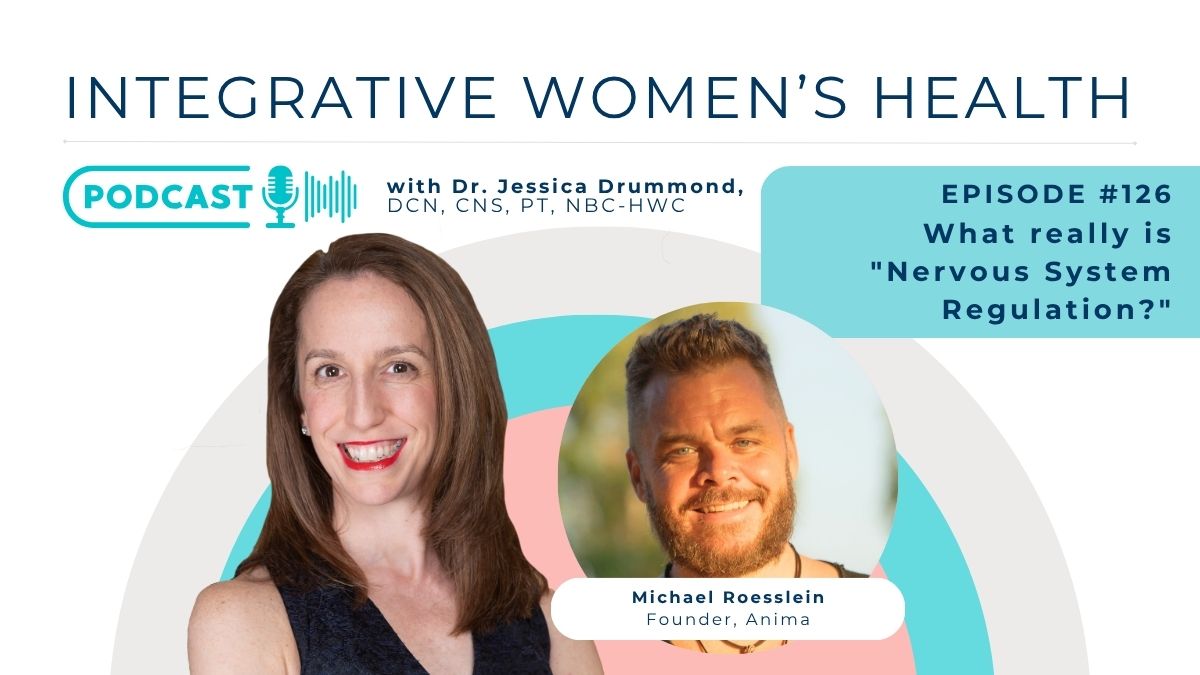
In today’s episode, I’m joined by Michael Roesslein, founder of Anima, to dig into what nervous system regulation means and why it’s so much more individualized than we sometimes make it sound. We talk about fight, flight, fawn, freeze, and shutdown states, why constantly trying to calm an activated nervous system can actually be counterproductive, medical gaslighting, trauma, the ways women learn to experience safety from a very young age, why doing all the “right” things for your health sometimes still isn’t enough, increasing our capacity for difficult emotions as well as joy, working with our own nervous systems as practitioners, learning to recognize what each individual patient may need to feel safer and more supported, and more.
Enjoy the episode, and let’s innovate and integrate together!
Join Dr. Jessica Drummond to learn proven strategies to confidently address perimenopause, menopause, and chronic conditions while growing a profitable and impactful practice.
Discover proven strategies to attract high-value clients, deliver transformational results, and position yourself as a sought-after expert in this rapidly growing field.
Highlights
- Why nervous system regulation techniques like breathwork and cold plunges don’t work the same way for everyone
- The role of personal history and individual signals of safety in shaping nervous system responses
- Why curiosity and awareness of your own capacity matter more than following a prescribed regulation technique
- The impact of medical gaslighting and invalidating healthcare experiences on nervous system safety
- The gaps in practitioner education around trauma, emotional safety, and nervous system regulation
- Recognizing that regulation is about building capacity to experience emotions and sensations
- What it means to experience both difficult and positive emotions without becoming stuck
- The role of parenting and co-regulation in helping children experience emotions
- How personal history can shape fight, flight, fawn, freeze, and shutdown responses
- The influence of gender, social conditioning, and early relationships on perceptions of safety and threat
- What functional freeze can look like and how it differs from other nervous system states
- How unresolved stress and dysregulation can affect therapy, health protocols, and behavior change
- Why compassion matters when addressing self-soothing strategies, coping behaviors, and nervous system healing
Learn more about Michael Roesslein & Anima
About Michael Roesslein
Michael Roesslein is the founder of Anima, where he teaches and facilitates work around trauma and the nervous system, emotional healing, breathing and breathwork, meditation, and somatic exploration of the patterns, beliefs, and behaviors people can’t think their way out of.
He spent eighteen years on the physical side of healing — fitness, nutrition, and functional medicine — studying under and collaborating with dozens of the world’s leading practitioners and researchers, and founding Rebel Health, a platform he ran for over a decade that reached more than half a million people.
In 2018, lifelong anxiety and depression collided with several overlapping life crises, and he went into the deeper work because he needed it himself. Nearly a decade and thousands of hours of training followed — in breathwork, somatic therapy, nervous system regulation, trauma-informed facilitation, meditation, and grief work.
Few practitioners have gone this deep on both sides of that equation, and knowing where the physical side reaches its limit is part of why Michael now works entirely on this one. It’s where his passion is, where he’s seen the deepest change happen, and it’s what shifted his own life and the lives of many people he’s met along the way.
Anima is that work: live educational and experiential sessions, programs, and courses, held in community rather than alone, with workshops, retreats, grief ritual facilitation, and individual and couples work. The aim is capacity — more of life fitting inside okay — along with the ability to feel and process what’s been held, see your own patterns without shame, and find your way back to curiosity, connection, and joy. It’s what he wished existed when he needed it most.
Michael is originally from the Chicago area, but has lived in Lucca, Italy since 2022.
Learn more about The Integrative Women’s Health Institute’s Programs
Ready to revolutionize your career and grow your practice?
- Integrative Women’s Health Institute on Instagram | @integrativewomenshealth
- Integrative Women’s Health Institute on YouTube
Click here for a full transcript of the episode.
Jessica Drummond 00:00:03 Hi and welcome to the Integrative Women’s Health Podcast. I’m your host, Doctor Jessica Drummond, and I am so thrilled to have you here. As we dive into today’s episode, as always innovating and integrating in the world of women’s health. And just as a reminder, the content in this podcast episode is no substitute for medical advice, diagnosis, or treatment from your medical or licensed health care team. While myself and many of my guests are licensed healthcare professionals, we are not your licensed healthcare professionals, so you want to get advice on your unique circumstances. Diagnostic recommendations treatment recommendations from your home medical team. Enjoy the episode. Let’s innovate and integrate together.
Jessica Drummond 00:01:02 Hi there. Welcome back to the Integrative Women’s Health Podcast. I’m your host, doctor Jessica Drummond, founder and CEO of the Integrative Women’s Health Institute. If you know our programs, our globally recognized program on perimenopause and menopause, the Perimenopause and Menopause Certificate Program, and the Endometriosis Certificate program, you know that the number one thing in our seven step system for healing is nervous system regulation.
Jessica Drummond 00:01:30 And in fact, one of the things I’m most passionate about is helping practitioners, women’s health and wellness practitioners of all disciplines learn to better regulate their own nervous systems, to build capacity in their own nervous systems, to be able to respond and be flexible so that they can be more coherent and be beneficial. co regulators for the patients and clients that they serve. But the hard part is what is nervous system regulation really? Sometimes breathwork practitioners will tell you, oh, you just have to do coherence breathing 5 to 6 seconds. Inhale 5 to 6 seconds. Exhale consistently for 15 minutes a day. And you’ll better regulate your heart rate variability. And that is a regulated nervous system. Sometimes people who adore cold plunging will say, oh, if I just get a daily cold plunge, my nervous system feels immediately reset after my heavy workouts. Both of those things may be true, and both of those things may be absolutely false. It really depends on the person. And that’s why this is so hard to really learn to understand, and it’s why it’s so hard to do, and why it’s so hard to teach about on Instagram or TikTok.
Jessica Drummond 00:03:12 Because there is not 1/32 to 92nd tool that will teach you in that quickly of a period of time how to regulate your own nervous system, how to understand what nervous system regulation is and how to co regulate with your patients and clients and even your children and partners and friends. And so I wanted to invite my friend Michael Roslyn to speak with us about his journey into nervous system regulation. I’ve had my own journey in nervous system regulation, overlapping with the depth of my work in physical health. Starting nearly 30 years ago, when I began working with patients as a physical therapist. I’ve experienced my own story of illness, chronic illness, burnout, injury. You know, I’ve been an athlete since I was literally six years old, and I’m now in my early 50s. So I think each of us has a very personal relationship with nervous system, nervous system regulation, nervous system understanding. And I want to spend this conversation really going deeper about what that all means. I think the very simplest explanation that I have come up with, in my experience, is related to the data around pain science, that at the end of the day, our nervous systems need to be experiencing signals of safety that are at least equivalent to, if not ideally more so than signals of danger.
Jessica Drummond 00:05:08 And what those signals even are highly variable, which Michael and I will give you an example. Water could be either one. Almost anything could be a signal of safety or a signal of danger to a different person. You know, someone who’s had a really positive experience with breathwork training. That could be a really foundational signal of safety for someone who had a terrible experience during a breathwork training experience. Just breathing in a certain way could be a signal of danger, and it’s really challenging to learn. It takes some introspection and practice. What state your nervous system is even in, and then how to see what someone else’s nervous system is in. And what I pride myself in our training programs is because all of our women’s health and wellness practitioners students are going to have some relationship with nervous system regulation when they come to us. Some are going to be advanced in their knowledge, but not having practiced very much. Others are going to have practiced far more than they even realized and didn’t know the terminology. Some have deep experience in Co regulation.
Jessica Drummond 00:06:33 Whether that was good Co regulation or less good Co regulation or even dangerous Co regulation for them and their clients. And there are so many angles to look at this. And so I say to Michael a few times during this conversation that I think when you’re in our programs, you learn this to sort of a middle school level, and he’s trying to take it to a high school level or college level. But I actually think that might be the wrong way to frame it. I think each of us is on our journey of deepening our relationships with understanding how our nervous systems respond to the world, what our own signals of safety are, what our own signals of danger are, and that, of course, there’s a continuum between those. It’s not black and white, and what our clients and students and patients need from us to feel safe in our presence is also going to be different for each and every one of us. So I think the number one thing I want you to take away from this conversation is to be very curious about, in each experience with another human.
Jessica Drummond 00:07:46 How are you showing up from a nervous system Some perspective. And in each experience with yourself, does it feel more regulating to lift weights or less? Does it feel more regulating to meditate or less? And are some of those things simply skills to be developed and deepened? And are some of those things maybe things that just aren’t the right fit for your beautiful, integrative, celebratory natural nervous system? Our nervous system is designed to protect us, so it’s a little bit sensitive, and the world that we live in actually creates more sensitivity because we have exposure to negative news and scary inputs through our phones far more than we had even 5 to 10 years ago, and this is accelerating. So join me for this conversation. Know that this is a subject I’m deeply passionate about, and you’re going to learn. And each and every one of our courses here at the Integrative Women’s Health Institute, but we’re going to now take it to the next level with Michael Roslyn. And I want to introduce you to him quickly.
Jessica Drummond 00:09:19 He’s the founder of Anima. I think I say that incorrectly in the video. I’m sorry about that. Anima, where he teaches and facilitates work around trauma and the nervous system, emotional healing, breathwork, breathing, meditation, somatic exploration of the patterns, beliefs, and behaviors that people can’t intellectually think their way out of it. And look, you and I love to intellectually think our way out of things. So we’re going to have to do our best to set that aside the best we can. He spent 18 years on the physical side of healing, fitness, nutrition and functional medicine, studying under and collaborating with dozens of the world’s leading practitioners and researchers, founding the Rebel Health Platform, which he ran for over a decade that reached more than half a million people in 2018. Lifelong anxiety and depression collided with several overlapping life crises, and he went into the deeper work because he needed it himself. Don’t all of us come to a lot of this for that reason? Right? Nearly a decade and thousands of hours in training followed in breathwork, somatic therapy, nervous system regulation, trauma informed facilitation, meditation and grief work.
Jessica Drummond 00:10:36 Few practitioners have gone to this depth on both sides of the equation, and you may have done so to some extent without even knowing it. If you have ten, 15, 20, 30 years of experience working with patients and clients, you’ve probably learned some things about yourself and about others that I want you to bring to this conversation and be curious about, even if you don’t know what the names of them are. Let’s get into it. Anima is that work? Live educational and experiential sessions, programs and courses. We are going to be hosting Michael next week, and you’re going to hear all about it in your email. We’re going to be hosting him, and there’s going to be a link associated with this episode where you can join that free workshop. It’s going to be so much fun. We’re going to go even deeper. And if you’re listening to this after the workshop, don’t worry, we’ll have a link to the replay for you. All right, without further ado, let’s get into it.
Jessica Drummond 00:11:38 Take some notes, open your curiosity. Think about what you maybe already know that you weren’t labeling nervous system regulation. And let’s get curious with Michael Roslin all about what the heck is nervous system regulation? And I’ll see you on the other side.
Jessica Drummond 00:12:01 Hi, and welcome back to the Integrative Women’s Health Podcast. I’m your host, Doctor Jessica Drummond, and I’m here with my dear friend Michael Roslyn of Anima. Is that how.
Jessica Drummond 00:12:10 You say it? Anima. Is that anima? Anima. Okay, awesome. We say the word nervous system regulation a lot around here, but what exactly that means is highly variable for different people. And one of the kind of groups of people that I wanted to specifically focus on today are women in the perimenopause transition or in the perinatal time, or who at any age are navigating complex chronic illness. And one of the things we were talking about yesterday when we were prepping for this conversation is I’ve seen more and more videos on Instagram lately of women or practitioners who are also patients, educating each other on how to put a certain armor on for when they go to their medical appointments so that they are not automatically gaslit.
Jessica Drummond 00:13:15 It’s like exactly how much makeup to wear and how sick to look and how not sick to look, because we really do have women who have been coming to seek health care for five, ten, 15, 20 years and have been periodically gaslit. So let’s talk about what that does to nervous system regulation and how we as practitioners can start to unravel that and help people feel safer.
Michael Roesslein 00:13:47 Yeah. Wow. That was as a man and someone who doctors would probably take seriously when I go into a doctor’s office. Yesterday was the first time I’d heard of this. Not that women are gaslit in the medical system. I’m very well aware of that. But I didn’t know of these that these videos, that this strategy, that this how to be when you go to the doctor, how to look, how to be, how to act so that you actually get the care that you’re supposed to get in the first place. I never heard of this. And every once in a while I hear something new in this world of I don’t know what to call it, what we do.
Michael Roesslein 00:14:29 That kind of blows my mind. And this was something that blew my mind. And. But it shouldn’t, because I know what the system is like. And I know the pressures that women are under in all kinds of different ways that men don’t know anything about. And it was shocking. And knowing what we know now physiologically, and how the state of one’s nervous system plays a role in chronic pain conditions and inflammatory conditions, in fatigue and energy levels, inability to focus in a lot of the symptoms that people, women, end up in doctor’s offices for in the first place. Having so much fear around the experience of going to the doctor, and not only the experience itself, but the recreation of a lot of wounding that’s happened in their life of like not being seen, not being understood, not being validated, being too much, being too little, being too pretty, being not pretty enough. Like it’s really feeding. It’s hitting something deeper than the experience itself. And that happens a lot in this kind of work that I am immersed in is the response of the body is not always to the thing that’s happening.
Michael Roesslein 00:15:46 It’s to something that happened before. Something that is reminded of, something that feels familiar. And I think medical gaslighting and negative medical experiences are a lifelong thing for a lot of people, especially women. And so throwing the body into a state of danger when they’re going to the place that is supposed to be the place that turns this around, it’s sad, it’s incredibly counterproductive, and it’s something I think a lot of practitioners are completely unaware of as well, because I think there’s in the functional medicine world, there’s a lot of throwing conventional doctors under the bus. But one of the things that I’ve heard over and over, and I don’t know the exact number, but insert very small number of hours, is the only amount of training that doctors get on nutrition. I’ve heard three, I’ve heard seven, I’ve heard ten. Whatever it is, it’s not enough. But it’s usually some tiny number, right? And I don’t know this as a fact, but I would guess that most medical doctors receive even less education than that about anything to do with emotional trauma or nervous system states, as pertaining to what we’re talking about here.
Michael Roesslein 00:16:59 They might learn neurology, or they might learn neuroscience of like, what is the nervous system? What does it do? What is a sympathetic nervous system response? They may be able to repeat that. But as far as what we’re talking about here and the impact that their behavior in their words and their receiving of their patients, I guess it’s bedside manner is the old term for this. How much of a very real impact it has on the people, especially the women in front of them. They probably receive close to zero training or education on this. So I don’t want to throw everybody under the bus. These are things that they don’t know.
Jessica Drummond 00:17:39 Yeah. And I think all kinds of practitioners don’t know this. Acupuncturists don’t know this functional medicine. Physicians don’t know this. So I think when we let’s maybe take one step back. So I think the reality is women are having to prepare to get care because they’re practitioners. Essentially, none of them have any depth of training in this. And our practitioners have, let’s say, a seventh grade level training of this just to throw a number out there.
Jessica Drummond 00:18:13 And ideally, what I’m trying to do as we introduce our community to your work, get them a collegiate level training in this. But because all of us are living with our own nervous system dysregulation, part of the work is actually working on our own emotional and nervous system regulatory practices. So. Is there a way to relatively simply define what is. Nervous system regulation which has been tossed around more and more?
Michael Roesslein 00:18:50 Yeah, it is completely taken over my Instagram. I don’t know if it’s like that for anyone else, but the work I do, but it’s like the whole what is this saying with airplanes? Put your mask on first before you help anybody else. And I know a lot of health practitioners. I was in that space for 15 years. I was a health practitioner myself. Then I collaborated with dozens of health practitioners. It is a stressful career for most. Not everyone has this smooth dialed in practice and juggling practice, juggling education like demands, juggling family and life outside of practice. And not just the practice, but the states of the people that you’re working with coming in frantic and panicked are shut down or this.
Michael Roesslein 00:19:35 So there’s a ton of stress and nervous system demand on health practitioners, especially now that we all get to be marketing experts as well. We all.
Jessica Drummond 00:19:45 Have businesses.
Michael Roesslein 00:19:46 Yeah, everybody has dual track expertise, expectations and pressure. Now you’re also your marketing person and probably your bookkeeper and probably your secretary and all of these things. And when you say dysregulation or regulation, I see a lot of I try to always give people the benefit of the doubt. So I’m going to say that I see a lot of well-meaning content on the internet now, a lot. It’s probably the thing I see the most about, and I’m sure that the algorithm has to do with my work, but I’m sure that you’re seeing some of it, too. And the first thing I’m going to name is a misconception is something that I did for years without knowing that it wasn’t the right thing to do, is that regulation means being calm all the time And that it means calming down. And so I have had anxiety for my whole life.
Michael Roesslein 00:20:40 I was pretty much born with it. And that’s my baseline state. Is being in fear or anxiety? Some people are wired that way. A lot of your listeners probably were or are wired in that way. And so they’re nervous. System is highly attuned to their environment and everything is noticed and everything is triggering or activating. So by the end of the day, running a business and a lot of other chaotic things that have been in my life, my body would be shaking. I would be really activated, I would be unable to sleep, I’d be inside, and I learned a whole bunch of different, really powerful ways to calm my body down. And I thought I was doing the stuff. I was like, I got this because I actually fell asleep by 11:00 last night. I am a master of nervous system regulation. I am the calmest person alive. And what I noticed over time is that I was becoming more reactive. I was becoming easier to be triggered. I became jumpy to sounds and noises.
Michael Roesslein 00:21:46 I became more reactive. My reactions were stronger. It was almost like shaking a carbonated beverage. Right? So it’s shaking. Is the stress right? It’s the inside is all ready to explode, not opening the beverage. And I’m not getting to the where we need to be screaming and hitting things and whatever, but it doesn’t make the bubbles go away. And so I was finding out ways to suppress what my body was wanting or needing or saying the response of the nervous system to very real things going on in my life. Calm down. And ladies, how much do you like being told to calm down when you’re not calm? I learned at a pretty young age that this is not the thing to ever say to a woman, Right. We say it to our nervous system and we say it to our body and the body, and the nervous system is like, wait a minute. That thing is happening. This thing is happening. This is happening, this is happening. I don’t want to calm down.
Michael Roesslein 00:22:45 And there’s ways we can force it to calm down in the moment. And then this is what’s getting sold as nervous system regulation. A lot of the places is calming practices. And over time this can actually be harmful for this like a activated system. What different nervous system states need is not the same. So if you’re giving like a highly activated system that needs some sort of movement or expression or some of it’s like outward pushing or there’s there’s a million different practices that are a state specific, appropriate allow the processing or movement of the energy because it’s like trauma, right. And a lot of trauma science and trauma therapy, the thing that you’ll always hear is that it’s an incomplete process like that. The process wasn’t able to be completed. I’m not going to get into the trauma side of things, but it’s similar with the nervous system. And on the other side, if someone is in like a shutdown collapse state and you give them calming practices as nervous system regulation, this is going to push them further into a collapse state and not be helpful to get their energy back up and get their system moving and reconnected again.
Michael Roesslein 00:24:02 So those need mild activation. And so there are times to use these like grounding calming practices, especially in an acute moment and perpetually doing nothing but calming down. It doesn’t increase our capacity. Which is the answer to your question, is that nervous system regulation is the ability to feel strong emotions and sensations, not get lost and stuck in them, and return to a baseline state that is balanced and alive and present and perpetually suppressing your state does not increase this. What’s called window of tolerance in the in that world is like, how big of things can you feel in either direction and stay present, not spiral out, not get triggered, not get lost. Not shut down. Feel it. Let it move. Come back to a baseline. That is what regulation really is. It is not being calm all the time. And so it is about increasing capacity because unfortunately life’s not going to stop laughing.
Jessica Drummond 00:25:14 Yeah. Yes. Yeah.
Michael Roesslein 00:25:17 And so learning the tools and practices to let your body move with life and be able to experience more.
Michael Roesslein 00:25:26 Because that’s not only bad things I say experience more or bigger things, and everyone associates that with pain and suffering and sadness. But when we have a small window of tolerance or a small ability to feel a small capacity, that also goes for joy and happiness and positive things as well, we don’t get to selectively choose which sensations or emotions we’re shutting down. And so I’m sure you hear a lot from patients, you and your practitioners. I don’t feel happy ever. I can’t access joy. I don’t feel this. And that’s a small tolerance for sensation. And there’s no capacity there. So nervous system regulation is about building capacity, being able to experience the different states and recognize them and let the body do and have what it needs to move through that, like animals do. We’re the only ones who have to learn how to do this.
Jessica Drummond 00:26:23 Because animals don’t have as formed a frontal lobe essentially to restrict themselves. And I think that is really at the core of what we’re talking about here, that humans learn very young, like before we can even remember how to we we can only capture initially the tolerance of the family members who are raising us in the very beginning.
Jessica Drummond 00:26:54 So that you start with, I think of this actually as a form of generational wealth. Like if you have parent, if you grew up in a safe home, that’s like a form of generational wealth. And then if you have parents who have the capacity to feel things and allow you to feel things and then help you come back to calmness or not even calmness regulation. If you have parents who support you in being emotional. And I think as a parent, I think about this all the time, I think of this as one of my core jobs with my kids is like, how much capacity? Which is hard as a parent. Like my oldest daughter last year was studying abroad and she was like, oh, mom, we’re going to Morocco this weekend. And I’m like, okay. And we’re gonna sleep in the desert. And you’re just like, great. But you’re like, I’m like, okay, call me when you get back. But like, what you have to be is you’re reminding them of safety and yet you’re allowing them to experience.
Jessica Drummond 00:28:08 And my younger daughter, who has more of a anxious set point or it actually hers wasn’t at birth. That was actually related to some later trauma. But I think it’s very interesting that it’s one of the hardest things to do as a parent. And yet I think it if you then or as a practitioner, you start to create more like you help people play at their edges, but you have to have tools. And I think this is the other thing that’s very confusing about nervous system regulation, and why on Instagram it comes off is so oversimplified. Like you just need to do these five tools.
Michael Roesslein 00:28:48 Do this breathing exercise.
Jessica Drummond 00:28:49 The reality is there are thousands of tools like for like literally just sitting in water could be a certain kind of tool shed on your arms. Yeah.
Michael Roesslein 00:29:04 Like Indian water for some people feels great. And for other people this would be like, oh shit, I’m in water.
Jessica Drummond 00:29:10 That might be really playing at their edge. It might go past their edge like some people. Maybe they had a drowning trauma or one of their family members had a drowning trauma.
Jessica Drummond 00:29:19 So I think that’s why it’s hard to explain what nervous system regulation is, because it’s just like how most people with chronic illness don’t all like. Everyone with Pots doesn’t need the exact same supplement protocol. It’s the same thing. Everything. Everyone with Pots or everyone with anxiety doesn’t need the exact same nervous system regulation strategies. So we want to introduce the fact that we’re going to do a workshop for practitioners together in about a week, and from this from when this episode is released. And so one of the things I think you’re going to teach us is like, what are even the states that people can be in? Can you talk about that a little bit?
Michael Roesslein 00:30:08 Yeah, yeah. And it’s the workshop is going to be fun. I’m excited. And the water is a great example. Right. And so I’ll get to the States in a second. But another thing is that there’s this thought that a nervous system is a nervous system, like everyone’s nervous system is the same. Nervous systems respond in this way to this thing, and some of that is generally true.
Michael Roesslein 00:30:34 If you lit a fire under someone’s foot, 99.9% of people’s nervous systems would be like, hey, move your foot, and then there would be a stress response triggered. But for things nuanced like water, for example, if you put me in the sea and I swim out to where I can’t really touch the bottom and I’m just treading water and floating around, and the waves are coming and I can’t really see a lot of stuff, I feel great. If you took another person and put them in that same place, they would freak out before they ever got that far into the water and they would probably go into a full collapse panic by the time like panic, collapse, shut down, maybe drown by the time they got to that point in the water. Our nervous systems are unique. They’re unique in how they’re wired, which was largely from our mother’s nervous system in utero and at birth and in small age. We were 100% co regulated and zero on our own. And then it’s also on life experience and what the nervous system remembers.
Michael Roesslein 00:31:41 Familiarity and safety in danger. It doesn’t make stories. Our mind makes stories of oh I. This is scary. Your body is just giving you signals that you interpret as scary. We have different nervous systems. So two states, one state. I’ll go through the states, but one is fight, and flight is the one everybody hears of or knows of. This is like a sympathetic, sympathetic nervous system. Responses. One is like to get away from something. In lots of different ways, whether it’s physically or mentally or whatever, we try to get away. Fighting is meeting something head on and trying to stop it or change it, or usually associated with anger, her boundaries, or its more of an outward kind of thing directed towards the stress where flight is more away. These responses in the body of your body and my body will not feel the same. There’s similarities oftentimes in the limbs or in the where the sensation is felt or there there’s similarities. There’s yeah, I’ll stop at that. There’s similarities, but not everybody feels the same in a flight response as they do as their neighbor.
Michael Roesslein 00:32:54 So these one size fits all a cookie cutter like, oh, you’re in fight or flight, do this thing. Here’s what fight or flight feels like. Maybe for some people it’s the same way with anatomy. When I was in anatomy physiology for my master’s program, our AP teacher told us in all the cadavers that he’s cut open, none of them are the same on the inside, and none of them look like the textbooks do.
Jessica Drummond 00:33:17 100% true. We went research in grad school, was dissecting 14 different forearms. We were doing a study on that. In every single case, there were some patterns. But in every single case, the nerve, literally the nerve branching was distinct. So if you think about, for example, someone during their life who played piano, their forearm nerve branching might be distinct. So I.
Michael Roesslein 00:33:41 Really.
Jessica Drummond 00:33:41 Think that’s a really good example.
Michael Roesslein 00:33:43 Yeah, yeah. And so it’s the same way with nervous system response like level like activation to certain things. And another is the actual sensations that the people feel.
Michael Roesslein 00:33:53 So there’s the fight and flight and one that’s debated that I like to include that’s very common is fun. And that is also a sympathetic response that usually comes before a fight or flight. And it’s very imperceptible to a lot of people, especially women, of doing what needs to be done in the environment to make yourself safe. And that’s making someone else happy, making a situation happy, doing something outside of you that makes the situation safe for you, and this is usually done subconsciously, immediately, without noticing it, and then later. It’s why did I agree to do that thing? Why did I say yes to this thing? Why am I always doing this thing? Because later you’re not in that stressed situation and you’re like, oh, now I have to do that thing that I didn’t want to do. Why did I say yes? You said yes to that because you felt scared.
Jessica Drummond 00:34:44 Yeah. Now, is there something different about women’s nervous system in general, or is this just a spectrum across people that like everyone’s nervous system?
Michael Roesslein 00:34:56 There’s a lot of differences in how it was initially wired and how it perceives danger, because there’s a lot more danger, like really there’s a lot more danger.
Michael Roesslein 00:35:09 Also like something like oxytocin has a huge impact on a woman’s nervous system state. More so than a man’s like, the actual physiological response to oxytocin is different in a woman’s body than a man’s body. That’s why physical closeness, like everything that increases oxytocin, which I think your audience is pretty familiar with, will calm a woman’s nervous system more than a man’s. And the absence of oxytocin will impact the dysregulation of a woman’s nervous system state more than it will impact a man’s. There’s also different relationships between other hormones and stress and nervous system like which hormones are affected by stress states more in a woman or a man, which applies to your perimenopause and menopause. But really, what you mentioned was the parents and what you learn as a child also of what’s acceptable and what’s not acceptable, what’s safe, what’s not safe. And this shapes what your nervous system perceives as danger or safe later in your life in a way that is much different from a boy. Like a girl learns safety much different than a boy.
Michael Roesslein 00:36:23 And I don’t just mean physical safety. I mean don’t be loud. Don’t stand out. Don’t argue, don’t speak up. Don’t that it that.
Jessica Drummond 00:36:34 Like relational and even financial safety and things like that. Like how you show up at work, how you show up among your brothers and sisters, things like that.
Michael Roesslein 00:36:44 How it might feel to be when you have the perception that someone doesn’t see you as intelligent or someone doesn’t see you as a peer, or someone doesn’t see you as talented or whatever, that may. Two guys whose egos are inflated and never had to deal with this, they might not even notice something like that. So they’re nervous system may not respond to it at all, but to a woman, it could put them into a spiral of a time that the brother, the father told them this. The nervous system will catch those little things and be much more attuned to them and then react. And it’s like half physiology and half like just learning.
Jessica Drummond 00:37:21 Like essentially this social learning.
Michael Roesslein 00:37:25 What’s acceptable, what’s not.
Michael Roesslein 00:37:26 And by safety, when I say what you learned, what’s safe as a kid, I don’t mean there are a lot of instances, sadly, of abuse. But disconnection from connection of parents of caretakers was the most unsafe thing to most children. We don’t realize it, but that’s devastatingly terrifying to kids. And when girls act a certain way versus when boys act a certain way, it’s much more likely that if the boy acts like that, they’re going to get the connection. And if a girl acts like that, they’re going to be told, no, that’s not the way to be. That’s not this. You can’t do this. Boys are told, don’t cry. They’re not told to not be allowed to not assert themselves, to not yell, to not do all these things. Yeah. It’s a different way of learning. What maintains safety and safety in childhood is like connection is acceptance is being seen, is being validated. All of these things that are going out the window and the doctor’s office that we went back to at the beginning of being seen and validated and understood, it just kind of came full circle there.
Michael Roesslein 00:38:26 And that’s why when the doctor acts like this, or the acupuncturist or whoever, it’s triggering something in the nervous system that is from developmental age, in girls and in women, a lot more than happens to boys.
Jessica Drummond 00:38:39 Yeah. And I think for women, it’s such a tightrope to like that idea. Even in those videos where not to like, you can’t be too pretty or too ugly. You can’t be too smart or too dumb, like it’s a very tight type tightrope, which is very interesting. Yeah. Like, what does that mean?
Michael Roesslein 00:39:02 Be normal. Be in the middle. Be this.
Jessica Drummond 00:39:04 Yeah yeah yeah.
Michael Roesslein 00:39:06 Yeah. Guys, we don’t have, we don’t have that. Those Like our safety, our connection, our acceptance was never based on this.
Jessica Drummond 00:39:15 So when we think about so quickly, walk us through the states or just introduce them. And then I want to talk about the women who have been doing everything right there on all the protocols there. They’ve done therapy, they’re on the perfect diet, they’re wearing exactly the right amount of makeup, and still they don’t feel well.
Michael Roesslein 00:39:38 It’s really sad that the right amount of makeup fits on that list. So of the fight and flight and fawn. Fawn isn’t always included in these lists and I’m not. There’s a lot of models of this out there. This is not like black white cut, dry. This is the way I have been taught it and see it show up. Like in real life. The fight, flight and fawn are the activated states like this is like sympathetic activation. You usually feel this in the body like it’s anxious or it’s activated, or there’s energy or there’s heat, there’s tingling or movement or twitching or something that’s on. Then there’s freeze, which sometimes freeze. The way I use freeze is like foot on the brake, foot on the gas at the same time. So it’s like sympathetic and parasympathetic activation at the same time, where either the brain is going a million miles an hour and but your body is exhausted and you can’t move. It’s like, hurry up and wait, or the body feels ready to go and anxious and energized.
Michael Roesslein 00:40:35 But there’s brain fog and exhaustion in the mind. And that’s not the only two ways it can show up, but it’s like a functional freeze is like this. This state where the sympathetic responses have been going on for so long, so strongly, so chronically all the time, that the bodies or the mind is starting to like, dissociate and shut down because that’s the progression it will go. But there’s still part of you that’s come on, let’s go. Let’s do this. We need to do it. We need to fix it. And it’s like.
Jessica Drummond 00:41:00 And for a while you can lock in and somehow.
Michael Roesslein 00:41:03 We can do it. For a really long time. I’ve lived most of the last nine years in some version of that, at times with a lot of personal life crises and moving overseas and business things in a small child and whatever. Yes. And so functional freeze or freeze states can be maintained. It depends on the person’s level of resilience. Now, women who are coming into your clinics to see your your practitioners, the ones who are really sick, they’re likely not in a state like that too much because it requires a lot.
Michael Roesslein 00:41:35 They could be. They can be. They’re not the they’re usually towards the end of their resilience rope. They’re usually pretty close to not so resilient anymore that they would usually end up there when their window, which could have been very long of being in functional freeze, is starting to end. So I don’t mean that they’re not resilient. I just mean that their gas tank is close to empty 100%.
Jessica Drummond 00:41:59 Yeah.
Michael Roesslein 00:42:00 And so they might still be in that state, but they’re nearing a tipping point where they might go into more of a collapse or shutdown state, which would be the further. So there’s the sympathetic responses. There’s the gas and break what I call functional freeze. And then there’s the collapse or the shutdown state, which in vagal theory is dorsal vagal shut down. Political theory is very debated, and I don’t stick super close to that framework all the time. But there is obviously a collapse and shutdown state of the nervous system. Some people go into it like this. The people who if there’s like a high stressful thing or an argument, they just dissociate or they check out or they go away.
Michael Roesslein 00:42:38 Some of you might have partners like this. It’s very common in relationship dynamics. The anxious avoidant kind of swirl. The avoidant person often has a quick trigger to a collapse or shutdown state, which is where they need to go away, or everything just glazes over. But chronically, in health purposes, this looks like fatigue. This looks like depression. This looks like no energy to do anything. No motivation to do anything. Hopelessness. Despair. Not so anxious anymore. Not so worried. Just like Eeyore. Are we too old? Do people know Eeyore? From what.
Jessica Drummond 00:43:14 You know.
Michael Roesslein 00:43:15 That’s collapsed and shut down. Digestion shuts down. Hormones usually go in the tank. Immune system can really shut down. Like. It can go either way. But it gets really haywire at this point when the nervous system is in this state because it’s like a deep state of survival. The animals go into that state. It’s when they know they can’t get away from the thing. You’ll see those videos where the lion chases the gazelle or whatever.
Michael Roesslein 00:43:40 At some point when the gazelle knows it’s toast, it stops running. It just collapses and produces a lot of endorphins when this happens, like pain killing chemicals in the animal and it shuts off memory. If you have periods of time you don’t remember. It’s often in that state. So it’s a protective thing. And then there’s what Gorgeous in the poly vagal people call like ventral vagal, like present aliveness. Like this is a lot through the face facial expressions. This is when we’re fully present. We balance. This is what regulated usually like people refer to as grounded, calm, present, alive, clear and in, in connection, able to maintain like real connection and communication. So this is not black and white. We don’t just switch from one state to the other. These are always on some sort of a gradient and they’re moving all the time. The more attuned to it you get, you can catch these shifts, learn your body and realize, oh, I’m pretty activated right now. Let me do this thing for a few minutes.
Michael Roesslein 00:44:45 And usually when you bring your awareness to the sensations, not the stories around it, I’m pissed off or I’m anxious or I’m scared or I’m no. The actual nervous system state sensations and work with those sensations. You can usually find your way back to a center point when it’s done correctly, and then you mention the ones who do everything right. Yeah, like the protocols, the diets, therapy on the other side because this is nervous system is foundational. The reason I’m just I just transitioned to Anima and doing this work from what I did with Rebel Health and Functional Medicine after a long time. And the reason I’m starting with the nervous system is because it’s foundational on both sides, and we both know reality. There is no side that the mental emotional affects the physical. And it’s there’s one person, but we compartmentalize everything professionally. So there’s two sides of this. And so it’s foundational on the mental emotional therapy counseling side of things as well. People can go to therapy for a decade and not really see a lot of changes.
Michael Roesslein 00:45:50 If they’re nervous. System is chronically activated and dysregulated. It’s going to be very difficult to implement or make any use of the things you’re learning in therapy. These are the ones who can tell you I do the same thing all the time and I can’t stop doing it, and they’re very aware of it. But then on the other side, and I saw a lot of these people in our community at Rebel Health, which was the supplements and the diet and the lifestyle changes. And they either are doing everything right and they’re not seeing as much progress or shifts as they would like, or they know everything to do and.
Jessica Drummond 00:46:27 They’re not.
Michael Roesslein 00:46:28 Compliant with it. Those are two separate people, but the nervous system is behind both of them. The one who’s doing everything right and not seeing all the results is because the state of the nervous system affects every other physiological system in the body. And a lot of times when someone when I would encounter somebody like this and this is difficult to hear sometimes. So this is not accusing anybody of anything.
Michael Roesslein 00:46:52 There’s no shame involved in this at all. They would say, I’m doing this, I’m doing this, I’m doing this. And I would say, how is your primary relationship? What is that like? And then they would go into some terrible story or what is your job like or your work like? And they would go into some terrible version, either their job or their relationship, either romantic partner or their family. What is your relationship with your family or your children? What is your living environment like? What your environment and your connections and your relationships? Do you have any significant childhood trauma? What have you done as far as that goes to address that? Like all of these questions, 95% of the time, I would find glaring things somewhere in there that are consistently driving the nervous system or they’re addicted to this thing. Well, mine’s not here. This one.
Jessica Drummond 00:47:50 Oh, yeah. The phone. Yeah.
Michael Roesslein 00:47:52 Boom box. Like the thing that we created to scare the hell out of us 24 over seven at all times.
Michael Roesslein 00:47:59 All right, let me just say this. You are not wired to know everything that’s going wrong in the world at the same time, all immediately right now. Yeah. So it’s a combination of things. But if the nervous system, if underlying trauma has not been addressed, which is another conversation or the nerves, which keeps the nervous system in a dysregulated state and is driving dysregulation, that’s where nervous system tools can become almost like whack a mole. Where is dysregulation coming from? Let me get it under control over and over again. But exploring like where it’s coming from is the things I just mentioned is unresolved trauma. And almost always this stuff is underneath those patients who aren’t moving the needle, and it’s underneath the inability to shift or change things like compliance. And we talked about this yesterday when I moved from Chicago out west all at one time, I quit doing every single possible thing I was doing that was unhealthy in my life, and I’m not going to name them all off. But it was an extensive list, and I quit doing them all at the same time because I wanted to feel better and be healthy.
Michael Roesslein 00:49:04 And for clients or patients, that could be dietary changes. It could be supplement protocols, it could be a new workout program. It could be all these things. People learn how to self soothe and self-regulate and self-medicate. They learn how to do it. It’s very important. It’s the reason a lot of people are still alive. It is the thing you learn how to do. Some of it might be food, some of it might be late night binge watching Netflix. Some of it could be unhealthy relationships, some of whatever. Taking all that stuff away from someone and changing it to something else all at the same time, without any compassion, in any acknowledgement of the positives of it, and then some help trying to help them discover like new ways to both remove the triggers and the things driving the need for them, but also some healthy alternative ways tools to regulate themselves outside of those things, it’s a recipe for failure, and it’s setting them up for failure. And then there’s shame, and then they go in a shame spiral, which is triggering to the nervous system, which puts you into a more dysregulated state.
Michael Roesslein 00:50:06 So there’s no shame in the ways that we learn how to survive. There’s no shame in a nervous system that’s dysregulated because it’s doing its job. It’s responding to your environment, your thoughts, your history, your everything, and meeting all of this stuff with compassion for yourself and for the people who put you there is pretty essential, I think. And as practitioners, really seeing these people as humans that have this, this swirling combination of factors and variables and treating them with respect and being regulated yourself and grounded yourself when you interact with them goes a long way, like being fully present with them, being regulated like yourself, like being able to listen to them. You hear difficult stuff like I’ve heard. Especially now that I switched quote sides. I hear stories because people are more open to talking about some really hard stuff in that side, and they don’t think to tell that to their health practitioner, which they should, but they don’t think of it. You hear stuff that will trigger you, and so how do you be with it and sit with it to where they don’t feel you getting triggered? Because those women, for most of their life have been told that they’re too much?
Jessica Drummond 00:51:24 Yeah.
Michael Roesslein 00:51:25 And if they feel like they’re too much for you, it’s going to trigger them. They’re not going to feel safe. And so learning to have the capacity yourself to to be with something difficult in the moment as a practitioner and stay grounded and maybe you get activated and come back like this is a huge thing to demonstrate for them, and it’s a huge thing for them to experience.
Jessica Drummond 00:51:47 Yeah, I really appreciate this. I think there’s so much depth to what we can learn as practitioners. And I think, as you said, it really starts with just getting your hands a little bit around what this is because most of us have even if you’ve been in our programs, you maybe have a elementary to middle school education around a.
Michael Roesslein 00:52:10 Little more.
Jessica Drummond 00:52:11 Than you give.
Michael Roesslein 00:52:12 Credit for.
Jessica Drummond 00:52:12 But yeah, but bottom line, though, is that this is something that just as we learn nutrition or fitness programming, like there are levels of depth and levels of advancement. And I think all of us, though, with this in particular, like we don’t necessarily have to have tried every supplement that our patients are going to be trying.
Jessica Drummond 00:52:40 But I think with this in particular, having the just grace and humbleness to just turn the mirror on yourself slowly, and also being willing to not to be uncertain in this area, to be willing to grow like as a professional who wants a lifelong career. I think this is where people with experience can really get stronger, get deeper, become safer people in their for the relationships, in their own, in their own lives, for themselves, and then ultimately for the patients and clients that they’re working with. That being humble enough to address this, to think, okay, I probably don’t know everything I need to know about this, and if I have some tools, I’m going to use them and keep building on them. Because some of our students are breathwork practitioners, some of our students are mindfulness experts, some of our students are yoga teachers, and they have a lot of tools. But I think the being willing and then some of us are come from conventional medical backgrounds or functional nutrition, doctorate or master’s programs and haven’t learned much about this at all.
Jessica Drummond 00:53:58 So I think all I’m saying is, I encourage you guys to join us for the workshop, to keep learning, and most importantly, not just to learn this on an intellectual level, but to start slowly and gently at your own pace. Because one of the things I always say is people can only heal at the pace of their nervous system, so we can’t rush it at your own pace. Start getting essentially building resilience. We’re always talking about strength training and all of that kind of thing, but the more we build this capacity, it’s going to make our lives better and more fun and more capacity for joy and more capacity even for sadness and anxiety and anger and the fullness of the human An experience, and we’re going to be safer and safer places for clients with complex, chronic challenges to land. So thank you for the work that you’ve done. Michael, thank you for this conversation, and I look forward to everyone joining us in a week where we’re going to go just a little deeper.
Michael Roesslein 00:55:08 Yeah.
Michael Roesslein 00:55:08 Thank you Jessica. It’s always a pleasure and I look forward to seeing everyone there. It’ll be fun. We’ll learn stuff. We’ll do things. I don’t like to just teach at workshops. I like to have it be experiential. So hopefully we can give everybody a little taste of what we’re talking about and an experience for them. And I look forward to meeting your community.
Jessica Drummond 00:55:25 That’s going to be great. And where can people find you in the meantime?
Michael Roesslein 00:55:29 And you can go to Anima Somatic Self Comm. The links will be in the show notes for this. I think the link we’re going to put in there though is actually to register for the workshop. The URL might be a little different. I’m not sure what that will be, but the link down there will be to come to the workshop and if it’s after the workshop, it’ll probably be to watch the workshop or watch a recording, but that’s where you would go the social media. I’m just getting started. It will be on Instagram soon, but the website would be the place to go and the workshop is the place to start.
Jessica Drummond 00:55:59 Excellent. So go to the show notes, get all the right links and we’ll see you guys back here next week.
Michael Roesslein 00:56:04 Thank you.
Jessica Drummond 00:56:10 I hope you enjoyed that conversation as much as I did, and that some of the explanations and anecdotes and trying to intellectualize something that is so hard to clearly define in a quick soundbite. I hope some light bulbs went off for you. I hope you started to realize some of the ways in which you have learned, even in childhood, to regulate your own nervous system and bring yourself a sense of safety and things you might not even remember learning from childhood. They’re just habits Now, this week I want you to get really curious about nervous system regulation, about how your nervous system interacts with your phone, your children, your patients, your partner nature, your dog, whatever you want to play with, play with it. I think that’s experiential. Learning is one of the best kinds of learning around nervous system regulation and nervous system capacity expansion. And yet remember that how something feels, whether expansive or constricting, safe or unsafe, or anywhere in between to you is not the same as it’s going to feel to someone who you are aiming to help support to better heal their bodies, minds and spirits.
Jessica Drummond 00:57:45 All right. I’ll see you at the workshop with Michael. Where? We’ll go another level deeper. If you need the link, simply look in the show notes. Check your email. Make sure you’re on our email list. If you’re not yet or you’re not sure if you are. Head over to support at Integrative Women’s Health institute.com and we can make sure you are follow us at Integrative Women’s Health on Instagram and I’ll see you soon.
Jessica Drummond 00:58:12 Thank you so much for joining me today for this episode of the Integrative Women’s Health Podcast. Please share this episode with a colleague and if you loved it, hit that subscribe or follow button on your favorite podcast streaming service so that we can do even more to make this podcast better for you and your clients. Let’s innovate and integrate in the world of women’s health.

Dr. Jessica Drummond
Founder & CEO
The Integrative Women’s Health Institute
At the Integrative Women’s Health Institute, we’ve dedicated 20 years to crafting evidence-driven, cutting-edge programs that empower practitioners like you to address the complexities of women’s health.
Dr. Jessica Drummond’s unique approach focuses on functional nutrition, lifestyle medicine, movement therapies, nervous system dysregulation, trauma, and mindset – essential elements often overlooked in traditional health education.
In addition, your training will be fully evidence-based, personalized, and nuanced (this is not a cookie-cutter approach) in functional nutrition, exercise, recovery, cellular health, and all other lifestyle medicine tools.
You’ll learn to support your clients with cutting-edge tools safely and effectively.