Follow Us for Free:


About the episode
“It’s okay that you don’t want to do the thing that looks so good on paper.” – Julie Granger
Sometimes the hardest transitions are the ones that come when everything in your life looks like it’s working. The career appears successful. The business is growing. The credentials are there. Other people admire what you’ve built. And yet, somewhere underneath all of that, there’s a quiet sense that something no longer fits.
For many midlife women, that realization comes as a surprise and can be quite unsettling. We spent decades learning how to achieve, how to care for others, how to keep moving forward even when things are difficult, but very few of us were taught what to do when the path we worked so hard to create no longer feels aligned. And even fewer of us know how to navigate that uncertainty without immediately rushing toward the next certification, the next goal, or the next plan.
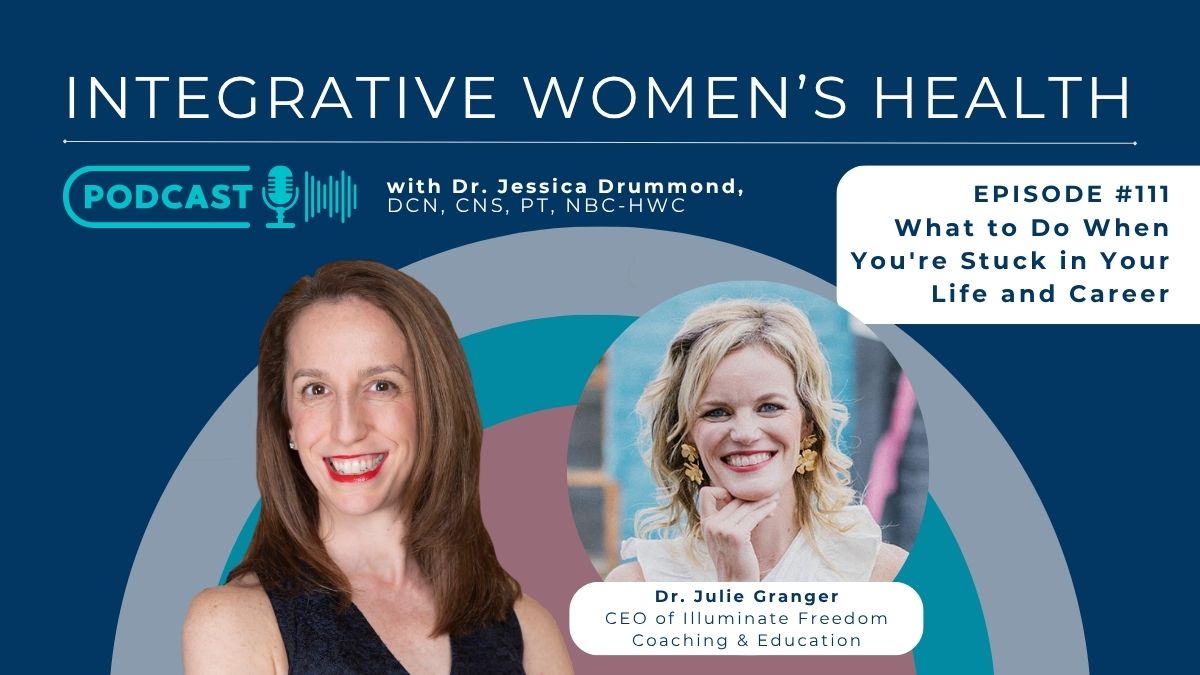
In today’s episode, I’m joined by Dr. Julie Granger, physical therapist, coach, and founder of Illuminate Freedom Coaching, to talk about life and career transitions, identity shifts, and learning to trust yourself through periods of uncertainty. Julie and I discuss her journey through cancer, entrepreneurship, multiple career pivots, and ultimately building work that feels more aligned with who she has become, the nervous system’s relationship with change, why women often stay attached to identities that no longer serve them, the role of community and co-regulation during transitions, financial safety and decision-making, how perimenopause can amplify the inner signals we’ve spent years ignoring, and more.
Enjoy the episode, and let’s innovate and integrate together!
Highlights
- Why health professionals often struggle to apply their own self-care knowledge
- What it means to safely deconstruct a life or career that no longer feels aligned
- Why community and co-regulation are essential when navigating uncertainty
- The courage required to move against social expectations and create a different path
- The four areas of life most affected during major personal and professional transitions
- Why a true career pivot requires an identity shift, not just a new certification or credential
- How financial safety and money beliefs influence decisions during periods of change
- How perimenopause can trigger profound questions about identity and purpose
- What happens when success no longer feels aligned
- Why meaningful change often comes through small, intentional pivots
Learn more about Julie Granger
- Julie Granger’s Website | IlluminateFreedomCoaching.com
- Julie Granger on Instagram @DrJulieGranger
- Julie Granger on Facebook
- Julie Granger on LinkedIn
- Julie Granger’s Substack
About Julie Granger
Julie Granger’s work sits at the intersection of human development, identity, biopsychosocial health, and leadership within high-performance cultures — particularly healthcare, entrepreneurship, and sport. She draws on developmental psychology, neuroscience, and body-based somatic frameworks alongside intuitive and embodied approaches to support women navigating identity transitions, performance pressure, and belonging inside systems that reward achievement but often neglect the human and soul experience within them.
Her perspective is shaped by a lifelong immersion in high performance. She began her NCAA Division I swimming career in 2002, entered coaching in 2004, and began her professional healthcare career in 2009 as a DPT.
At Illuminate Freedom, Julie guides high-performing, purpose-driven women in healthcare and service industries to match the story they tell about their lives on the outside to the story their Soul tells on the inside. By bridging science and soul through high-touch, one-on-one coaching and mentoring, she helps clients attune to their body’s physical, emotional, and intuitive cues — not as problems to fix, but as data and guidance.
Learn more about The Integrative Women’s Health Institute’s Programs
- Perimenopause and Menopause Certificate Program
- The Integrative Women’s Health Membership
- Endometriosis Certificate Program
Ready to revolutionize your career and grow your practice?
- Integrative Women’s Health Institute on Instagram | @integrativewomenshealth
- Integrative Women’s Health Institute on YouTube
Click here for a full transcript of the episode.
Dr. Jessica Drummond 00:00:03 Hi and welcome to the Integrative Women’s Health Podcast. I’m your host, Doctor Jessica Drummond, and I am so thrilled to have you here. As we dive into today’s episode, as always innovating and integrating in the world of women’s health. And just as a reminder, the content in this podcast episode is no substitute for medical advice, diagnosis, or treatment from your medical or licensed health care team. While myself and many of my guests are licensed healthcare professionals, we are not your licensed healthcare professionals, so you want to get advice on your unique circumstances. Diagnostic recommendations treatment recommendations from your home medical team. Enjoy the episode. Let’s innovate and integrate together. Hi there. Welcome back to the Integrative Women’s Health Podcast. I’m your host, doctor Jessica Drummond, and I’m thrilled to be here today with one of my absolute dearest friends, Julie Granger. She and I have had so much fun in our life and our career. Being high maintenance and staying in bougie hotels for, oh gosh, more than a decade now.
Dr. Jessica Drummond 00:01:25 And I’m so excited for this conversation because if you’re feeling any kind of inkling of I’m not 100% sure I’m in the right place, do I need to shift my career? Do I need to shift my life? Are there people or relationships I need to deepen or let go of? Like if you’re in any kind of uncertainty, transition, grief, curiosity you maybe want more for yourself than you actually have right now. And you know it’s possible. This is exactly what Julie does. She helps people make transitions in a way that is safe and resourced for their nervous system. And practically, we talk about the financial implications of making a transition or a pivot. We talk about the relationship implications. We talk about what it means to our identities as high achieving health and wellness professionals and what that all means. So let me introduce her by just reading to you her deep well of accomplishments. And we’re going to talk about them in more detail in the episode. But Julie’s work, she is a physical therapist with her doctorate.
Dr. Jessica Drummond 00:02:42 She’s a well-trained coach. She’s a graduate of our programs, and her work sits at the intersection of human development, identity, biopsychosocial health, and leadership within high performance cultures, particularly healthcare, entrepreneurship and sport. She has deep training and expertise in athletes, female athletes across the spectrum. She’s been a Division one collegiate athlete in swimming, where you have a lot of swimming metaphors in here, you’re going to love if you’re a swimmer. She works with all of this heady intellectual skill with body based somatic frameworks, alongside of intuitive and embodied approaches to supporting women navigating identity transitions, performance pressures and belonging inside of systems, and sometimes shifting those systems that reward achievement but often neglect the human and soul experience. Julie’s perspective is shaped by a lifelong immersion in high performance as a Division one swimmer, as a doctoral trained physical therapist, and for the last 20 years she’s worked with collegiate athletes. Pediatric and adolescent sports medicine, women’s health, clinician education and research and entrepreneurship. And she is well acquainted with those of us who consider ourselves Type-A, high achieving.
Dr. Jessica Drummond 00:04:09 We want a lot out of life, and we want a lot for ourselves, and we’re real givers. If that sounds like you, you’re going to love this episode. So tune in and I’ll meet with you on the other side, where we can talk about how you can apply this in your work tomorrow. Hi, everyone. Welcome back to the Integrative Women’s Health Podcast. I’m thrilled to be here today with Doctor Julie Granger, who has been a dear friend of mine for a really long time. I don’t even know how old we are at this point. So it doesn’t matter. It doesn’t matter. And we’re going to talk a lot today about as clinicians, coaches, health and wellness professionals. When we think about career and life transitions, we’re often very good at doing these with and for our patients and clients, but not that good actually at doing it ourselves. And I think about two years ago when I took a group of our students to Italy and we did a breathwork session, and it was like, you know, everyone in that group intellectually had 100% understanding of the parasympathetic activation of breathwork and types of breathwork, cadences and protocols and what they were for and when.
Dr. Jessica Drummond 00:05:27 And 0% of the people in that group had been doing breathwork ever. So let’s start with your story and your career, Julie, because you have a really interesting experience of doing all the things you had, the career that looked amazing on paper the dream dpt do graduate international speaking. You had all the credentials and then you got cancer. Then you created, which actually was a really important part of your story. Then you were like pivoting. You created a seven figure business for multiple years. And still when we connected a couple of years ago, you were like, actually, this is wrong too. So talk about this, because what happens when you do it perfectly and then you’re like, oh, shoot. It is such a disorienting moment. And having done so many pivots, and I got to that most recent one and I might have some more ahead of me. But I think that having done so many, there was a level of willingness and courage that I had built to be really honest with myself and face the dissonance that I was feeling and really let my body speak up and say, hey, you know what? Great stuff on paper.
Dr. Jessica Drummond 00:06:58 You’re actually very good at this. You genuinely like it, but it’s still wrong. And let my head step aside. And all of my thoughts and all of my smarts and brilliance. Step aside for a minute and really listen to that disorienting, sobering, humbling. And it’s a moment that I could not have done alone because I would have been in my own way. I would have been like, nope, this makes sense. It’s a seven figure business. I’m helping people, I’m serving people, I like it. And I think that what I learned through that process, like the final moment of you have done a lot of pivots and I’ve had coaches and I’ve had people mentor me, but I really needed someone who said, hey, it’s okay that you don’t want to do the thing that looks so good on paper that people look up to you. for that you’re being invited to speak about, and that you’ve led so many clients into the same thing you’ve built. And I’m here for you to help you figure out whatever is next.
Dr. Julie Granger 00:07:57 And so the women that come to you now in your work. So you made that pivot about two years ago, something like that. That’s right. And so they’re deeply vested in hormones in women’s physiology and evidence based medicine. Everything that we work on here. They also have somatic training. They have these deep intellectual understandings of mental health, spiritual health, physical health. But they have the same thing that you were struggling with, which is a disconnection from their own voice. Or even if they hear it, they don’t know what to do with that, because like, how do we tear it all down in a safe way? So talk about what you do now.
Dr. Jessica Drummond 00:08:44 Yeah, I think my own story is really what I want people through now. And it’s like, I love how you said it needs to be safe is from a somatic standpoint, from a neurobiological standpoint, we have to do it in small bites and in a way that the system isn’t going to just totally put up full resistance. Now a little bit of resistance is normal.
Dr. Jessica Drummond 00:09:03 That should be there. But a way that is titrated is the word. So, medically speaking, that your system takes a little bite and it’s like, okay, I’m all right, let’s try the next one. And so there’s a deconstructing process. There’s a sinking all the way to the bottom process where there’s a reckoning, there’s sifting through what needs to be let go. There’s a I’m not 100% sure what’s next in dealing with the uncertainty of that, which is terrifying for the achieving woman who always seems to know what’s coming next. There’s reckoning with community. There’s grief. There’s letting go of. If I let go of this identity and this thing that I’m doing, who might I lose in the process? Who isn’t going to understand who’s going to push back and challenge me, both in personal and intimate relationships, but also in professional relationships? And there’s also the reckoning of sunk cost. I’ve put all this money all this time, all this energy into all of these things. And what am I doing? What do I really want to take this leap and so that the system doesn’t feel like it’s an actual leap.
Dr. Jessica Drummond 00:10:09 There’s this process that needs to happen of digestion and metabolizing and letting things just be a little uncertain for a while, while creating a safety net financially in community, surrounding yourself with people who are ready to help you rise to whatever’s next so that you get that beautiful. As we know, oxytocin that helps you feel co regulated in community. I think that the at least Co regulation with one other person is so key for what I call. It’s like the valley of becoming, where you’re just like, I don’t really know. And it’s terrifying to go there and you can’t get there by yourself because your nervous system will always put you back in safety.
Dr. Julie Granger 00:10:53 Yeah, I think that’s a lot of times where the resistance comes from. It’s not that people don’t want to change or even the identity, but it’s like almost the subconscious block. You can understand things very well in an intellectual level and still hold yourself back.
Dr. Jessica Drummond 00:11:14 That’s right.
Dr. Julie Granger 00:11:15 I think what’s so interesting is you integrate so much of your entire life story. So you were a Division one swimmer at Duke University, and you took a break from that after your cancer diagnosis and your reconstruction of your rib cage and all of that, and which is still an amazing story in and of itself.
Dr. Julie Granger 00:11:36 But this idea that Essentially, if you are a practitioner in women’s health, there is a current, there’s a current of expectation of certain credentials, certain understanding, certain populations that are now in the mainstream conversation that weren’t there just very recently. And so if you swim with that current, it’s a heck of a lot easier to build a job around that. And if you swim against it or just slightly, you pick the slow lane or something like that to to maintain the metaphor again, it might feel like, am I taking the hard route unnecessarily?
Dr. Jessica Drummond 00:12:22 Yes. Yeah. It’s so funny. I love that we’re going with the swimming metaphor, because that’s the whole. The name of my podcast being Sink and Swim is. It’s like everyone wants to keep swimming on the surface, and the whole thing I’m describing is the people who really step into what’s meant for them. You have to think, right? You’re going against everything. Your system is telling you to stay afloat and keep breathing and keep swimming and keep paddling.
Dr. Jessica Drummond 00:12:46 And like you said, the system there’s this current. And for as women were wired neurobiological to be in community. And when everyone around you is in the current. Your friends, your mentors, your colleagues. What’s so interesting? And I remember when I learned this a couple of years ago, is we are more biased in our nervous systems to maintain bonds from an attachment standpoint than we are to live authentically, to be who we really are. That’s a protective mechanism so that you don’t get kicked out of the tribe and die. Right. And it goes back to true biological. It’s called belonging, right? But so the current is actually I call it. I have a couple of names for it. I call it the clinician contract and the conformity corset. And it’s very much this thing that kind of keeps us going and moving in one direction. But it can box you in and it can keep you from quite expanding or shining or whatever metaphor we want to use. But really doing something that is not you’re not only good at that’s not only helpful to the people you serve, but that you genuinely love that actually fills you up just as much as you fill other people.
Dr. Jessica Drummond 00:14:04 And so because of that wiring, that’s why you need other people, because you don’t want to stray from the community. We’re wired for that. We’re trained into that. That’s there’s nothing wrong with that. And so you’ve got to have someone else or a group of other people who are like, come over here. We’re going to it’s still okay. Because the last the thing that I see women struggle with the most and it’s very much, often unspoken, is the fear of losing friendships, colleagues, mentorships, letting people down. What will people think? And that’s often pejorative. Like it’s often shunned or oh, you shouldn’t worry what people think, but actually you should. We’re wired to care what people think. And it’s you just got to find the people who now are there to honor what you think and what that tug towards who you really are and what you should really be doing is pulling you towards.
Dr. Julie Granger 00:14:55 I really like that because it gives a, a real strategy for okay, you were in the fast lane, if you will, with the people and the majority or whatever.
Dr. Julie Granger 00:15:06 You’re actually I think one of the things that really drives us is the fact that everything we do now is so algorithmically driven that because you’re always in an algorithm, you don’t actually know that there are like infinite number of other algorithms that you’re just simply not aware of. And so if you find it, if you know which one you want to be in, there are probably already people there.
Dr. Jessica Drummond 00:15:30 That’s right.
Dr. Julie Granger 00:15:31 That’s I think that’s really encouraging. And for most of the women that you work with, it’s not just a career pivot. It’s also a life pivot, a parenting pivot, an empty nest pivot, an illness pivot. So how are these things complementary versus I really feel like anytime you’re making a big life change, usually everything’s involved, right?
Dr. Jessica Drummond 00:16:03 It’s I see it as four layers. There’s the you with, you like what’s going on inside of you layer. And a lot of women are actually your breathwork example was such a good one. But we’re now trained up on self-care and listen to your body.
Dr. Jessica Drummond 00:16:16 And what are your thoughts saying? What’s your nervous system doing today? That’s great. Internally, I’m in touch with myself. The second layer is your most intimate relationships family. Friends, neighbors. We’re going to say non-work relationships. The third layer is what I call your livelihood, which is not your work, but actually what keeps you alive and makes you feel alive. Just you with you again. Just your activities. And then the fourth layer is another relational one, which is your contribution to the world, which is like your work, your devotion, your people, but also the community that you serve. And so if I’m going to mess with the fourth layer, which is the outermost layer, it has tethers all the way down into my relationship with my own inner world. And it’s gonna it’s going to rock the boat. It’s going to rock the system. There’s no way that it’s not going to. And so my identity is going to be challenge. My nervous system is going to speak up my my most intimate relationships.
Dr. Jessica Drummond 00:17:06 This is the thing that often pushes back the most. Right? It’s the parents that are like, why would you leave a stable job? Why would you shut down a business you’ve built that makes seven figures? I remember my parents being like, are you okay? We’re genuinely worried about you. And it was hard. It was hard to feel that pushback because I put it nicely. That’s not how it was put grace to me. But also one thing we’re also very good is as women in the wilderness space. Is that on that livelihood branch, like all of the activities. Right? Like, I’m going to do the things to care for my hormones and my diet and my exercise and my stress. Good. But at the same time, when you’re going through something like this that might need to increase or those things might start to feel like they’re off. In a way, what was working for you is no longer working for you. And then the last one is the professional purpose and community. And what I find is a lot of women stay very focused on that outermost layer, that professional purpose and community.
Dr. Jessica Drummond 00:18:02 And they’re like, all right, I’m going to take the course, I’m going to get the certification, and that’s going to give me my next career purpose. And then they get into it and they get six months in or a year in and they’re like, oh, this isn’t right either,
Dr. Julie Granger 00:18:15 Or maybe it’s right. But and here’s what I see a lot. They haven’t thought about how they’re going to actually apply it. They almost think that getting some specific skill is going to do the work for them.
Dr. Jessica Drummond 00:18:32 Unlock it. That’s right.
Dr. Julie Granger 00:18:34 Yeah, yeah.
Dr. Jessica Drummond 00:18:34 Yeah, I see that a lot. And usually if a woman can get to me before she’s pulled the trigger on that, like signing up for a certification or a course. Not that the certification course are wrong for her. I usually they are correct for her, but if we can dig in a little bit and be like, what do you actually want? Not just in your career, but also, okay, you’re a mom. You are now three years postpartum.
Dr. Jessica Drummond 00:19:00 You’ve got little ones. You’re thinking about another one. How what do you want your relationship to be, not only to your work, but also mothering? And there’s usually some grief with that. Oh, I never even thought about that. I might have to give up this or that or whatever. And so then we’re looking at if you’re going to do something new, we always have to subtract to add. So what’s going to have to be let go in order to do the new thing. And then as they get through a program like one of yours and they get to get through it and they’re like, wait, hold on, I have the credential, but I still don’t feel like I belong here. There’s an identity shift that has to come, and a lot of times that’s more of an inside job than just doing the work and getting the credential and learning the skills and the techniques and all of that. So it’s fun to bring people through that. And having gone through your programs, it’s fun to be like, I’ve been there and through all of this and I’ve been the coach who’s I don’t know what I’m doing.
Dr. Julie Granger 00:19:52 And I think that’s a healthy thing. If you already feel like you know what you’re doing, you’re probably a little less humble than you maybe should be because there’s always a level of learning. And that’s one of the reasons why, in our programs, we always start individually with people to say, what is your plan for this? What is your goal? What is it? What is success look like? But I think taking that next step and not just thinking about the question that I’m asking, which is essentially what does this look like in your work? How do you want to apply this? What’s the result going to be? But how is that also going to shift your identity? What else do you need to let go of? Because I think one of the things that is really stressful for women in this current day and age and has been, but I think even more so now as everything is really accelerating in terms of pace and there’s a lot of financial insecurity, I think we have to be real about that.
Dr. Julie Granger 00:20:51 Or I wouldn’t even say insecurity as much as lack of stability. And some for some people that is a positive in the sense that they’re benefiting from that, from some people that’s a negative from. Honestly, for most people it’s negative in the United States, but and probably globally as well. But I think what makes a career and life transition hard for a lot of women, particularly because a lot of women, What I’ve learned as I’ve approached the empty nester stage is so many women, despite the fact that we now can have awareness of our money and own bank accounts and all this stuff, really don’t know it for themselves, so they don’t really know what they need to do. They don’t know what safety looks like. They’ve never really defined it.
Dr. Jessica Drummond 00:21:46 Yeah. On Maslow’s hierarchy of needs, financial safety comes just one rung above food, shelter, water. And that’s actually a conversation I have with people at their initial session with me. It’s called a soul mapping session. So we’re actually drawing the map and we’re having financial conversations because it is very difficult from a resourcing perspective to take one step forward.
Dr. Jessica Drummond 00:22:09 And that titrated way, if you don’t, it’s not even a logistical financial safety. It’s emotional financial safety, it’s the emotion behind it. And so we get into the emotion of money, their relationship to money. Do they even know how much they need to be contributing to their family’s budget every month? A lot of women do not. Someone else is managing the budget, or like they’re aware of the budget, and they’re aware of things, but they don’t know. And they’re often overestimating how much money they need to be contributing, which is very interesting. And so that can be a reason you’re afraid to leave the job or start the business, or take the risk, or close down your business or any number of pivots that I help women through. And I think that when we come back down to that, just the brass tacks of both the logistics and the emotions of money, it’s incredibly illuminating and incredibly freeing. But it’s an incredibly brave conversation to have.
Dr. Julie Granger 00:23:03 Yeah. And I think what you said about it, that in the fact that almost always it’s less risky than they think, but they’ve literally never run the numbers.
Dr. Julie Granger 00:23:16 And I love. There’s another podcast I love that a friend of mine produces by a guy named Ramit Sati or something like that. And his it’s called money for couples because he looks at money in a family kind of couple perspective, which I think is valuable for people who are coupled. Even if you’re not, it’s still valuable. But one of the things he says constantly is the actual financial number doesn’t change your relationship to it. For many people who are like, I don’t, we don’t have enough. And then he says, okay, what is enough? And then they’re like, and then they just pull a number out of the air. 10 million. He’s like, okay, well, you have 9 million. Whose are you feeling like you’re almost there. And there there’s like no, actually probably it’s 15 million. It’s never. And he’s when you get to 15 million, how are you going to feel. And there’s just never this sense that there’s enough. So it’s actually a different problem than what most people think.
Dr. Julie Granger 00:24:12 And so that’s what it sounds like, the work that you do to say, oh, and for some people, a hundred thousand is enough. 30,000 is enough. They already have enough. They just don’t know. They’ve never asked the question.
Dr. Jessica Drummond 00:24:25 They never asked the question or it’s ever been asked of them in a non pressurized way. So I think that when I bring it back to having at least one other person to correlate with you who has a vested interest in you. For me, it’s people doing what they really are designed to do and want to do and how they want to live, but that can be a hard conversation to have with a spouse, for example. Speaking of partnered, because it might feel like pressure, there might be shame involved, there might be just unspoken things we never talk about. It might be really difficult for a woman to feel like she can ask for what she wants. Women are trained to not receive so many layers, and so when we can actually just almost practice having the conversation with each other, not that like we’re reading a script or anything, but she has someone to have the conversation with where I’m not like, oh, we got to think about the kids and this and that.
Dr. Jessica Drummond 00:25:13 We talk about those things, but at the same time, there’s the pressure valve is open, so she can just be honest and scared and wobbly instead of feeling like she’s got to have herself all put together and like, suit up to go have this conversation with someone else. Again, it’s just all about tie trading. Those little baby steps one and the next to keep moving through those uncertainties. And this again, like you said, is for the person who’s actually listened to that little voice that’s like, oh, something else is for me.
Dr. Julie Granger 00:25:45 Yeah, yeah. So to circle back to that, I think step one is there’s a sense of, okay, whatever I’m doing is not quite.
Dr. Jessica Drummond 00:25:53 Not.
Dr. Julie Granger 00:25:54 It. Yeah, yeah. Step two is I need to figure out what is for me. So that’s work they can do in that cocoa coordination co regulation experience. Just even figuring it out. And I think that’s an important piece of permission as well. Because this idea that you don’t already know is okay.
Dr. Jessica Drummond 00:26:15 Yeah. It’s okay. And that’s why it’s just a one off. It’s a one session. It’s 90 minutes where it’s just let’s put it all out on the table and you might not be walking away with clarity. But what you might be walking away with is a lot of information that you then let process and metabolize and digest through your body to start to get some ideas down. Because what a lot of women want to avoid because they’ve already felt it, right. They’re like, oh, I built this and now it’s not for me. Either you’ve just outgrown it or there’s something new beckoning you and whether they know what it is or they don’t. The more you can actually just stay with yourself through uncertainty, the easier it’s going to be to keep moving through it to what it actually is for you.
Dr. Julie Granger 00:26:58 Yeah. And I think as we’re talking about this, one of the things that comes to mind is so we know some of the reasons they’re afraid to take that step, a lot of judgment Financial or safety.
Dr. Julie Granger 00:27:10 Other safety issues what their even their partner will think, what their parents will think. Will they be able to spend as much time or more time or less time with their kids, like all these kinds of pieces of fears? But I think there’s also something interesting about the fact that a lot of people having this conversation are 35 to 55. Now, I think maybe we wouldn’t need to. If, for example, you had this amazing guidance counselor who said you can have multiple careers or.
Dr. Jessica Drummond 00:27:44 That was just normalized.
Dr. Julie Granger 00:27:45 Yeah, yeah. If you had this as a teenager. But I think most of us in this age group at this time had the messaging was you get on a path of a career, and I think that’s important in the US, it’s even more defined in the UK and Europe, where it’s like, you only get to pick this line, career or this line career, literally starting when you’re about 16 to 18 years old. So there’s a hormonal aspect, there’s a programming aspect. What are some of the things you’ve seen in your practice that really are, I think, insightful?
Dr. Jessica Drummond 00:28:22 Yeah, I think that I my original clinical expertise was adolescence.
Dr. Jessica Drummond 00:28:28 I actually love the very chaotic, ambiguous becoming part of life, the liminal spaces of life. And now that I’m here in the Perimenopausal range, I’m like, oh, this is so interesting. It’s the same thing.
Dr. Julie Granger 00:28:43 Yeah.
Dr. Jessica Drummond 00:28:43 In fact, I find that it’s the same work that I helped adolescents with as a coach and as a clinician. Who are you becoming? It’s just a different era of life. It’s act two. So that was act one. This is act two. And what’s so rich as you? You lose estrogen, for example, and you lose the hormonal buffer that adolescents were just gaining. Right.
Dr. Julie Granger 00:29:05 Yeah.
Dr. Jessica Drummond 00:29:05 And that was, for better or worse, giving you energy and all the things that estrogen is great for. But also it was masking. Maybe you’re deeper. I call them your more feral drives. Your anger, your sense of injustice. Not that it’s gone, but your ability to BS your way through your career and just keep following the current and not hear those voices.
Dr. Jessica Drummond 00:29:31 And those rumblings from inside was masked by estrogen. That’s his job, right? And so that’s a really beautiful thing about it. And then as it starts to just gently and slowly and sometimes chaotically fall away, things that I saw, a meme called perimenopause is the coming of rage. Rage becomes a thing, right? Yeah. You see a lot more neurodivergent starting to unmask itself, right? You see just multi-dimensional parts of you that maybe got quieted for a while that are speaking up suddenly. I’m interested in gardening. I’m a bird lady. Like, where did that come from? Right. And I think also just your ability to push back against the current becomes louder. And so it’s such an opportunity. Yes. Do what you need to do to support yourself hormonally, 100%. And let’s not actually mask the voices and the signals that are coming from within and waking up and maybe speaking up, possibly for the first time in your life, because there’s so much interesting information, especially behind rage, that I guide women into, is like actually gently and with safety moving into that rage and sitting with it and being with it and listening to it, instead of being like, oh my God, my nervous system is dysregulated and I need to quiet it.
Dr. Jessica Drummond 00:30:48 It’s like I actually be with it a little bit, because rage is the most loyal defender for what you want.
Dr. Julie Granger 00:30:55 Yeah.
Dr. Jessica Drummond 00:30:55 And when we can get there, which for women in health care who are servants, who are supposed to be the calm one. You keep it together. It’s sometimes the first time we get there. Like it’s such a gift to be able to be that person with someone. I was there, too. And when we can actually listen to those desires that are hiding behind the rage, it. It gives you that. What’s next?
Dr. Julie Granger 00:31:20 Yeah. Yeah. I think the comfort that you provide or the support that you provide to help people actually experience that, it’s going to be really new for most people, because most people, I think, who are at the level of doing this work have brought up against these walls were really successful, just like you were at everything they did. And so it’s going to feel weird to not stay on the path.
Dr. Jessica Drummond 00:31:53 It’s still weird for me.
Dr. Jessica Drummond 00:31:54 I’m really I’m now in the third year since I looked at my seven figure business and was like, and it’s not that what I was doing was wrong, it’s what I was calling it and the meaning behind it and the goal setting. And who was it for, really. And I really like that really statement. Who was this for really. And it was for I. It’s like I still grapple with saying this out loud, but as much as I had already done so much work around being the hyper achiever and having perfectionism, it became achievement for achievement sake. Oh, how much more can we do? And I was doing all the things I was like regulating my system and taking care of myself. There wasn’t a lack of self-care and all of that and balance, but it was just like there’s still a should here, there’s still something I should be doing and I, I had to take some time. I was still worked with clients for a while, but I had to take some time to step back and go, oh, which parts of that actually feel really authentic? Because I was almost there.
Dr. Jessica Drummond 00:32:58 And which parts am I doing? Because it seems like a worthwhile cause.
Dr. Julie Granger 00:33:04 And I also think when we think about business growth, the definition of business in a capitalistic society, which we are all living in, the super late stage capitalism. And I think even women who are, who want to run a very successful business, there is this idea that the only way to be successful is to focus on continuous growth. Yes, because that is the definition of business inside capitalism. And the reality is capitalism is the system we were born into and that we have here in this country and that we have in most countries. But there are different versions of capitalism. There are different versions of other economic systems. In a way, you have a little bit of choice about whether or not you want to do that because you’re not. Most of the time. It’s different if you’re running a publicly traded organization where you have a fiduciary responsibility as a CEO to your shareholders, right. The vast majority of the people we’re talking to here aren’t in that position.
Dr. Julie Granger 00:34:12 And yet we are taught the exact same playbook. Well, I think what’s so interesting about your pivot here is actually you were already doing what you wanted to do. Yeah. You just didn’t have to do it in the way that someone with a fiduciary responsibility to their shareholders has to do it. That’s literally their job, or they’re going to get fired. So I think it’s fun to recognize that, like you, if you’re listening to this and you’re like, I’ve been taking all the books, reading all the books, taking all the courses, listening to all the podcasts, I feel like I’m on the right track. But there’s something about this that I just don’t want to do. Maybe you’re trying to run a business in a way that you just don’t actually have to. You might be really close, and it might not take that much to have a pivot that feels so much calmer.
Dr. Jessica Drummond 00:35:07 I love that you said that because so many of the clients I work with, there’s not actually a burn it all down and move into something else.
Dr. Jessica Drummond 00:35:14 And I technically didn’t. I’ve still got the business. I’m still coaching people. It’s not nearly as large as it was. There’s not nearly as much revenue. But and I have goals. There’s a growth goal here to maybe not get up that big, but at the same time go somewhere with it. But I think that it feels to your body like a huge thing, right? And for some people it is. I’ve had people completely change professions. I’ve had people sell their partnership in a partnership and get out, but I’ve also had people just pivot within their own business, pivot within the way they’re doing it. And it’s not necessarily business coaching. It’s a little bit more executive coaching. It’s a little bit more. How are we doing this? And what do I actually want this to feel like? And maybe five years ago, this is how I wanted it to feel. And now here’s how I want it to feel. And now I have team members and what I’m wait. Hold on.
Dr. Jessica Drummond 00:36:06 Like, how do I organize around this? Present it to them. Do I need to get rid of them? There’s lots of things that come there that I think sometimes you just you still end up in that valley of becoming of. It’s a lot easier just to stay in the current and stay the course. And your body speaks up though, which shows up as the insomnia shows up as all the symptoms we call perimenopause. And they and it may just be them amplified. You know, it’s probably both. And it’s yes, do all the things to care for your body. And there might be something that is here that’s beckoning you to listen. And so I love that I have the experience in both the body work and also more of the somatic and soul. And let’s listen to bridge that for people.
Dr. Julie Granger 00:36:51 And I think that can feel a little encouraging that you can, quote unquote, burn it all down. You can make a gentler transition. You can change what you’re doing completely over a period of time.
Dr. Julie Granger 00:37:07 There’s a lot of choice here. Once you acknowledge that. And I think that connection to perimenopause is so important because I think there are multiple things going on right now as to why perimenopause is such a loud conversation, when I think the reality is that our mothers probably experienced it and were just relatively silenced because they didn’t really have many tools for them because it was like, no hormones, I think. Obviously, we’re living in a repetitive viral infection situation that’s harming people left and right. I think that people are under a lot of stress and stress is going to amplify all of this, but I think one of those stressors could be this little message, like whether it’s your work or your family or your responsibilities. I’m in a group of other moms of like older kids. So my kids are 15 and 22, and there’s a lot of like all of a sudden they’re like, oh my gosh, if I didn’t do this hundred page list of things, our whole like family life would fall apart. They’re like, I’m tired.
Dr. Julie Granger 00:38:24 I don’t want to do this anymore. So I think that these messages of a need to change. I go back to Steve Jobs, said something like, if for more than, I don’t know, six months a year, you’re like, you’d wake up and you’re not like, oh, you wake up and you feel like, oh, then you have to meet with someone like you get safe enough to figure out, like, what is that? Because it could be any of those. Any or all of those things could be.
Dr. Jessica Drummond 00:38:57 And what’s so fun about the mapping is it doesn’t equal movement, doesn’t have to. And again, as women who are doers and achievers, that is sometimes something that is really difficult to sit with. And I actually see this a lot in our audience. Our colleagues is once you know then shoot you can’t unsee it. It’s really hard to stop that moving train and actually just sit with the desire. But it’s actually a huge flex to also learn how to hold a desire or a vision and not move on it yet because and let yourself build the safety.
Dr. Jessica Drummond 00:39:34 So it’s one thing to do the deconstructing and build the titration and the safety, and to the breaking down whatever past you or past work was. And then the reconstruction also needs to come with safety because you don’t have the capacity you did when you were 22.
Dr. Julie Granger 00:39:50 To just go.
Dr. Jessica Drummond 00:39:51 Yeah, right. Your brain still thinks it does. But you also have built a family. You also have built a career community. Right. And maybe you’re building a skill like coaching or something like that. And so the easing into it is also on the upswing. Needs time and space. And that’s what I continue to do with some people. They continue to work with me and we make the map come alive. But a lot of people, sometimes the coaching is actually let’s see if we can just stay with this for a little bit and maybe it’s not fully clear or stay with it. Give it six months. Go live your life. Stay in the thing that you’re still in, get uncomfortable enough and then come back and we’ll work together to actually bring it alive.
Dr. Julie Granger 00:40:34 Yeah, I like that so much because I was working with one of our students last week and this I there’s a panic sometimes when it’s like you’re feeling burned out in the place where you are. You know the vision of what you want, but like, you can’t always immediately jump there. So this idea that there can be a plan over one to 2 to 3 years, it doesn’t have to be like a decade. It doesn’t have to be that hard. It could be six months. I think is actually in and of itself, calming to the nervous system because it’s okay. This doesn’t have to happen right now. And I do think how we work with our kids and our daughters, my youngest is going to be a sophomore in high school. She’s ending her freshman year. And already it’s like, where are you going to college? And like, and I’m like, who knows? With AI, we’re going to have college in three years. Let’s not worry about that.
Dr. Jessica Drummond 00:41:32 So so true.
Dr. Julie Granger 00:41:34 But and hopefully we will.
Dr. Julie Granger 00:41:35 But hopefully it does. But I always say to my kids now like there are many ways like she has this kind of like idea of what she wants to do. I don’t know if she’s even going to really want to do that. Once she really knows what it is. And I’m like, okay, so this is a really competitive school you’re excited about. That might be fantastic. You’re doing great. Your grades are good. You might get in. You absolutely might not. Even with all of the right credentials. There’s always another path. And my oldest is launching. She’s got her. She’s graduating from college at the end of the year. And I just think that one of the things we get from this experience where we’re not in act one, is that we know we’ve now met many people, like friends of ours, who are music majors, who now run corporations, or people who ran corporations and then quit their job and started singing.
Dr. Jessica Drummond 00:42:30 Totally true.
Dr. Julie Granger 00:42:31 So I think it’s that level of experience, and having met people who take wildly different paths can be calming to the nervous system to know that you don’t have to do this, like immediately or it’s not going to be there.
Dr. Julie Granger 00:42:44 But sometimes it does feel like that. If I don’t decide now, this opportunity is not going to exist. That’s right.
Dr. Jessica Drummond 00:42:51 Yeah, you’re so right. I have a great story of a client I’m working with currently who built. Actually, I helped her build her business in my last iteration of business. It was business and marketing coaching, and I helped her build her business. Very successful. Multi six figure rehab like so neuro rehab practice, outpatient. She’s built a team. She’s got a business partner. And about a year ago she came to me for a mapping session and was like, I know it’s not this and I don’t know what it is truly. And I was like, great, this is exactly what I’m here for. And we talked through it and we ended up working together long term, and we’re still working together to to actually start putting the map into action. And she actually didn’t know at the time she had an inkling that the business part, she needed to leave the partnership, and it wasn’t because of the partner.
Dr. Jessica Drummond 00:43:39 It was just she was done. She was complete and she didn’t know what was next. And so she wanted the help actually figuring out to what’s next. Now this is the part that she started to rush. She was like, all right, I’m going to take. She said, I want to do coaching. Great. Let’s do coaching. Great. Lots of recommendations for places. You can get that if you want. So she signs up for a coaching certification with a very well-known group, very holistic, spiritual like that kind of thing. And she finds out if she signs up early, they have a sale. You know how this is. And the thing doesn’t start for three months. Two months after she signs up, she finds out that the founder of the certification has been implicated in a certain very high profile, damning case that’s currently being stalled in Congress. I won’t say which one. Sure.
Dr. Julie Granger 00:44:33 I think we get an idea. Yeah.
Dr. Jessica Drummond 00:44:36 We’ll see if there’s some predator stuff going on with it.
Dr. Jessica Drummond 00:44:38 And she was like, oh, I don’t want to be associated with this person whatsoever. They are not who they say they are. She pulled her registration, got her refund, all the things. And like the lesson there was, she was jumping to security. And to your point, it was very much like she, she had an inkling of what she wanted to do, which was build a coaching business. And there was a little bit of direction behind it. But I also knew as the coach and, you know, as the coach, it’s not my job to be like, no, don’t jump. Yeah. I was like, she’s kind of got a jump and figure out, is this right or not? I got a letter fall on her face and we’ll figure it out. Sure enough, she thankfully that the universe sent her. That was like, get out! And she gave it more time. She gave it more time to actually do do some metabolizing and deconstructing of the current life, get resourced financially.
Dr. Jessica Drummond 00:45:26 And for her, what financial resource looked like was coming up with interim jobs. She knew she needed a clean break from the business, which is a huge financial risk, and she was going to sell, so she was going to get a financial windfall from it, but that wasn’t going to sustain her forever. So she’s literally and this is where it’s so fun. I love my job so much. We’re brainstorming what do you want to do, dog walking. We’re talking about maybe just working at a yoga studio, not teaching, just working, just being around people. I don’t know if it was her. We talked about working at a florist, but it’s like, why not? She knew how much she needed to make. We got clear on that what financial security looks and feels. And then it was like, what would be fun?
Dr. Julie Granger 00:46:09 Yeah.
Dr. Jessica Drummond 00:46:09 Because, you know, you’re going to build this business. You’re the type of person who’s going to succeed and achieve. It’s fine. What would you do in the interim with your time? And so that’s part of that.
Dr. Jessica Drummond 00:46:20 And she did eventually in that sort of interim, letting it be not jumping to the next certification or thing that brings certainty. She found the right one and it took her eight months, but she started it in February. She loves it. It’s great. Great.
Dr. Julie Granger 00:46:37 Yeah. I love that story because it shows us that even in an environment of financial uncertainty, you know, I always think about, like, this feels a little weird to us because there was this relatively perceived for stability for most of our lifetime. But that’s really rare, actually, in the world. And in time, I just finished reading a book that’s rough, but it was excellent. It was called The Nightingale by. Oh, yeah. Have you read that? And you think people really survived absolutely horrible things. And we do probably have a lot more safety and a lot less need than we think we do. And sometimes I like to even rewind in my mind. What was it like in 80. It was just I was only five years old in 1980, but late 80s times when I can remember when I was like a teenager, when an older kid where there was just less need for the frenetic pace that we have now.
Dr. Julie Granger 00:47:46 The pace of life has accelerated, and so we have within us the capacity to slow it down. It feels weird because just back to the swimming metaphor, there’s a current, but you can actually step out of the current and be actually more aligned with more of the world. And I think that can be really encouraging that we don’t have to move so fast. And if we have someone supporting that from an overregulation way, because you’ve actually lived that you’ve lived on the road, you’ve settled down into a home, you have some of the lived experience that allows you to understand what it feels like in the fast lane and the slower lane, and how both of those things can be very successful.
Dr. Jessica Drummond 00:48:38 Yeah, I think back on, the first real major pivot was when cancer hit and I had to go out on disability leave from what was currently what was a job that I had outgrown, but I didn’t know what to do next. And thank you cancer for that. It truly was like I have to leave.
Dr. Jessica Drummond 00:48:57 And I remember telling my parents, I’m not going back to that. I don’t know what I’m doing, but I’m not going back. And I had this wide open space of forced rest, and I also had financial security from short term disability pay. So everything was covered. And this was really the first time I had all my resources in check, and I was being paid to slow down and yes, go through treatment that was rough, but also reflect and think and metabolize. And I had someone helping me. You were there also, you know, so it’s like I had enough people on the like. Come this way. It could be like this side that I was okay with letting go. And it was very hard. I remember sitting who was my boss at the time and now a very good friend, down and crying and being like, I’m sorry, I’m leaving you. I’m gonna go do my own thing though. And it was so hard. And yet I remember the moment of intentionally deciding, this is how I want to start a business.
Dr. Jessica Drummond 00:49:51 I’m going to start I want to go into coaching, but I’m going to start it as physical therapy because that’s my current skill set, and that’s what I can offer. And I know how to make money with that. And I have a following. It was always thinking of baby steps with the larger vision in mind, and through all the pivots I’ve made since then, which is about seven within my coaching business, I think that being on the road and traveling for a year and a half, you learn to live in constant liminal space and uncertainty and getting financially creative sometimes when we needed to. There’s just a lot that is available outside of that current. If you’re willing to not just do it on your own because you can’t always hear it on your own, you’ve got to sometimes have people present it to you. You’ve got to decide on your own. But ultimately, sometimes the ideas have to come to you via other people.
Dr. Julie Granger 00:50:43 And I think that really builds self trust because you’re doing you’re making these changes of your own deep inner wisdom.
Dr. Julie Granger 00:50:55 And it’s a real skill set in the sense that everything else has trained us away from it. Thank you so much for being here today, Julie. This was fantastic fun. Where can people find you and learn more about working with you?
Dr. Jessica Drummond 00:51:11 Yeah, my company is illuminate With an Eye. Some people think I’m saying illuminate. So it’s illuminate freedom coaching. And the easiest place to get in touch with me is Instagram, which is at Doctor Julie Granger.
Dr. Julie Granger 00:51:24 Excellent. Thank you so much for being here. Thanks for having me, buddy. I hope you enjoyed meeting my dear friend, Doctor Julie Granger. Go and follow her right now on Instagram. She’s wonderful and illuminate freedom is her coaching practice. I just hope that you took some little nugget or clinical pearl. You may want to go back and listen to that episode if you’re in transition again and take some notes, because I think everything she’s saying applies so much to many of us in the Perimenopausal transition who are also thinking about career and life transitions, empty nester retirement, job change, financial instability, aging parents.
Dr. Julie Granger 00:52:13 this just shows up in so many ways in this transformation and transition of perimenopause to menopause, these 35 to 55 year old years, and sometimes earlier, sometimes a little later are a bit tumultuous. And the key nugget that I’m taking away from this conversation is that as much as we intellectually might want to, might know exactly what we want to do, might be ready to do it from a skill set perspective, from a just go for it achievement perspective, until our body and our nervous system feels safe to make that transition at the right pacing, with the right support, with the right resources, with the right co regulation of a team and a community and a coach, we might hit a wall even if we intellectually know exactly what we need to do. So take a minute this week, sit outside or sit in a comfortable space in your home and journal. Just listen to your own internal dialogue. What are you curious about? What might you want to change in your life or career, and what could make it easier for you to take that next step? To get curious, to be more successful, and not only from an outward achievement perspective, but how you feel in your own body if you do that with safety and support.
Dr. Julie Granger 00:53:43 I’ll see you next week.
Multiple Speakers 00:53:48 Thank you so much for joining me today for this episode of the Integrative Women’s Health Podcast. Please share this episode with a colleague and if you loved it, hit that subscribe or follow button on your favorite podcast streaming service so that we can do even more to make this podcast better for you and your clients. Let’s innovate and integrate in the world of women’s health.
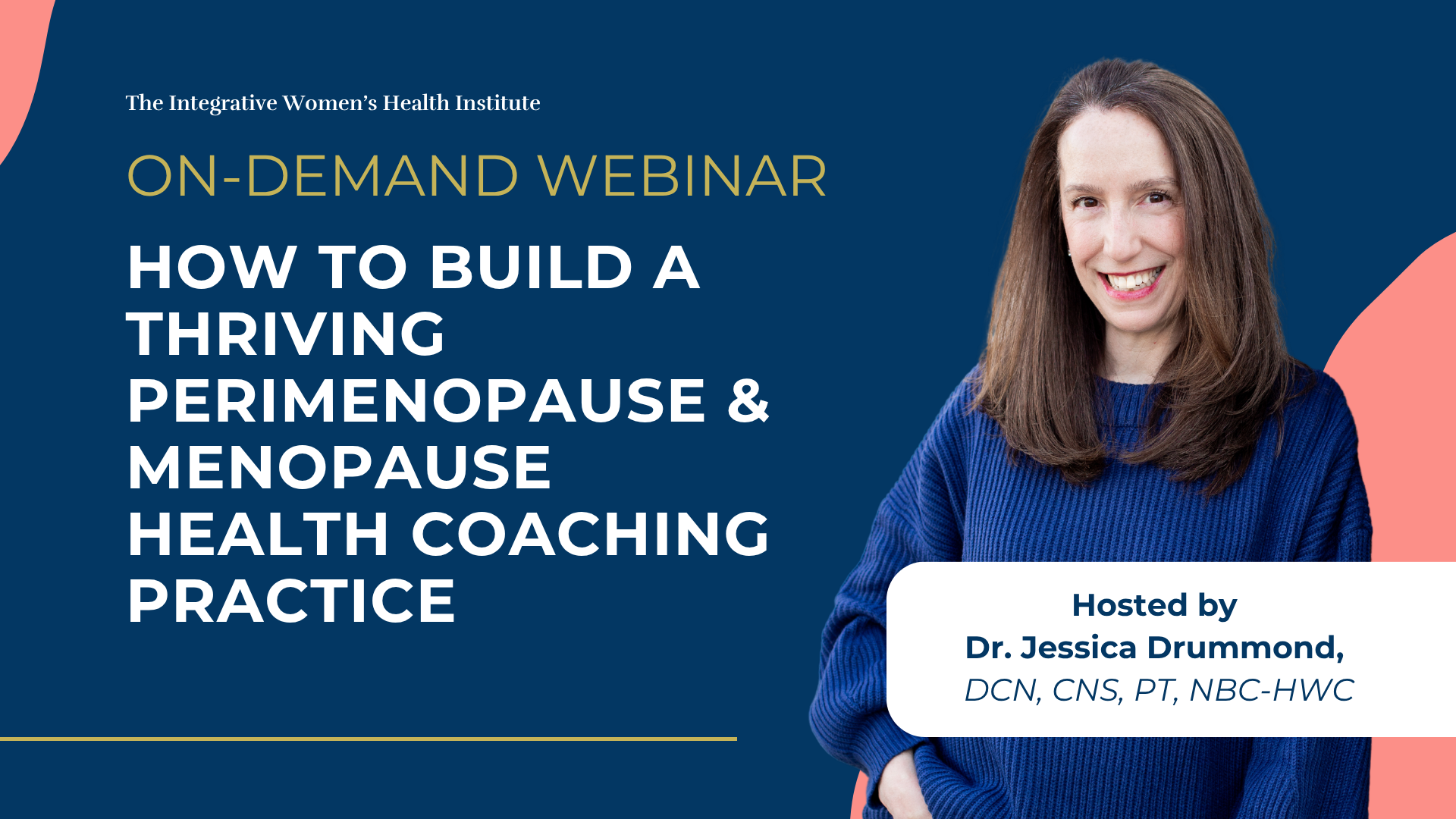
Join Dr. Jessica Drummond to learn proven strategies to confidently address perimenopause, menopause, and chronic conditions while growing a profitable and impactful practice.
Discover proven strategies to attract high-value clients, deliver transformational results, and position yourself as a sought-after expert in this rapidly growing field.

Dr. Jessica Drummond
Founder & CEO
The Integrative Women’s Health Institute
At the Integrative Women’s Health Institute, we’ve dedicated 17 years to crafting evidence-driven, cutting-edge programs that empower practitioners like you to address the complexities of women’s health.
Dr. Jessica Drummond’s unique approach focuses on functional nutrition, lifestyle medicine, movement therapies, nervous system dysregulation, trauma, and mindset – essential elements often overlooked in traditional health education.
In addition, your training will be fully evidence based, personalized, and nuanced (this is not a cookie cutter approach) in functional nutrition, exercise, recovery, cellular health, and all other lifestyle medicine tools.
You’ll learn to support your clients with cutting edge tools safely and effectively.