Follow Us for Free:


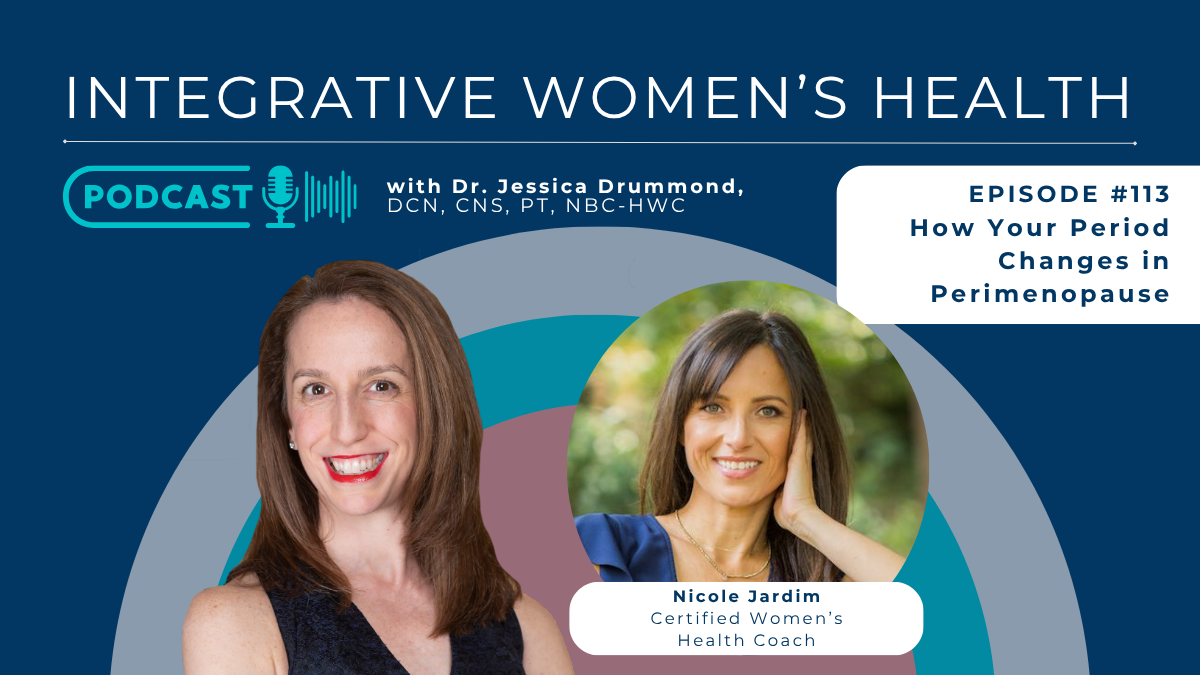
About the episode
“You don’t need to white-knuckle your way through this perimenopause transition.” – Nicole Jardim
How do you know if your period symptoms are being caused by perimenopause? For most of us, finding that clarity is challenging because by our 40s we’re juggling careers, kids, ageing parents, relationship changes, and years of accumulated stress – all of which can affect the menstrual cycle. So when periods start to change, it isn’t obvious whether you’re looking at a life-stage transition, a response to stress, or something that deserves a closer look.
When women understand what a healthy cycle has looked like for them over time, they have a much better starting point for recognizing what’s changing and why. That’s one of the main reasons I’ve always believed that menstrual health is the foundation of perimenopause care. That doesn’t mean every change is a problem to fix. Perimenopause is a normal transition, but learning to distinguish between expected hormonal shifts and red flags can help women get the right support much sooner.
In today’s episode, I’m joined by my longtime friend and colleague Nicole Jardim, women’s health coach and author of Fix Your Period, to talk about how menstrual cycles evolve during perimenopause and what those changes can teach us. We explore why both heavy and very light periods can be normal parts of the transition, how stress and perimenopause can produce similar symptoms for very different reasons, what cycle tracking looks like when hormones become less predictable, the red flags that should never be brushed off, fertility awareness, hormone monitoring, why understanding your own normal is one of the most valuable tools women can bring into midlife, and more.
Enjoy the episode, and let’s innovate and integrate together!
Highlights
- How to tell whether period changes to your period are caused by perimenopause or other health conditions
- Why the body’s ability to recover from stress changes during your 40s
- The conversation around delaying menopause, healthy aging, and embracing this stage of life
- How high stress in your 30s can mimic early perimenopause symptoms
- Why heavy periods become more common during perimenopause
- What lighter, shorter, or skipped periods can reveal about the menopause transition
- Why tracking your menstrual cycle becomes even more valuable during your 40s
- How cervical fluid, ovulation patterns, and fertility tracking tools can provide insight into hormonal changes
- The menstrual symptoms that should never be dismissed as “just perimenopause”
- How to advocate for yourself and find the right healthcare support
Learn more about Nicole Jardim
- Nicole Jardim’s Website | NicoleJardim.com
- Nicole Jardim’s Membership | The Fix Your Period Collective
- Nicole Jardim’s Practitioner Program | Institute for Menstrual Health
- Nicole Jardim on Instagram @nicolemjardim
- Nicole Jardim on Facebook
About Nicole Jardim
Nicole Jardim is a Certified Women’s Health Coach and Author of Fix Your Period: 6 Weeks to Banish Bloating, Conquer Cramps, Manage Moodiness, and Ignite Lasting Hormone Balance, a life-changing step-by-step natural protocol to ignite lasting hormone balance and improve everything from PMS, period pain, and heavy periods to irregular and missing periods. She has developed education and offerings that empower women to reclaim their hormone health using a method that combines evidence-based information with simplicity and sass.
Her work has impacted the lives of tens of thousands of people around the world by addressing the root cause of what’s really going on in their bodies and minds rather than treating just their symptoms. She passionately believes that the fundamentals of healing any hormone imbalance lie in an approach that addresses the unique physiology of every woman. This is essential to reclaiming and maintaining optimal health and vitality at any age.
Nicole is the creator of the Fix Your Period Collective, a first-of-its-kind membership experience that will give you a clear roadmap to achieving better periods. The Fix Your Period Collective is an interactive and dynamic membership platform that starts with you taking The Period Quiz. From there, you’ll receive an easy-to-implement plan to support your hormones and overhaul your menstrual cycle.
As a member, you’ll receive tailored insights and metrics based on your specific symptoms, access to Nicole’s signature course, released in stages to help you steadily improve your menstrual and hormonal health, step-by-step guides addressing specific health concerns such as heavy periods, ovarian cysts, and perimenopause, and so much more.
Nicole is the founder of the Institute for Menstrual Health, which offers training programs, mentorship and resources for an international community of women’s health practitioners and coaches. Through its signature program, the Women’s Hormone Health Certification, Nicole teaches other health practitioners and coaches the fundamentals of hormones, menstrual cycles and fertility.
Finally, Nicole is the host of The Period Party, a top-rated podcast on Apple Podcasts, the co-author of The Happy Balance, a recipe book filled with over 80 hormone-balancing recipes, and has been called on as a women’s health expert for sites such as The Guardian, Well+Good, mindbodygreen and Healthline.
Learn more about The Integrative Women’s Health Institute’s Programs
- Perimenopause and Menopause Certificate Program
- The Integrative Women’s Health Membership
- Endometriosis Certificate Program
Ready to revolutionize your career and grow your practice?
- Integrative Women’s Health Institute on Instagram | @integrativewomenshealth
- Integrative Women’s Health Institute on YouTube
Click here for a full transcript of the episode.
Dr. Jessica Drummond 00:00:03 Hi and welcome to the Integrative Women’s Health Podcast. I’m your host, Doctor Jessica Drummond, and I am so thrilled to have you here. As we dive into today’s episode, as always innovating and integrating in the world of women’s health. And just as a reminder, the content in this podcast episode is no substitute for medical advice, diagnosis, or treatment from your medical or licensed health care team. While myself and many of my guests are licensed healthcare professionals, we are not your licensed healthcare professionals, so you want to get advice on your unique circumstances. Diagnostic recommendations treatment recommendations from your home medical team. Enjoy the episode. Let’s innovate and integrate together.
Dr. Jessica Drummond 00:01:02 Hi, everybody. Welcome back to the Integrative Women’s Health Podcast. I’m your host, doctor Jessica Drummond. And I’m so excited to be here today with my dear friend Nicole Jardim. I’m going to give you her bio because she has, gosh at least 15 years maybe going on 20 years just like me in this field of integrative women’s and pelvic health. She’s a certified women’s health coach.
Dr. Jessica Drummond 00:01:27 She was certified right here at the Integrative Women’s Health Institute, and she is the author of a book that absolutely every woman and everyone who cares about a woman, every woman, all their partners, all their dads, all their brothers, all their boyfriends, all their friends, and every single woman and girl need to read this book. And we’re going to talk about why it’s the foundation of your perimenopausal Hormone shifts. If you don’t have this basic understanding and these basic foundations in place for your menstrual health, your perimenopause transition shifts in your menstrual cycle are going to feel out of nowhere. So right now, pause this podcast and go over and bi fix your period. Six weeks to banish bloating, conquer cramps, manage moodiness, and ignite lasting hormone balance a life changing, step by step natural protocol to ignite lasting hormone balance and improve everything from PMS to period pain to heavy, irregular, spotty, scant missing periods. This book is for everyone. Nicole has developed education and offerings that empower women to reclaim their hormone health, using a method that combines evidence based information with simplicity.
Dr. Jessica Drummond 00:02:50 And she’s such a great educator for someone who’s just starting at zero. Doesn’t have a lot of sciency background. She educates with simplicity and sass. A little fun, and her work has impacted tens of thousands of women and girls around the world. Just share this episode with absolutely every woman you know, even if she’s in her 20s. This is the time to get her menstrual cycles optimized so that her perimenopause transition will be much more smooth from a menstrual health perspective. But even if she is 4850 just to the tail end of her perimenopause to menopause transition. This is still important information about what these menstrual cycle changes can actually indicate in the perimenopause and menopause transition. So let’s get right into the episode and I’ll see you on the other side.
Dr. Jessica Drummond 00:03:49 Hi everybody. Welcome back to the Integrative Women’s Health Podcast. I’m so excited to be here today.
Dr. Jessica Drummond 00:03:55 With my.
Dr. Jessica Drummond 00:03:55 Dear.
Dr. Jessica Drummond 00:03:56 Friend Nicole Jardim, and we are going to talk about, you know, her in terms of as the queen of all things, period and menstrual health.
Dr. Jessica Drummond 00:04:07 And I really feel like, yeah, the six year period author I really feel like despite the fact that a lot of people with large platforms today and whatever credentials are talking about, we need ovulation. And period health is the fifth vital sign. Nicole and several of our other colleagues have been talking about that since 2010, at least. And so none of this is brand new to us. So we’re going to move the conversation a little bit more forward today. So welcome Nicole.
Nicole Jardim 00:04:42 Thank you so much for having me. And I’m just laughing, thinking about our previous conversation about endometriosis and how there are people talking about how nutrition is amazing for endo. And you’re like, I’ve been talking about this for 20 years.
Dr. Jessica Drummond 00:04:57 Yeah. So if you want a little depth of experience and not just the high level like, oh my gosh, that’s where we’re going to get into today. If you already know that your menstrual cycle is an important, vital sign that watching for changes in your cycle is really impactful for your health.
Dr. Jessica Drummond 00:05:13 If you learned about that a decade ago, and you want to learn a lot more in detail, that’s where we’re going to get into today. So because the conversation is so important in the world of perimenopause and menopause, how do you know? This is a really tricky question. Like how do you know as you’re transitioning into perimenopause that your period changes and maybe your late 30s or early 40s, even mid to late 40s are actually perimenopause? Or are they like stress or thyroid issues under eating burnout? We also know that divorce is most common in the 40s, that mental health stressors and just having just passed my 40s myself, you have teenagers and you’re in peak career. There’s a lot going on. How do you know your menstrual cycle changes are related specifically to perimenopause, not some of the other common things that mess up our cycles.
Nicole Jardim 00:06:11 I think that this is just so layered. You just named off ten different things that are going on in life in your 40s, not to mention things like aging parents.
Nicole Jardim 00:06:21 And yes, you know this. My mom recently passed away and it’s just going through. So so thank you. But just all of those processes as an adult in your 40s is so overwhelming in so many ways. And I feel like none of us are prepared for that level of adulting. And then we have to deal with period problems on top of it. Yeah. I think one of the most important things to understand is that changes in your cycle during your 40s don’t automatically mean that something is wrong per se, but obviously they shouldn’t be dismissed with a casual. It’s just perimenopause either. I think that tends to happen way too often. And so the real question is, in my experience, are these changes responsive or non-responsive? So if you think back to your 20s and your 30s, many women would notice that when they address those foundational issues, all of the things you actually just brought up, right. Things like eating enough, or eating a nutrient dense diet or stabilizing your blood sugar, reducing your stress or managing your stress better, improving sleep.
Nicole Jardim 00:07:26 Things along those lines, their cycle will respond generally in your 20s and 30s, ovulation becomes more reliable. Cervical fluid patterns start to regulate a little bit. You start to see improvement with cervical fluid changes, whereas you might not be seeing as much cervical fluid if you were having health issues, your premenstrual symptoms might calm down or dissipate completely. Your cycle length normalizes. There’s this degree of resilience and almost recoverability that you have that in your 20s and 30s that you don’t really have. Unfortunately, in your 40s, things really shift. And I feel like that’s because our ovaries are just becoming less responsive and they’re less predictable when you’re doing all the quote unquote right things. So I think if someone is cleaning up their nutrition and they’re handling all of those things I just talked about and ovulation is drifting later and later, or it’s disappearing completely, you’re becoming an ovulatory or symptoms with your cycle are just not improving. I think that’s a really strong clue that you’re in that perimenopausal transition.
Dr. Jessica Drummond 00:08:29 I love that because in a sense, when you do that, you put these foundational supports into place anyway, which is going to help you no matter how old you are, looking at your nutrition, looking at the basics of sleep hygiene, looking at movement and day and light exposure, and having things like your thyroid tested fully.
Dr. Jessica Drummond 00:08:52 That is a part of what you would do anyway to start improving your menstrual health, whether you’re in perimenopause officially or not. And then you can see, okay, so if you’re not in perimenopause, a lot of times putting that checklist into place, everything will start to improve. You’ll start to see things improving. With perimenopause, you may start to see things improve, but they’re going to hit a wall of how consistently it’s able to improve. And that’s one of the reasons why I think people should get your book and others like it, to actually understand how to track your cycles and your ovulation. You can also use tools like the mirror or things like that. Learn your cervical fluid, learn signs of ovulation because then you can actually see are you in perimenopause, which by definition you’re actually skipping some ovulatory cycles. The levels of hormones are actually changing, even if you put that lifestyle into place.
Nicole Jardim 00:09:57 Totally. I was thinking that to, as you were saying, that it’s not that lifestyle stops mattering.
Nicole Jardim 00:10:03 It matters enormously during this time. But just as we were discussing, it may no longer restore that level of cycle consistency that you once might have experienced if you have been doing those kinds of things consistently. And I kind of feel like it’s really important for us to hold almost two truths at once, in that we want to support the foundations and recognize when this pattern suggests this deeper life stage transition that isn’t necessarily fixable. It’s just something that’s shifting and changing. And so I feel like we have to hold those two things at the same time for the most part.
Dr. Jessica Drummond 00:10:39 Yeah. And if we do all the things that are going to optimize our hormonal and menstrual health earlier in our lives, it’ll still help smooth the perimenopause to menopause transition. It just obviously isn’t going to stop it. At some point you will go into menopause if you live long enough.
Multiple Speakers 00:10:58 Are we going to say really quickly too? I’ve been asked that often. Oh, can I stop this? Can I stop this perimenopause thing from happening? Is it.
Nicole Jardim 00:11:06 Possible to.
Multiple Speakers 00:11:06 Delay or.
Nicole Jardim 00:11:08 Stop.
Multiple Speakers 00:11:08 Menopause?
Nicole Jardim 00:11:09 And I feel like it. That’s almost. It reminds me so much of the fact that we pathologies, so many women’s health issues, our bodies are just so mythologized. And so as a result, I think that this is another pathology, another thing happening to us that we can fix or stop. And I would love for you to talk about that too, because I feel as though this is an inevitable process that we all go through. And yet when we I think just existing in this environment that we live in currently, this very hyper focus on anti-aging and not getting older. And body is not changing. Face is.
Multiple Speakers 00:11:45 Not changing.
Nicole Jardim 00:11:46 That. We also prescribe this to our menstrual cycles and our biology too.
Dr. Jessica Drummond 00:11:51 I think that’s a really important nuance. So I do think and we do don’t really have any research on this yet, but I do think it may be possible to delay menopause. There is some evidence that the healthier people are menopause starts.
Nicole Jardim 00:12:10 A.
Dr. Jessica Drummond 00:12:10 Little bit later, like a couple months to a year. Delayed puberty or not, early puberty is a sign of health, but of course there is a normal range and some of that is is genetically predetermined. Most likely some of it may be epigenetic predetermined, some of it may be environmental exposures that we don’t have a heck of a lot of control over in our current environment that’s full of things like air pollution and microplastics and many environmental chemicals that are hormone disruptors. But the reality is, and so there may be some quote unquote, longevity or even health advantage to somewhat of a delay of menopause. So you have your own normal hormones cycling longer, but we don’t have the science to not go into menopause or even delay it significantly outside the normal range. Maybe it’s 52 instead of 51, but it’s not going to be 60. In most cases, there are certainly some women who are still perimenopausal at 60, but that’s pretty rare. Everything’s on a curve, right? And there are people that are outliers of those curves.
Dr. Jessica Drummond 00:13:26 But I do think it’s we have to be really careful around this conversation of anti-aging. And I think longevity medicine is just rebranded thinness and anti-aging. The number of people I know in the kind of or know of in the world of longevity that have had a lot of cosmetic surgery and things that make externally they have this youthful appearance or are utilizing lots of tools for thinness. I think that’s a dangerous conversation because it I actually am all for people doing whatever they want. But I also think when we equate never aging with healthier, that’s not always the case. We are humans. We are animals. We are going to age. We are going to go through menopause. And while we can keep ourselves healthier in that stage, I’m actually think we can embrace the benefits of menopause as well. What do you think?
Nicole Jardim 00:14:28 Oh, absolutely. I think that there’s a clear Delineation between these different stages of the life cycle. And I think one of the biggest issues, though, is that we’ve been conditioned to believe that youth and youthfulness is the optimal for all women.
Nicole Jardim 00:14:46 And in fact, there is so much wisdom and there’s so much to gain from being on the other side of having that the consistent menstrual cycle and all the things that come with that, I don’t know. It’s so difficult and it’s so layered, as you know. And I know this is totally what we were going to talk about on this podcast episode, but I do really think that there’s something to that, because on the flip side of this, I also have women who are 33, 34, 35 telling me that they’re going into perimenopause and I’m like, no, girl, you are not. Let’s like, let’s look at what’s happening in your life and talk about exactly what I was just saying earlier, with the hormonal resilience and the fact that you can make some changes and you will likely see big, big improvements in your menstrual cycle and the symptoms that you’re experiencing. So you will see that response much more than someone who might be 45 at this point. So I always say that to let’s not use perimenopause as this catchall phrase for all of us, because I feel like that’s the other thing that happens too, is that something becomes popular in our culture, and then suddenly everyone wants to go on HRT and is in perimenopause.
Dr. Jessica Drummond 00:16:01 So I don’t.
Nicole Jardim 00:16:01 Know if you’ve seen that, but that’s another thing that’s showing up a lot.
Dr. Jessica Drummond 00:16:04 I haven’t seen that as much, but I can see how that could be an issue that someone with menstrual challenges, or even the symptoms of perimenopause, are essentially expressing those really early, like late 20s, early 30s because of premature ovarian insufficiency. Or sometimes it’s going. It’s to be expected because let’s say someone had cancer or someone had endometriosis, or someone had a hysterectomy, or someone had a surgery that impacted the ovaries. For some reason, not everyone with endometriosis will go into menopause early. So I don’t want to scare anybody. But there are like traumas, if you will, to our ovary health that could put someone into an early perimenopause state. But generally speaking, if you have fully functioning ovaries, you don’t. You haven’t had surgery, you don’t have cancer. If you’re experiencing the symptoms of perimenopause in your very early 30s or even up to even 35, I start, I think no matter what, it’s this range, right? So if you put into place a lot of the lifestyle stuff that you talk about in your book, even in the late 30s, even in the early 40s, a lot of the issues.
Dr. Jessica Drummond 00:17:22 And of course it’s easier the younger you are, will improve without needing hormone therapies that early.
Nicole Jardim 00:17:31 Yeah, totally. I completely agree with that. And I am so glad you mentioned all of the nuances of what can potentially be influencing a cycle, because I completely agree with that. I’ve just noticed this trend almost across the board now, and and I’ve had many conversations with women. And actually I feel as though it’s hopeful because I’m saying to them, you’re not on this trajectory necessarily, and you have so much more control than you think you do. And I think that is so important in the work that we do. We’re giving women back their power and reminding them that they actually do have a lot of control over the symptoms that they’re experiencing.
Dr. Jessica Drummond 00:18:08 Yeah. And I do think that the lifestyle of women today in their 30s, if I think about myself ten, 15 years ago, 20, just a couple of years ago, when I was in my early 30s, I had two little kids. I was running a business.
Dr. Jessica Drummond 00:18:28 I was working out heavily. I had low estrogen, particularly during times of postpartum. I definitely had postpartum hot flashes, night sweats, all of that. And I so I think that’s actually a valuable conversation, that nuance that we didn’t really talk about because the level of stress in your 30s and the fact that we have no maternity leave in our country and very little financial support for pregnant and postpartum women and our health care costs are very high. There’s a lot of pressure in your 30s. And it’s also when you very often if you’re going to have children, you have young children, which is super busy and sleep depriving. And so I could imagine that if if I knew absolutely everything, I knew now that if I were in my 32 year old body, let’s say, when I actually did struggle with a miscarriage. And I had a like a four year old or a three year old at the time. If I had tested my estrogen, it was probably low. And it’s not to say that I would have.
Dr. Jessica Drummond 00:19:36 Knowing what I know now. Added topical estrogen patch, I would have looked at my life and see how I could better nourish myself, which is what I did anyway. At that time, knowing everything I you know, I did know a lot then. I was already doing a lot of this work. And so I think everything you teach in your book applied to a woman who’s either postpartum or in the middle of having kids or has young kids, or just has a really busy job, maybe no children at all, but might be traveling across time zones multiple times a week, or in the midst of a divorce, or is caring for aging parents. That level of stress can put you in a hormone state. that’s very similar to perimenopause. The difference is you can get out of it without needing supplemental hormones. That makes sense.
Nicole Jardim 00:20:31 Totally. Yeah. No, I think that’s it. That that’s. You hit it on the head. Yeah.
Dr. Jessica Drummond 00:20:36 Excellent. So let’s talk about some nitty gritty of your period.
Dr. Jessica Drummond 00:20:40 So let’s say you’ve never before had like flooding Claudy heavy periods. But again now you’re in your mid 40s and I’ll never forget a story my mom told me. I asked her once, what when did you go into menopause? Because there’s a little bit of a correlation. I was trying to figure out if I was going into menopause. Like how old should I expect? And she said, oh, I remember it like it was yesterday. I was at my dad’s or her in-laws. Like, I don’t know, 60th wedding anniversary party. She got up and bled like a huge rush in the middle of this party, and she was just like, we gotta go. And she’s. I grabbed her dad and I was like, we’re leaving this party right now.
Nicole Jardim 00:21:25 Horrible. Horrifying.
Dr. Jessica Drummond 00:21:26 I hope she doesn’t mind sharing that story, but I’m sure it’s very common. Too late now, mom. Sorry, mom. Yeah, so talk about that. I think it’s not uncommon. And. No, no one now would know what to do either.
Nicole Jardim 00:21:37 No kidding. I agree completely, and I think for women who generally aren’t really tracking their cycles, which I would say is the vast majority of women, we need to work on that, ladies, but they really do struggle with this. I think, though, I did want to say, I think one of the biggest misconceptions about perimenopause is that there’s one type of period change, but in reality, women can experience the opposite ends of the spectrum. Really, some develop these heavy flooding Claudy prolonged periods like what you just described, while others might notice periods that become lighter and lighter, and then they shorten and sometimes they just they almost disappear. I feel like Both of these patterns happen in that same transition, because obviously the deeper issue is that hormonal variability, the changing ovarian hormone output is basically what’s driving so much of that. And so for anyone who doesn’t really understand, basically ovulation is changing. Your follicular function is changing, the consistency of your hormone production across the cycle is changing dramatically. And so when we think about earlier in our reproductive life, what we’ve just been talking about with women in their 20s and 30s, you have these developing follicles, they produce a much stronger, more coordinated rise in estradiol in that first half of your cycle.
Nicole Jardim 00:23:00 So in that follicular phase, that, of course, helps to prepare that brain ovary signaling that we then need to have happen for the LH surge. So that’s luteinizing hormone. And that triggers ovulation. And so then we have Ovulation happening and then that follicle is healthy generally. And so it’s producing this lovely progesterone and it’s producing it consistently and reliably. Of course in perimenopause the whole dance routine is all messed up. The choreography is screwed. So it becomes a lot less predictable. And so what I think is important for women to understand is those follicles that were healthier back in your 20s and 30s. And again, this kind of speaks to what you said, too, about how there are outliers. Some women get go into puberty later and may end up in menopause later. The health of your over your overall health generally may influence that to some degree too. But for the most part, for us in our 40s, that those follicles are less responsive to the brain hormones that are trying to stimulate them to do what they need to do, which is produce estradiol in that first half of the cycle and then progesterone.
Nicole Jardim 00:24:09 So we see this erratic estradiol production and this pre ovulatory rise of estrogen is not very consistent in fact. I like you I see this on the mirror a lot now in my own cycle and then also with clients as well. And so it’s fascinating to be able to actually track so many cycles with the mirror device in a much easier way, and we get to really see clearly what’s happening. And so then of course, ovulation may be delayed or it may skip, and then that luteal progesterone output may be lower. And it’s obviously going to show up in this way. So we might see these different bleeding patterns. So we might see that progesterone now is weaker. So we are not regulated or our bodies are not regulating that endometrial growth as well as they used to because estrogen is that builder hormone. Progesterone basically smooths things out. It doesn’t quite or it basically checks estrogen really. And so we have that happening. So we’ve got this estrogen happening. And then we’ve got lower progesterone. And not necessarily that we have higher estrogen.
Nicole Jardim 00:25:14 Like we just have fluctuations that we didn’t quite have before because the ovary is responding erratically to the brain. And so then we have this heavier bleeding. We have your mom getting up from the chair at third party, and all of a sudden she’s like, I got to get out of here immediately. And like, I have a friend who recently, she’s in her early 40s now and she never had any issues with her period at all. And all of a sudden she’s noticing spotting for 2 or 3, four days before her period. So that’s something that she had never seen before. So of course I have her using the mirror because I want to see is that progesterone just dropping prematurely now? And that’s something that I think comes up so often as well too. And we see this in 20s and 30s as well with low progesterone. But if you’ve never really noticed it before now and now you’re seeing it, that could certainly be that your progesterone isn’t quite getting to where it needs to be. And then you get stuck with these, the spotting or the long drawn out periods or the flooding patterns.
Nicole Jardim 00:26:09 So yeah. Fun times.
Dr. Jessica Drummond 00:26:12 So fun. And by the way, for any of you who are not familiar with the Mira device, I’ll stick a link for that in the show notes. You can explore it, but essentially it’s it measures hormone metabolites in the urine, just like an ovulation stick. It measures more hormones than just the ovulation stick, but you can do it every single day of the cycle to see a pattern. And I think what’s so interesting about those patterns in perimenopause is they’re not patterns. They’re really a big mess. And they’re different from month to month. And so the next question is, okay, what if you’re bleeding? So if you’re bleeding is very heavy cloudy, it’s probably that your estrogen is relatively higher compared to lower progesterone because you didn’t have a complete follicle growth, fully complete its growth cycle and then trigger a huge progesterone surge. So you really just have a lot more relative estrogen than progesterone during that cycle, more uterine lining growth and so heavier period. And then on the flip side, describe the hormone shift.
Dr. Jessica Drummond 00:27:21 If someone is on the lighter hormone or lighter bleeding side.
Nicole Jardim 00:27:27 Oh yeah I know that’s me. So this has been my life for a number of years now. And so what I find fascinating is that, like I said, there’s this misconception, right, that we all just have these heavy flooding periods and we’re just drowning in perimenopause, but or at least in the earlier stages. But what I saw with myself and what I have my sister as well, I’m going to mention her name too, because she has also had a very similar pattern to me. And then so many other women in my community. Is these lighter periods. So your period is just getting progressively lighter, or you’re skipping a period or you’re noticing ovulation is becoming more and more delayed and it’s just or it’s skipping completely and you’re like, wait, I’m not having any heavy bleeding. But everybody’s told me that I was supposed to have all this heavy bleeding. And I think that so many women will just think, oh, this is great.
Nicole Jardim 00:28:21 I don’t have to worry about it. I have less inconvenience and less mess. And this is wonderful. But obviously, from a physiological perspective, this is a really important signal that ovarian hormone production is definitely changing. So I would say if anyone used to have a 3 to 5 day period or a 4 to 5 day period, and it’s becoming progressively lighter or scanty, or it’s just taper tapering off quickly or it’s arriving further apart, that that’s pretty significant. And so that’s another sign to that that things are changing. So that follicular function is changing. That ovarian reserve is declining. Those follicles are becoming less responsive. So it’s it’s similar to what’s happening with you. If you have a heavy period. You’re just having a slightly different hormonal pattern emerge. And so I feel like you’re just not having that robust estradiol rise at all. Your estrogen is really reduced, that output is reduced. And so your uterine lining is just not building as fully. And then this translates generally into a lighter bleed. And and then of course like if ovulation skips then you might just completely skip a period.
Nicole Jardim 00:29:30 So that was what was starting to happen to me. I’d always had these really consistent periods. I tracked probably since my mid 20s and tracked my basal temperature. My cervical fluid changes all of it, and then all of a sudden I was just I it was like day 20 and I had an ovulating. And I just thought, wait, what is happening right now? So a lot of women start to think, oh no, am I pregnant? And this is where I think that we’ll talk about cycle tracking for sure. But I think that this is where that knowledge comes in, because it will save you a lot of pain and anguish and suffering. So yeah, that that is something. And then I think two of the other thing is that something that I’ve seen as well is the follicular recruitment. So those follicles are being recruited in your little ovary and it can speed up. And it actually can make you ovulate even sooner because there is because again, the inconsistent conversation between the brain and the ovary that’s happening.
Nicole Jardim 00:30:24 So you may ovulate even sooner and then you might have these really shortened cycles, but you still might have a light period. So that’s another pattern that I’ve seen as well too.
Dr. Jessica Drummond 00:30:32 So let’s talk specifically about cycle tracking in your 40s. Now obviously it’s ideal if you had been tracking earlier. So you know what’s common for you. What’s consistency look like for you. And if you guys want to go back I just interviewed a few episodes ago, Tony Wexler’s niece who runs cycles. So Tony Weschler is like the grandmother, if you will. I don’t know if she wants to be called that. Let’s say the mother of cycle tracking and just knowing Understanding your own body and in your book talks a lot about cycle tracking. If people haven’t started and now they’re 42, 45 and they’re either having flooding periods or they’re skipping periods and they’re stressed out that they’re pregnant every month, where should they begin? I know right? I will say.
Nicole Jardim 00:31:23 That if you have been tracking, keep tracking because that’s a good idea, although it does change quite dramatically.
Nicole Jardim 00:31:30 It’s like I was saying in your 20s and 30s tracking feels so straightforward generally once you get the hang of it, because the patterns are just so repeatable. I felt like I tracked, like I said, from my mid 20s into my early 40s, and then things just got crazy. So I will say that I slowed down on the basal temperature tracking and the cervical fluid changes because it changed so dramatically. Generally up until your early 40s for the most part, and some women even longer. It just again, depends like we were saying, you’ll see a pretty consistent cervical fluid pattern where you see that change starting somewhere in early to mid follicular phase. And then the cervical fluid becomes consistently more wet and eventually egg white watery. Something like that to indicate ovulation is happening. And then it will change to a more sticky or tacky texture, or disappear after ovulation happens and progesterone takes over. And so I always saw that you have this familiar progression. And then the temperatures rise as well after ovulation happens. So again that’s very predictable.
Nicole Jardim 00:32:31 So you know, like I always knew when ovulation was about to happen. And then when it had happened with the temperature change and the cervical fluid changes. But all of a sudden in my 40s I felt very unsettled because I this sort of map that I had for so long. And I think this is very much the same for so many women, is that you’ve relied on this thing for so long and it stops looking the same, so your cervical fluid may become less obvious and harder to chart or track more intermittent. In a way, that’s what was happening to me. It would show up in in clusters, multiple waves, and then all of a sudden I wouldn’t see it again. I just thought, okay, wait, I was on track, I know I was on track, and so then ovulation two might shift or because I was ovulating somewhere between days 13 and 15 or 16. And then all of a sudden, like I said, ovulation just started moving out later and later. And then there was one cycle randomly where it was like day nine or something like that.
Nicole Jardim 00:33:25 And I’ve had clients get pregnant accidentally because they’ve ovulating so early in their cycle, and they just weren’t expecting that. So I feel like all of that, with all of that said, what I would say to women is that just think about something like the Mirror, and I found it to be such a game changer. I know you just described it, so we don’t need an education lesson on that, but what I found is that you can now, or I can now see clearly what is happening with my hormones starting from day 3 or 4 of my cycle. Whereas before I never really needed any of that because my body signals and symptoms were there and really obvious and very clear. But now, because everything is a little bit less obvious now, I can see what’s happening with my estradiol. I can see if ovulation is potentially on the way because you can see your LH. So I think something like that is tremendously helpful, but also to paying attention to what what other symptoms you’re experiencing too. Because that’s the other thing that all of a sudden we’re having symptoms we never experienced before.
Nicole Jardim 00:34:31 And that’s something I know you’ve covered extensively, but I feel the things that we don’t even think are related to our period, our sleep and our libido and our energy and our headaches and our mood and all of it. So that, I think, is something that we really want to be paying attention to, as well as the bleeding patterns, which we’ve just covered, because that could indicate something much more. And so we really want to try and create a fuller picture of how our hormones are functioning now versus what they were doing maybe 5 or 10 years ago.
Dr. Jessica Drummond 00:35:02 Yeah. And that is another reason that I do like the mirror tracking and the fact that it’s daily over time, especially in perimenopause, because for people that do have maybe something like new onset migraines or really inconsistent like intrusive thoughts, like they feel perfectly normal some days and mental mood stability feels really inconsistent other days or brain fog is, I think, another early indicator that we’ve talked about on other episodes, especially if these symptoms feel random, it can be helpful to track because then you can see, oh, they tend to only happen on very low estrogen days or very high progesterone days, or vice versa, or both.
Dr. Jessica Drummond 00:35:50 Or when I’m having an LH surge, which is at the totally wrong time than what it used to be. And I think that’s so helpful because it makes I think women in perimenopause do feel like really unsettled by the fact that especially if they had a condition that was mentally related, but they had good control over it for many years, they knew when the symptoms might flare. They had some strategies around that. And now it’s like it could be any time it’s it feels like it’s hard to plan your life. Totally.
Nicole Jardim 00:36:23 It really does. I it is so untethered and really does feel that way. And I think that when you’re using something like the mirror or anything really, we both use and love the mirror. But there’s, there’s.
Dr. Jessica Drummond 00:36:35 Another.
Nicole Jardim 00:36:35 One called Anita, and there’s even a product called a keg, which you can use vaginal and that’ll track your cervical fluid, which again, if you don’t see it as obviously anymore outside of you, it can certainly help by tracking internally. And so if you can have that, it makes these invisible hormone changes visible to us now and again, reorient us to this new way of tracking our cycles and understanding what our bodies are doing now, because it is definitely in flux for sure.
Nicole Jardim 00:37:04 Yeah, yeah, I.
Dr. Jessica Drummond 00:37:05 Know, and it’s nice to see because then you’re just like, okay, now it makes sense.
Nicole Jardim 00:37:10 Yes. Yeah, totally. I like what you said too about the symptoms that show up because that’s something too, right? I feel in your for a lot of women say this in my 40s, suddenly I feel like I have endometriosis. I have this pelvic pain I never had before. And so like you said, about things being under control that now suddenly are showing up that are that and everything’s feels a little out of control. I think that’s something to speak about and to be thinking about too.
Dr. Jessica Drummond 00:37:37 Yeah, that’s the whole reason we built our perimenopause and menopause training program for professionals, because 87% of women in perimenopause also have some other chronic illness that they either had pre-existing or was actually triggered by the vulnerabilities of the perimenopausal stage. Perimenopause is a risk factor for some of these conditions, and so it might be brand new, it might be unmasked, it might be an exacerbation of something you had before.
Dr. Jessica Drummond 00:38:10 And so we do have to tease that out. So that brings me to the last question I wanted to ask you, especially from a menstrual health perspective, are there any real red flag symptoms that you want to make sure you’re not just, oh, it’s just hormones and ignore it.
Nicole Jardim 00:38:27 Girl. I think that this is this really circles back to what we were talking about in the beginning, right? Which is that when we were talking about endometriosis diagnosis, for instance, and what’s happening now and the fact that it’s still the same as it’s always been you asking for an MRI and not and that not being offered immediately as a way to at least start exploring about what’s what might be happening. And I think that really comes back to what we’ve been huge proponents of for so long, which is that you have to be a fierce advocate for yourself, and no one’s coming to save you. I’m sorry. I wish we were all being saved, but that’s not happening. And so I feel like we need to be real about the fact that there are some major red flags that are going to be perpetually normalized in a conventional medical setting.
Nicole Jardim 00:39:12 For the most part, not everyone, but it does happen so often that I feel like it’s pretty common, and one of them is bleeding through pads or tampons on an hourly basis. I feel like that’s a big one, and that’s something that I talk about throughout your life. You don’t want to be doing that even though it is so common. Women always say to me when I share my charts of what’s a normal, what’s normal blood loss? They immediately in the comments I always have at least five people say, is that for a whole period and not just a day? Women are shocked by that. So things like that large clots regularly. If your period blood is clotted and clumpy and is not flowing. That’s another sign that we want to be paying attention to. And I think you want to really look at it as a whole, not just, okay, if you have clots, that’s not a huge deal and everything else is fine. But you’re looking at this as a collective of issues, I think bleeding longer than 7 to 8 days as well.
Nicole Jardim 00:40:07 I’ve had women tell me I have a 12 day period. Is that normal? And and they’re commenting on a post where I say 3 to 5 days is the ideal. I’m like, no, it’s not normal. And but they’ve been told for so long that it is and they can’t really wrap their heads around that. It isn’t, I would say bleeding between your periods. So spotting before your period, spotting for multiple days after your period even, or maybe even heavy spotting at ovulation, a little spotting and ovulation is okay, but not too much. Or somewhere in between. Pelvic pain that’s come out of nowhere. That’s not happening a little bit at your period because I think a little bit of period pain is not a huge sign if it’s just one thing. Again, that’s happening. And I think to like severe pain, like we said. Right. So that that seems to show up often maybe like dizziness, fatigue, shortness of breath. Like when you get your period, if that’s happening in combination with a really heavy period.
Nicole Jardim 00:41:00 That to me is also a sign that something’s going on. And I know you mentioned migraines as well. That just show up. So yeah, those and then post menopausal bleeding I think is another one too. If I’m thinking about bleeding that we absolutely have to look into. So some of those things are what really comes to mind.
Dr. Jessica Drummond 00:41:16 Yeah I think that’s really important because the signs of reproductive cancers are very vague. So if you have new onset digestive issues, that’s a really common sign of ovarian cancer. If you have bleeding postmenopausal, that’s a common sign of uterine cancer. So I think keeping some of those things in mind is really important, particularly. And even we have an increased risk for women, particularly in their 30s and 40s, of having colon cancer. And so we want to be thinking about are your bowels regular? Are you having big changes in your bowels with your cycle? Some of these more vague and earlier signs, if we investigate them more quickly. All of your cancer risk will be reduced.
Dr. Jessica Drummond 00:42:10 Even if you are diagnosed with cancer, it’ll be at a much earlier stage.
Nicole Jardim 00:42:14 It’s so helpful. I love that you said that because I think that we were talking about this too earlier, before we recorded. I feel like we always share the good stuff.
Dr. Jessica Drummond 00:42:24 Yeah.
Nicole Jardim 00:42:24 Sorry guys I know, sorry, ladies.
Dr. Jessica Drummond 00:42:26 It’s so.
Multiple Speakers 00:42:27 True. In a room together. We were just talking.
Nicole Jardim 00:42:29 About the fact that women delay getting care because of how barbaric some of these procedures are, and the fact that we are denied or were never even told that we can request pain medication or pain relief and just talking about basic things like what is it like a polyp removal or a certain no, not a polyp removal. Yeah, just like a cervical.
Dr. Jessica Drummond 00:42:50 You’ll generally have anesthesia for it, but for the biopsy you won’t know. That’s important.
Nicole Jardim 00:42:58 an IUD placement is terrific.
Dr. Jessica Drummond 00:43:01 Yes.
Nicole Jardim 00:43:01 So all of these very basic things. Yeah. Like the cervix. What was it? It’s like the. It’s something that I shared on Instagram.
Nicole Jardim 00:43:08 I think it was a while ago, but I feel like it’s like that little puncture. I guess it is the same thing as a biopsy.
Dr. Jessica Drummond 00:43:14 Yeah. So a cervical. That’s a cervical biopsy. So a uterine biopsy. You actually obviously have to go into the uterus. But cervical biopsy is a little puncture for people that may have HPV triggered cervical cancer. Or they’re trying to roll that out. I don’t think you get anesthesia for that at all.
Nicole Jardim 00:43:32 When I posted this thing, the amount of women talking about how horrific the experience was for them. And so this just comes back to our final point, which is that we tend to delay these things because we’ve already had a potentially traumatic experience at the doctor. And then when you have these kind of vague symptoms, it’s really challenging.
Dr. Jessica Drummond 00:43:51 And it is. Yeah, it’s.
Nicole Jardim 00:43:53 Back to really advocating for yourself.
Dr. Jessica Drummond 00:43:55 Yeah. So I think that’s really helpful when you’re thinking about you’re in your 40s, things are a bit awry. The sort of step by step is make sure you start tracking in some way, even if you weren’t before.
Dr. Jessica Drummond 00:44:10 Just so you start to get to understand how your body feels in different phases. Develop a relationship with a hands on gynecologist, nurse practitioner, or PA who you feel comfortable with and you may have to shop around. You may have to travel, but so much of gynecologic care is going online that I do think it’s really important to still establish relationships with people in person, so that if you need an actual exam and actual biopsy, you’re doing it in a place where you feel more comfortable. Your nervous system can stay regulated. You can get the pain management that you need. Have these conversations when you’re interviewing people because just because you may be no either no longer interested in having children or past that point, or you never wanted children, that we should have women’s gynecologic care. That’s not just through a telehealth, not even portal these days. It’s just like a message and you get all your prescriptions. But that’s not the entirety of gynecologic care. A pelvic PT is a really good person to have on your team, because they understand all of this and help you can help you prepare and advocate and write those questions.
Dr. Jessica Drummond 00:45:24 A menopause and perimenopause coach can help you find that person in your community, so these changes will happen. Its normal and healthy to go through menopause. That’s totally fine. We just want to do it in a way that’s healthier. And tracking your cycles and looking at the changes in your cycles, I think is so empowering because it helps you see how healthy your menopause transition is going. And then when you do actually need a little more support, whether it’s through medical hormone therapies or herbal medicine or acupuncture or manual and pelvic health therapies, we have a lot of tools, but you won’t know which to look for until you know what’s normal for you and what’s changed.
Nicole Jardim 00:46:11 This is it exactly. It’s knowing your unique biology is knowing you’re normal, and also what you said to to build and what you said. You don’t need to white knuckle this. This is not I feel like we already are conditioned to do that as women. And I feel like you don’t need to white knuckle your way through this perimenopause transition.
Nicole Jardim 00:46:29 There is actually so much help out there.
Dr. Jessica Drummond 00:46:32 Yeah, absolutely. Thanks so much for sharing your time with us today, Nicole. Everybody go read Nicole’s book, because even if you are 48 years old and just glancing at your period for the last couple of years, it’s still worth understanding this. And it’ll make your menopause transition that much better. Thank you, thank you.
Nicole Jardim 00:46:54 Thanks, Jess. Thank you for having me.
Dr. Jessica Drummond 00:47:00 I so enjoyed that conversation with my dear friend Nicole Jardim. She’s such a wealth of knowledge and has such.
Dr. Jessica Drummond 00:47:06 Deep.
Dr. Jessica Drummond 00:47:07 Experience, decades long, of really understanding the science behind menstrual health and then translating it into language that absolutely every woman and every person on the planet should know, understand and be able to take action on in her own life. It’s such an important educational role that Nicole holds because she educates literally tens of thousands. I would even say hundreds of thousands of women around the world. And her wisdom and experience really speaks to just being in this field over a prolonged period of time, seeing the shifts, seeing the trends and sticking with the science and really skillful educational communication.
Dr. Jessica Drummond 00:47:54 So follow her, get her book, All the Things and What I Really think. One thing for you to take away back to your practice this week is to help your clients understand the importance of cycle tracking, to know the length of their cycle, to know the length of their period, to know what’s normal for them in terms of heaviness of periods you know, when they’re ovulating, to know the signs, whether it’s temperature or cervical fluid or they’re going to be tracking with a tool. We talked about mirror and many other tools in this episode. Help your clients understand the importance of really utilizing ovulation and menstrual health as a vital sign of their health in general, so that when it changes in perimenopause, which is part of it, that’s normal. But how it changes and then how those changes are related to any symptoms of perimenopause will become so much easier for both you and them to tease out and get the best health care as needed, and implement the most priority lifestyle changes for that individual woman depending on what all this information tells us.
Dr. Jessica Drummond 00:49:09 But. So even if you’re working with teenage girls, women in their young 20s who aren’t in perimenopause or near perimenopause at all, or you’re working with complex cases like women who had maybe one ovary removed surgically, or has a history of cancer or endometriosis and has had surgery that has impacted her ovarian function. Even more important for these women to understand what their normal is, so that when it shifts, they’ll be able to smooth that transition, have fewer symptoms, and be healthier and healthier as they age. Thanks so much for being here with me today, and I’ll see you next week.
Dr. Jessica Drummond 00:49:52 Thank you so much for joining me today for this episode of the Integrative Women’s Health Podcast. Please share this episode with a colleague and if you loved it, hit that subscribe or follow button on your favorite podcast streaming service so that we can do even more to make this podcast better for you and your clients. Let’s innovate and integrate in the world of women’s health.
Join Dr. Jessica Drummond to learn proven strategies to confidently address perimenopause, menopause, and chronic conditions while growing a profitable and impactful practice.
Discover proven strategies to attract high-value clients, deliver transformational results, and position yourself as a sought-after expert in this rapidly growing field.

Dr. Jessica Drummond
Founder & CEO
The Integrative Women’s Health Institute
At the Integrative Women’s Health Institute, we’ve dedicated 17 years to crafting evidence-driven, cutting-edge programs that empower practitioners like you to address the complexities of women’s health.
Dr. Jessica Drummond’s unique approach focuses on functional nutrition, lifestyle medicine, movement therapies, nervous system dysregulation, trauma, and mindset – essential elements often overlooked in traditional health education.
In addition, your training will be fully evidence based, personalized, and nuanced (this is not a cookie cutter approach) in functional nutrition, exercise, recovery, cellular health, and all other lifestyle medicine tools.
You’ll learn to support your clients with cutting edge tools safely and effectively.