Follow Us for Free:


About the episode
“What a GLP-1 agonist does is teach us about our weight health hormones.” – Ashley Koff
GLP-1 medications are everywhere right now, and for many women in perimenopause, they feel like the only thing that can finally move the needle. But for practitioners, this landscape is far more nuanced. In midlife, women’s weight is tied to shifting sex hormones, gut peptide function, nutrient status, nervous system load, inflammation, and life experiences. When GLP-1s enter the picture, they can help, they can harm, and they can reveal underlying issues we might otherwise miss.
Understanding how these medications work inside the full weight ecosystem is an essential part of responsible, trauma-informed care. GLP-1s impact digestion, vagal tone, appetite signaling, bowel motility, and cardiometabolic markers, and they interact with stress physiology and immune activation in ways that can either support or destabilize clients already navigating complex chronic conditions. When practitioners rely on GLP-1s as a standalone tool, we risk overlooking the deeper patterns driving weight changes in perimenopause.
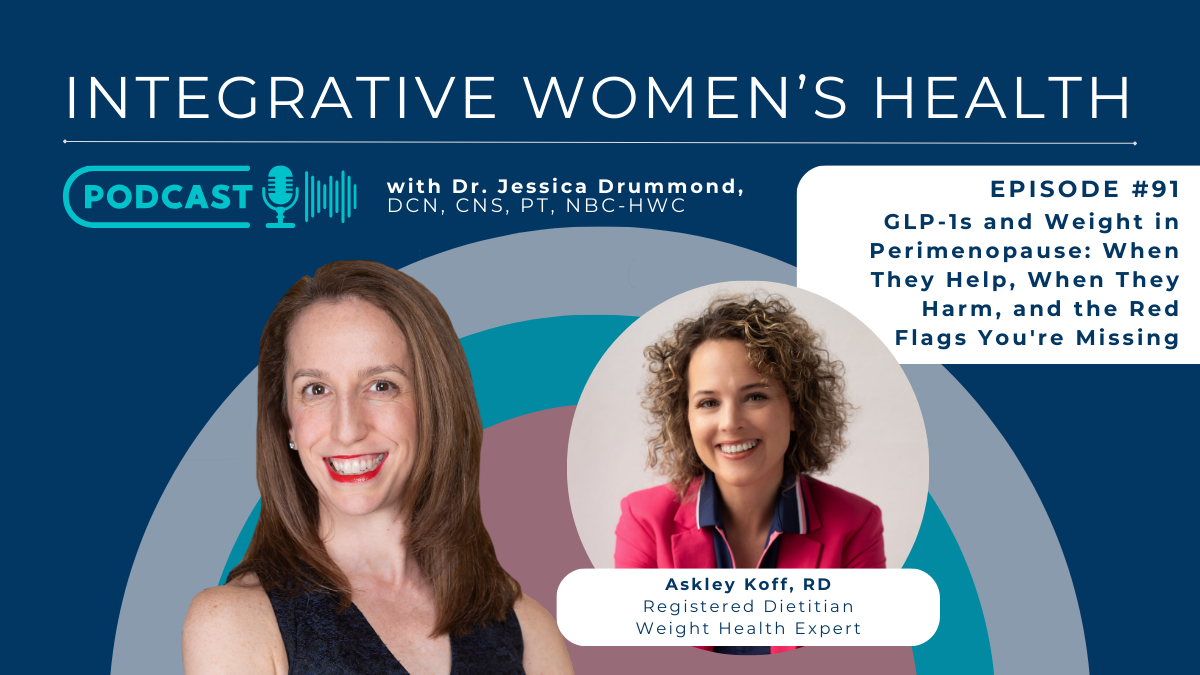
Today, I’m joined by registered dietitian Ashley Koff, author of Your Best Shot, for an evidence-informed conversation about GLP-1s in midlife. Together, we explore when these medications can support whole-body health, when they create new problems, how to evaluate your clients’ readiness, red flags that practitioners often miss, assessments to determine whether your clients’ weight health hormones are functioning as intended, low and microdosing strategies, how GLP-1s influence pain and immune activation, why a multidisciplinary approach is essential for sustainable outcomes, and more.
Enjoy the episode, and let’s innovate and integrate together!
Highlights
- Understanding weight as a whole health ecosystem, not a willpower issue
- Ashley’s journey and how generational experiences shape weight health
- The main weight-health hormones and how they influence the body
- GLP-1 medications: who they help, who they may harm, and what practitioners must screen for
- Understanding these medications’ system-wide effects as a practitioner
- Microdosing vs low-dose GLP-1 and why individualized dosing is critical
- A multifactorial framework for assessing weight-health hormone function
- Supporting long COVID, MCAS, endometriosis, autoimmune issues, and chronic pain
- How GLP-1 agonists may influence gut, immune, and receptor-level functioning
- Peptides, protein diversity, and their impact on pain and metabolic health
- Differences between short-acting and long-acting GLP-1 medications
- How to approach weaning off GLP-1s
- Examining internalized bias, ableism, and beauty standards in weight-related decisions
Connect with Ashley Koff, RD
- The Better Nutrition Program
- GLP-1 Assessment
- Ashley Koff’s Book | Your Best Shot: The Personalized System for Optimal Weight Health—GLP-1 Shot or Not
- Ashley Koff on Instagram @ashleykoffapproved
About Ashley Koff, RD
Ashley Koff, RD, is the founder of The Better Nutrition Program (BNP), the Nutrition Course Director for UC Irvine’s Susan Samueli Integrative Health Institute’s Integrative and Functional Medicine Fellowship, and a faculty member at the Integrative and Functional Nutrition Academy (IFNA), where she teaches “An Integrative and Functional Nutrition Approach to Obesity and Weight Management.” She is also the author of the upcoming book, Your Best Shot (Harper One, January 6, 2026). A practitioner for over 25 years, Koff is leading a transformative movement in personalized nutrition, turning “better, not perfect” choices into practical, sustainable strategies that deliver real health outcomes. Through patient stories and personal experience, she shows that optimal health is not just possible—it’s essential to living your fullest life. Koff has been recognized as one of CNN’s Top 100 Health Makers, featured in InStyle as “Hollywood’s Leading Dietitian,” and has been selected as Westin’s Global Nutrition Ambassador.
Ready to revolutionize your career and grow your practice?
- The Integrative Women’s Health Membership
- What is the next step in your career in women’s health and wellness? Start here: https://integrativewomenshealthinstitute.com/start-here/
- Integrative Women’s Health Institute on Instagram | @integrativewomenshealth
- Integrative Women’s Health Institute on YouTube
Learn more about The Integrative Women’s Health Institute’s Programs.
Click here for a full transcript of the episode.
Dr. Jessica Drummond 00:00:03 Hi and welcome to the Integrative Women’s Health Podcast. I’m your host, Doctor Jessica Drummond, and I am so thrilled to have you here. As we dive into today’s episode, as always innovating and integrating in the world of women’s health. And just as a reminder, the content in this podcast episode is no substitute for medical advice, diagnosis, or treatment from your medical or licensed health care team. While myself and many of my guests are licensed healthcare professionals, we are not your licensed healthcare professionals, so you want to get advice on your unique circumstances. Diagnostic recommendations treatment recommendations from your home medical team. Enjoy the episode. Let’s innovate and integrate together. Hi, and welcome back to the Integrative Women’s Health Podcast. I’m your host, Doctor Jessica Drummond, and I’m thrilled to be diving in today to one of the hottest topics in health in general, in women’s health specifically, we’re going to be talking about GLP one and GIP medications and other peptides. In fact, with registered dietitian Ashley Koff, she is the brand new author of the book Your Best Shot The Personalized Plan for Optimal Weight Health, GLP one Shot or not.
Dr. Jessica Drummond 00:01:38 And Ashley has been the founder of the Better Nutrition Program for, gosh, decades now. She and her practice keeps things simple, focusing on how better nutrition and better digestive function. If we’re thinking about this through a functional medicine lens means better health. and that’s why they are on a mission to make personalized nutrition practical and accessible for everyone. And she has a personal story around weight, health, and what that meant in her life, beginning at childhood that we’re going to talk about. And she spent over 25 years dedicated to creating resources that simplify nutrition and help people live better. She has the privilege of serving as the nutrition director for UC Irvine’s Susan Samuel Integrative and Functional Medicine Fellowship, as well. She’s been teaching, educating, working with patients and professionals for more than two decades. And we had a really nitty gritty, professional level conversation here. So dive in. Take some notes. Think of all the questions. Think of what you’re seeing in your practice. There’s a lot of clinical pearls here.
Dr. Jessica Drummond 00:02:55 And this is where the conversation Station starts. This is not us telling you. This is exactly what you need to do with your clients and patients. This is us opening the dialogue on our own biases, on new tools, on how we communicate with clients, on the world of peptides and what that means for people’s digestive function or not, and how that integrates with the immune system and the nervous system. Things we’re talking about here all the time. And get your notebook ready, get your pen ready, and I’ll see you on the other side of our conversation. Welcome back to the Integrative Women’s Health Podcast. I’m your host, Doctor Jessica Drummond, and I’m thrilled to be here with Ashley Koff. She is a registered dietitian. We’re going to be diving deep into her brand new book, Your Best Shot. And she’s going to be talking all about the intersection between nutrition, lifestyle, medicine, weight gain, weight loss, weight loss resistance, weight gain resistance, difficulty building muscle. And how? The really hot conversation around GLP ones is so important for everyone to understand.
Dr. Jessica Drummond 00:04:09 All of us health and wellness practitioners, not just prescribing practitioners because we’re all going to be working with this. So welcome.
Ashley Koff, RD 00:04:16 Ashley, thanks so much for having me.
Dr. Jessica Drummond 00:04:18 So as we think about this book and we want to think about weight as a part of health. So I think it’s older thought processes and older perspectives to see weight as like an issue of willpower. But I do think in layperson conversation, that’s still very much part of the conversation. And you’ll definitely see Instagram fitness professionals being like, you just need to cut calories and work out harder. But of course, generally that can be incorrect any time in a woman’s life, but certainly in the perimenopause transition. So how can women’s health practitioners shift their focus from things like calories or even macros, to assessing a full weight health ecosystem? And explain what you mean by that from your perspective?
Ashley Koff, RD 00:05:18 Yeah. Thank you. As a kid, if my life trajectory hadn’t changed really in my 20s, I would have been any of your patients today.
Ashley Koff, RD 00:05:25 And that really it hurts me in the idea of this really is rooted in in early development and how we really look at the body. And so shifting our perspective of how we look at the body is like, absolutely, the first place that we need to be at. And what I mean by that is I was a kid who had a belly. I was really cute until I was about age ten. And then unfortunately, like really battled being what one called a fat kid. Like, I was never I never sort of hit the threshold of obesity where someone was like, okay, here’s what we need to do. But for me, it was I tried every diet under the sun and got all of those pieces of information. And as somebody who was as really good at a lot of things, including sports, I wasn’t great at sports, you know, but I was active and in that piece, not being able to fix my belly, which was deemed a weight problem but not a health problem, really set me off on a trajectory of things that are so unhealthy that even impact things like my bone health today, and certainly impacted my digestion and definitely impacted my early menstrual cycle, you know, and these sorts of things.
Ashley Koff, RD 00:06:29 So I bring that up because one of the goals here is to create generational weight health. And when we help women today perimenopausal women really maybe for the first time ever enjoy weight health or help course correct for them. We are actually creating a generational impact, whether they’re moms at that point or whether they’re grandparents or caregivers or, you know, colleagues to other women in that space. So the first thing is to understand weight health. So the body is an ecosystem. If we go back to the old model of how we’re trained in individual systems, there is no weight system. So that’s a problem. Right. It’s like, you know, I didn’t fit into any bucket for a doctor, you know, to to see or to detect. So I think it’s really important for us to help people understand that you’re not your digestion or your cardiovascular system or you’re not your if you’re concerned about cognitive health, it’s not your nervous system separate from your digestive system. And the big moment for me, the reason I’m finally able to have this conversation outside of our very small world of integrative functional root cause, you know, lifestyle medicine is that we have a GLP one agonist and what a GLP one agonist has done because it is a biosimilar hormone replacement is it’s actually teaching people about our weight, health hormones.
Ashley Koff, RD 00:07:43 So the fact that we have GLP one, GIP pai, CCK amyloid like we can go down, you know, we were not taught as the that these were the first domino or that just how important they are. And these hormones regulate weight health. So that’s why I call them our weight health hormones. And it helps us to understand that our weight and really our weight composition, muscle, bone, fat, water as well, you know, is a key performance indicator for our overall health. So one of the things, no matter what you’re working on with someone, you know, whether somebody comes into you and says, I’m unhappy about my belly, or they come in and they’re working on their cholesterol, or they come in for long Covid, or they come in for perimenopausal symptoms, you know, brain fog, all these other things. We have to assess the function of these weight health hormones, because that is going to give us an indication of how the whole ecosystem is working. Right. And one just one example of the ecosystem is noting that our vagus nerve, so from our brain via our vagus nerve delivers messages to the gut for the release of these hormones that are then secreted.
Ashley Koff, RD 00:08:49 And some travel back up by way of the vagus nerve. Other go through the bloodstream and then they impact things like digestion, like inflammation, like blood sugar. Right. So they’re a part of all the different things that we’re seeing, side effects and challenges for in the perimenopausal women.
Dr. Jessica Drummond 00:09:05 Yeah. And I think what’s so valuable about that is we don’t generally think of weight and body composition as being related to exactly the function of the communication between the gut microbiome, the nervous system and the immune system, really, and metabolic system. It’s just sort of like it’s almost like taken separate. It’s kind of like how we’ve started to look at perimenopause. It’s like once you’re in perimenopause, we just only look at that and we don’t think about the rest of what’s going on. So that’s such a valuable way to, I think, organize our biochemical thinking around that. Your patient stories highlight that GLP one medications help some, harm some and are unnecessary for many. So let’s talk a little bit more about that.
Dr. Jessica Drummond 00:09:58 What what are some of the things we might, as health and wellness professionals be either screening for or looking for as green flags or red flags?
Ashley Koff, RD 00:10:08 Yeah. So the harm one is the easiest one to come forward. If somebody goes on a medication that is a biosimilar hormone replacement. And the dissimilarity to our own is that our own stand for 2 to 5 minutes, and these medications stay on for about 24 hours, seven days a week. And I do want to be especially for a clinical audience. I want to be clear, I’m talking about liraglutide. Semaglutide enters appetite. There’s a new version of agonists that’s coming out that are non peptide. They’re small molecule non peptide. Let’s leave those aside for a second. And because they’re not biosimilar but just acknowledging that. And so when we look at that what we basically can say is that when you do something to an exponential extent, right from 2 to 5 minutes to 24 hours, seven days a week, you are going to see an exacerbation of any underlying issues.
Ashley Koff, RD 00:11:00 And you also could see the the origin of issues if they are not addressed. So if the if the body isn’t being nourished in a way and by nourished I mean nutrition and lifestyle choices, we can see things come up. The person it’s going to harm is the person for whom is nobody’s considering that is not looking at that piece, right. So an example is if we’re delaying gastric emptying in a body that is already has a delay of gastric emptying or a delay of motility. So somebody where they’re slower motility, where they’re not moving their bowels with ease, or maybe where their hormonal shifts. Because remember when our sex hormones shift they negatively they throw off our digestive system. Right. And so when these things are happening we can see exacerbation very difficult Constipation. We can see intense hemorrhoid issues, we can see reflux, we can see more bloating and gas and like real pains and some nausea. Right? Like, you know, all of that can come on in. Another example would be in somebody where maybe they’re being told to eat more protein, and maybe they’re also on a proton pump inhibitor.
Ashley Koff, RD 00:12:03 And maybe they also have, you know, some skin issues or some inflammatory issues. And if we don’t know if their current protein intake is not being well broken down and absorbed and able to get where it’s supposed to go, and then we tell someone to significantly increase their protein intake, we may significantly exacerbate those issues. And then the final one from harm that I see a lot of that I think goes so misdiagnosed is a lot of people will complain of fatigue and the natural assumption. And this goes straight to weight bias. This is more a weight health issue and a weight health ecosystem issue. But everybody says, oh, you’re now just not eating enough, right? You’re under nourishing. And that can absolutely be the case. You could be under nourishing yourself, but more often than not. What happens is these hormones are stimulating your their metabolic stimulators, if you will. They’re telling insulin to go to work. They’re monitoring how glucagon goes to work. They’re telling leptin and ghrelin. So their activation, they’re not recovery.
Ashley Koff, RD 00:13:02 So they’re in the more of the young like than the, you know, on on that part. And so what I see in individuals is if they stay on these when they’re on these, and especially as they go to a higher dose, I usually see heart rate variability tank. I usually see that time we’re not seeing recovery. We in many of these individuals. We’re also seeing that there’s already sleep challenges. And I say these individuals like 90% of Americans aren’t sleeping well. Right.
Dr. Jessica Drummond 00:13:26 So right.
Ashley Koff, RD 00:13:27 You know, if we’re putting some, you know, an 80% or on KPIs, you know, so it’s this is not a small subset of, you know, this isn’t like a unique little thing. So where harm can happen is not having that whole system, that ecosystem, you know, approach for an individual on the flip side, where it can be so incredibly helpful. And in particular, I really like this at the lower doses. Now I call them low dose. Society is calling them microdosing.
Ashley Koff, RD 00:13:51 Typically they are the exact same thing. A true micro dose would be a microscopic amount, and that is not usually used for weight health that may be used for very strategic, inflammatory or metabolic. Usually when we’re not looking at metabolic health, they follow Doctor Tina Moore and some others, you know, work on that piece. But in the low dose space, what we can see is we can see that perhaps this is the first time that if we pretend that we have 100 receptor sites for GLP one and GIP throughout the body, perhaps this is the first time that 90 of them are getting satisfied, or even 95 are getting satisfied. So we see things like, you know, wow, the receptors in my brain that are around the food noise and the thoughts about food and maybe thoughts about other things, you know, so whether it’s in sets and thoughts of obsessive compulsive nature, you know, thinking about things, whether it’s, you know, alcohol and others. We’re seeing like a, you know, a little bit of a dulling there.
Ashley Koff, RD 00:14:46 Now for some people that dulling feels like too much. And, and that’s something we have to look at. And for others we’re also seeing. And this is eco. This explains the ecosystem that when their blood when they do better by way of their blood sugar, better messaging for insulin, better messaging for glucagon receptor sites also in the arteries and on the heart muscle that we’re seeing cardiometabolic benefit. And we’re also seeing cognitive benefits. So when in that space it’s like, wait a second. This biosimilar hormone is actually teaching us that if there is a way for us to help somebody have receptor site satisfaction, that’s the agonist part of it on a, on a more thorough basis than actually this is advantageous.
Dr. Jessica Drummond 00:15:27 And I think this is why people like pelvic TS and OTS and nutritionists and dietitians need to really understand these medications, because, you know, we might be seeing as a pelvic floor For rehab therapists like hemorrhoids or constipation or real like pushing and bad ass energetic organization, between kind of holding the breath and pushing because they’re more and more and more constipated.
Dr. Jessica Drummond 00:15:55 And the other thing I’ve also seen that sort of a negative is when people are more constipated, if they have some degree or just slow motility, which again fascia is involved. Biochemistry is involved about how well they’re chewing, what their stomach acid looks like, how well they’re secreting digestive enzymes. You know what they’re eating. So there’s all these layers of things we can help support the best benefit. Because the other thing I tend to see is when the digestive system gets slowed down, either too much or too quickly by these tools. Then we also can have tachycardia, which is related to the HRV challenge, especially in people like people with endometriosis or people with Ehlers-Danlos, or people with long Covid that have dis autonomia. And so I think we have to think about, as you’re saying, this ecosystem, the digestive system, is not separate from the autonomic nervous system, from the gut microbiome, from the nervous system in general, from the immune system. So I really love those things to look for. And then conversely, one of the things that we’ve seen that I would love to talk about in terms of quote unquote microdosing, I say the same thing like microdosing, I think is a marketing term, but low dose simply means like, you know, I think the standard pharmaceutical dose is generally 2.5mg starting.
Dr. Jessica Drummond 00:17:24 Is that true? And it’s funny, I was talking about this on a different podcast a couple of weeks ago. And in Europe it it might actually be lower. The host was saying she thought the standard dose was one milligram.
Ashley Koff, RD 00:17:35 So there’s three things I want to mention as it relates to what you were saying, So I don’t typically get into a dose conversation because what I found is from the pen to the vial to the practitioner, where someone is starting off. But what we are, there are two sides of low. There’s starting low and then staying low. And then there’s also starting at a lower than dose, you know. And one of the interesting things is also can you I can’t think of really any other medication that doesn’t consider somebody’s weight, somebody’s, you know, physiologic weight as a part of it. Right. So it’s also like kind of interesting, you know, I’m I very often will have somebody on, you know, a half of a statin or, you know, like, I mean, you know, will adjust things, you know, based on their digestion or based on, you know, things that we call out.
Ashley Koff, RD 00:18:18 So I think the dosing needs to be more personalized. I think, you know, we can agree on that. You know, I want to go back to something you were saying a moment ago, though. One of the things where for me, the rubber really met the road with this was it’s one thing to talk about weight, health and to talk about the weight, health, hormones, and it’s another to be able to actually evaluate their function, and because they only stay on for 2 to 5 minutes, I was talking to a bunch of individuals about the research and they were like, you know, actually the research is really hard because we can’t show what’s happening to your own hormones. And that includes the suppression of our own hormones when we’re on an agonist, because you’re on a higher dose. And so the body doesn’t need to make those particular. And that’s going to have a ecosystem impact for, say, k and p y you know, for the others. So one of the things that I did and it’s included in my book, it’s also free for clinicians on my website.
Ashley Koff, RD 00:19:07 So you can I do want to be very clear. This is a clinical tool. And I love where your brain went. So I wanted to just acknowledge that when I set out to assess the function of weight health hormones, I realized it had to be so multifactorial. So the first thing is, and this goes to your point about PT and trainers and dieticians and is first asking somebody about their lived experience. Now I ask questions about their lived experience with their eating. Like when do I feel full or how do I feel after meals and some of that stuff? I love how you extended it into how does your body. Tell me a little bit about how your body feels and all of these things. You know what could be driving it? But then something else that you brought up is I also include in their breathing assessment. And why do I include breathing assessment like your Boult score, your respiratory rate. So I was having a conversation with Doctor Nawaz Habib, who is one of a few vagus nerve experts that I really, you know, rely on and looks at, you know, poly vagal theory and dives deep into that.
Ashley Koff, RD 00:20:05 And he was like, you know, we actually can tell a lot about vagus nerve function in this. And so when you talk about, you know, if somebody is experiencing pain, we know that that physical pain, we know that that’s such a vagus nerve disrupter. But then also live trauma. Right. So our acute trauma and our past trauma. And then you know, a lot of that can also be birthing related trauma. Right. So afterwards the body doesn’t go back into alignment. You’re talking about, you know, working on those pieces. So I include breathing in there. Of course I include digestion, and for me, I also incorporate hydration as a part of digestion. And then we get into labs and then we get into weight composition. And so when you do a full clinical assessment like this, you’re actually able to show somebody, not just tell them, but you’re able to show them where suboptimal function of these weight health hormones is occurring. And and that helps you also focus in with them on how they can move forward with some of that optimization.
Ashley Koff, RD 00:21:02 So I just wanted to acknowledge that because as you’re, as you were sort of like looking at different parts of it, it was like ecosystem light bulbs, you know, were going off in the communication. So that’s great.
Dr. Jessica Drummond 00:21:11 Absolutely. Yes, I love that. And I think that’s why everyone on the team needs to be thinking about this as a part of the puzzle, because these medications are very popular and widespread use. And so we need to be asking about it. So going back to the subtopic of microdosing, I think generally you and I are talking about the same thing when we just start talking about a lower than one milligram per week or 2.5mg per week dose. Whether it’s through a pen or a, you know, a vial and people are self administering it. And one thing that’s very interesting, we just had published a case series from Doctor Afrin and his lab about mass cell activation syndrome. And in the context often of long Covid and using micro doses, you know, very low doses and clinically I’ve spoken we do this in our practice with the nurse practitioner who works with us, and I’ve talked to other nurse practitioners who specialize in long Covid and MCAS, somewhere between 0.1mg, 0.3mg, maybe 0.6mg.
Dr. Jessica Drummond 00:22:22 It depends on, like you said, the whole rest of it. Like, how big is this person? Do they have weight to lose? Have they always had a weight issue prior to having the mast cell activation challenge. Did they have dysautonomia as well? How delicate is their digestive system? But assuming a low dose and we do. I’m very excited because Scripps Hospital I think it’s in LA or San Diego. I’ve heard it’s San Diego. Yeah. Yeah. Is now doing a really patient driven long Covid study looking at appetite. It’s the most patient friendly study I’ve seen, which I love. And so we will have some more better RCT data soon. And I don’t know actually though if they’re using low doses or standard doses. So that would be interesting. But let’s talk about your experience, insights, anything you’ve learned from. Because the other side of the coin of what we were talking about with the red flags is what we’ve seen in our practice with long Covid MCAS. And actually even endometriosis is people sometimes go on these medications for other reasons like weight loss, and suddenly all their pain is gone.
Dr. Jessica Drummond 00:23:37 So what’s your insight to that?
Ashley Koff, RD 00:23:39 Yeah. And there’s there are some larger studies looking at rheumatoid arthritis, looking at psoriasis and looking at a reduced risk or identifying a lowering of a risk of developing an autoimmune disease. The issue that I have is a lot of these studies have then said and in people in persons who are type two diabetic and who are obese. And so one of the issues so I find super unhelpful the terminology around obesity, we may evolve. I know there’s a push to move to more of a European Union determination and not have it just be wait for height. But until we move beyond weight as the marker in obesity, I don’t think we’re really helping to much better. You know, we’re judging a tree and not the forest, you know, on the on that part. The other part is diabetes. So one of the things I talk about in my book is that an agency is is a is not such a useful number. I mean, if you’re a seven versus a five, it is helpful in that regard.
Ashley Koff, RD 00:24:32 But in the fives, we’re missing a lot of people with highly dysregulated blood sugar. And in the sevens we might be missing that somebody actually has rolling hills, but they’re up at a higher number. And we want to make sure we don’t, you know, disturb for that. What is interesting there is that we’re seeing that pain scores where there is a reduction there. And that also in addition to the pain scores, we are seeing symptomatic reduction, you know, in a larger capacity. And those studies I think what when I look at MCAS and when I look at autoimmune N of one, like maybe N of ten, like I, you know, I think these smaller studies I think provide so much more value because for so many of us, our patients don’t align in a large RCT like it just isn’t, you know, within there. So I’d acknowledge that at first. And part of that is to look at what is what are the other medication therapies. So one caution would be to make sure that you, if you are going to introduce it, that it’s the only thing that gets introduced in a time period and that you work with someone strategically on their nutrition.
Ashley Koff, RD 00:25:34 So as an example, terms like saying more fiber or more protein or more strength training, which are what if somebody is going to Google? What are the recommendations for? My medication can be really harmful, I am not. I always want somebody to optimally resource their body with fibers and with amino acids. But is the body able to take in a certain amount and to break it down, you might have a benefit where you see maybe in the first couple of days of a shot, even at a low dose, you may see benefit where not having them increase their fiber on days one and day two, but like starting at day three to increase their fiber. Now you also have to know where they are in their cycle if they have a cycle. And you also want to know if they’re getting on an airplane and flying like there’s a lot to this. This is why I think a dietitian, I mean, it should be mandated. I will just back up and say, one of the things that I think is the most misplaced and harmful about GLP one agonists is that they’re scripted by a doctor.
Ashley Koff, RD 00:26:26 I’m not arguing with how we prescribe medications in this country, but doctors should not be. They are not the ones to do wake health like they just that that is not in their wheelhouse because of the attention to detail and personalization. You know that’s required. So you can hear from that part. So this collaboration I think is really important. Here’s where I’m curious. So what I’m really curious is, is the introduction of a biosimilar hormone replacement therapy that where the dissimilarity, as we said, is such a high intensity receptor site satisfaction. What’s interesting then is we know that it would suppress our own production. Right. So our own GLP and our own GIP. So is it giving like a timeout to the digestive system. Is that what’s happening. And so as a result because you don’t have to the digestive system doesn’t have to be so responsive to the messages of the vagus nerve, which if they’re design, if our own hormones are designed like a motion detector, I would argue it’s like they’re experiencing a stampede in front of the motion detector, Like all day long and and even all night long.
Ashley Koff, RD 00:27:28 Often. And so I think that’s actually causing irritation and overwhelm for the L cells and the K cells and, you know, trying to do that. So in a very similar way that when we’re able to help somebody reduce the amount of sugar they take in, in, you know, especially if added sugar, insulin has a better chance at being able to work, you know, and we see a better blood sugar response. Is the introduction mean that because we’re circumventing that part of the ecosystem that the body relaxes or and this is an interesting or are the receptor sites in the gut, the ones that are actually now being activated and those historically haven’t been activated. Right. And so there there’s a piece that’s there. And I would say from the research that I’ve seen, which is I don’t claim in any capacity to be the only one, you know, look at this research. I don’t think that we know. But yeah, when you look at MCAS and so you look at mast cell, I think what we really have to look at That is, we have to be so careful to understand the nuances of what is actually an activation issue for this individual.
Ashley Koff, RD 00:28:32 And in there you can be extremely favorable with a with the introduction of a semi glutted or trans appetite. And there may be a reason to use semi glutted overtures appetite as well depending on on blood sugar. I’ll also acknowledge, though, that there’s at least one GLP one activator. The only one that I’ve been comfortable using so far has been a hops from New Zealand, and it works for about four hours. And so for somebody where cravings and appetite are really the driving factor for them, because this one isn’t broken down and it’s not absorbed in the digestive system. I’ve been using that. And that might be a nice either starter for somebody or at that really low dose. If they say that, you know, by day 3 or 4, some of my cravings come back or some of my food noise comes back. Sometimes I’ll use both of those, you know, in that place. And then the third area to consider is there are there are supplements that are a part of optimizing the actual production of our own.
Ashley Koff, RD 00:29:33 And in somebody with mass cell activation, it may actually be beneficial to look at what if I tried to make or mantia what if I am including glutamine because of the benefit for the gut lining, but the right, you know, looking at the right kind of glutamine? What about polyphenols? Maybe in the food sources they’re more problematic for me. Maybe using those in a supplemental form will actually help my own system. So we have a range of options, and I don’t want to just turn to the medication.
Dr. Jessica Drummond 00:30:01 No, I agree with that. And I think the challenge is it’s very hard to tell if it’s really taking its activity almost entirely in the gut or somewhere else. And I think it’s probably both. So in full transparency, I’ve used about 6 or 8 months point three milligrams a week. Giuseppe tied for MCAS from long Covid. And what’s been interesting about it for me, and I think this sort of leads into my next question about do we do this forever? Do we try to wean off like there’s a really clear every week? I’m kind of looking forward to Tuesday because the the symptoms do come back a little bit, but the digestion turns back on a little bit.
Dr. Jessica Drummond 00:30:51 And so I have very because the dose is so low, I have very few side effects at all. But there is this subtle shift in like what the week like. I generally would not eat a steak on a Tuesday because that’s the day I’d do the shot, right? Yeah, yeah, I might eat it on a weekend, but I do eat a lot of protein. But as you said, I’ve already optimized chewing, eating mindfully, adding digestive enzymes. My diet was already sugar free, gluten free, dairy free, full of polyphenols and and fibers and protein. But I think the little shift was the capacity to exercise. And so that plays into the weight or metabolic ecosystem. For me it wasn’t a big weight change either way because it’s never been my challenge. But the I had too much pain and fatigue to be able to consistently lift heavier weights. And the MCAS was really flaring off the dysautonomia. So I think what’s interesting is it also immune modulating because mast cells have GLP receptors.
Ashley Koff, RD 00:32:05 Yeah, I think it’s okay.
Ashley Koff, RD 00:32:06 So a couple of thoughts here. And thank you so much for like being vulnerable and transparent. I know you do this on your podcast so I’m open to it. I do want to remind everyone that, we’re talking here about concepts. You guys are all clinicians, but I just don’t want anybody to go like, oh yes, and I went and did this and didn’t work for my patients.
Dr. Jessica Drummond 00:32:24 Correct.
Ashley Koff, RD 00:32:25 Technology. You know that we’re having an educational conversation.
Dr. Jessica Drummond 00:32:28 100%.
Ashley Koff, RD 00:32:29 Interesting because I so number one, I have some patients where and I’m using it a low dose for experiences of disordered eating. And I actually partner with a practitioner team who are using it in patients with eating disorder. And we’re actually splitting the dose to twice a week. So what we found in that regard was that even taking that low dose and lowering it into, you know, twice a week because we needed that brain hit, you know, we needed that pain hit, you know, on that part. I love what you said about, you know, just understanding receptor sites.
Ashley Koff, RD 00:33:02 I mean, I think what we are now starting to understand is just the global nature of GLP one in particular, a little bit less with GIP, but still significant in terms of receptor sites throughout the body and the impact there. And then I think the other piece of it is really understanding Peptides, you know. So what’s fascinating about this, and it really helps us understand why the quality of our protein intake matters, the diversity of our protein intake matters. And then why our digestive function and our ability to break down into amino acids. And what I think is probably like even a more important conversation is that all of these ideas of what were deemed like essential versus non-essential amino acids, I think we kind of have to throw out the door in modern day, because even if the body can make them, is it making them? Is it making enough of them? Are we getting it in? So we look at these peptide hormones. What we can understand is that we need those amino acids. We need the capability of the body to build those.
Ashley Koff, RD 00:33:59 So the enzymes have to come in and staple it together. Right. In very layman’s terms you know, to create that yet. So one of the things that I’m seeing is just overall in MCA’s, I think the, the potential and in anywhere where there’s pain, the potential to look at right, array of peptides, you know. So an example of BPC 157, certainly from a gut health standpoint and really looking at that. But there is no question. I mean, I like I sometimes let myself on Twitter, you know, you know, a new study comes out in somebody like, look at the power of this medication. And I’m like, actually it’s disclosing the power of the human body. You know, so when receptors right, you know, is happening. So I think there’s that piece. What’s really interesting is nobody did the research on liraglutide to look at pain. And I think that would have been fascinating. I still think it would be fascinating. The issue that we have with liraglutide is it’s a once daily injection that went out the door as soon as there was a once a week injection.
Ashley Koff, RD 00:34:54 But I would consider in certain patients or maybe as an on ramp on that part. Now let’s talk about the off ramp piece because.
Dr. Jessica Drummond 00:35:03 No is what is the receptor agonist of liraglutide. Right.
Ashley Koff, RD 00:35:07 So you’re when you’re you’re still in the GLP one. So it’s still just.
Dr. Jessica Drummond 00:35:11 One GFP one is just shorter. Acting essentially is what you’re saying.
Ashley Koff, RD 00:35:14 Just one day. So it’s the original. We have that since 2005. So you know, anytime anybody has any concern, you know and that piece and we saw a variety of changes in diabetes and what is at the root of diabetes. You know yes it’s blood sugar dysregulation but it’s also inflammation. So it makes so much sense there. You know, and to be able to look at that when we ask the question about coming off of it, I want to acknowledge that inherent in that question for these medications is some of the worst weight bias that we see in health care. And I do go point blank at my colleagues, whether it’s dieticians, doctors, PT, like everyone, because we don’t ask this about other medications.
Ashley Koff, RD 00:35:54 We don’t come in and say, like, hopefully, you know, you’ll just be on it for a year, you know, your SSRI and then your brain should be fixed and you should be better, you know, but we’re saying that to people where their primary complaint is excess fat, you know, so we really have to be and I never think somebody’s primary complaint is excess fat. I’m oversimplifying, you know, in that space. But where, you know, that’s a key to what we’re working on. So I do want to acknowledge when we’re talking here about coming off of it, there are some very real considerations. Number one, cost and access will continue to be an issue because in our insurance system, which is unfortunately derived based off of BMI and the definition of obesity, there is also tremendous bias. look no further than Blue Cross and communication around coming back and saying that through employers, they’ll continue to cover it if you have diabetes, but they won’t cover it if you have obesity because the the information, the data for diet and exercise is so strong.
Ashley Koff, RD 00:36:49 I mean, it’s just it’s embarrassing, you know, on that part. So when we look at saying to when we have a conversation with someone as a practitioner, I’d recommend three things. If somebody asks you out of concern, will I have to be on this for the rest of my life? My response is, I don’t have a crystal ball about the rest of your life. I can share with you that for some of my patients, they have been off the medication for a period of time, and that has worked for them, because during that time period, we continue to see that they’re able to maintain or even continue to progress in their goals without needing the medication. I have a lot of people that have moved to once a month or once quarterly, and we’re using it almost in the same way I might use like prolonged fasting, mimicking, like we’re using, you know, once a quarter to, you know, on that part. And I have other people where they had to come off it very abruptly due to a diagnosis or a health change or an access issue.
Ashley Koff, RD 00:37:41 And we’ve really had to do a lot of work to support the body, because again, when you’re on the medication, you’re suppressing your own production. And then prior to if the medication helped you at all prior to, it’s showing me that there was dysfunction of your own weight, health hormones, or at least suboptimal function. So when we look at this, when we look at it through the lens, what you were asking me about with long Covid, with MCAS, etc. is we definitively do not know because any anything that could be a new exposure. So as an example, say you get Covid again, right? You know, or say you get something else that triggers, you know, some of your symptoms or say you go through a time period in your life where things are extremely stressful, out of your control, access becomes an issue. Any of these other things that meant that being on the medication may be the tool that we need to, again, replace your own so that you have that support.
Ashley Koff, RD 00:38:33 So as long as we’re not setting it as a destination, I think that piece is going to be really clear. And then the third piece that I hope is has been made clear, but I just want to double click on it is if you are making a decision in any capacity to wean, which I prefer weaning period, or to come off of the medication, you have to go through a whole process of restarting your own and then we have to be checking it. So any doctor or anybody who’s sharing data like, oh, you know, 50% of people gain all of their weight back, well, all that did was just tell me that those people did not have the right practice in place, the right support in place to maintain because at £5 of weight gain, especially if we’re looking at body composition, if somebody regains £5 of fat and let’s say we were we had they had lost weight as a primary marker of a goal or say that their pain scores, you know, instead of being down in the one, two, three are now at the four, five, six.
Ashley Koff, RD 00:39:30 That’s going to be the point where I’m going to say, okay, we got to stop. We have to come back because we don’t have it figured out yet. And I think that, you know, again, that’s why a doctor that’s scripting that then says, come back monthly or come back quarterly and let me know how you’re doing is not the right model for these medications.
Dr. Jessica Drummond 00:39:48 I think that’s so important. And there’s a few things I want to highlight about what you said and that like essentially we do have some skill around how to help the body better build these peptides. Is it getting the adequate amino acids, are they being absorbed? Are they getting broken down? A lot of that is functional nutrition. It’s just nutrition, health care. And then there are supportive supplements to help those processes work better. Or maybe amino acids to be absorbed more simply, or acontia to then help with the enzymes to what did you call that staple them together? I love that.
Ashley Koff, RD 00:40:26 So you want to say nutrition and lifestyle, right.
Ashley Koff, RD 00:40:28 Because you’re you’re so you bring that up like breathing and sleep and joy. Yeah.
Dr. Jessica Drummond 00:40:33 Yeah. And I think that’s so important because we do know for sure that the vagus nerve is a bidirectional communicator. And even without the vagus nerve, you have this bidirectional communication between the gut microbiome and the brain. So for those people who have alcohol craving sugar cravings, other food cravings, disordered eating, emotional eating, the brain part of it is really important. And I think really that’s probably also important in pain in certain people, because pain is always an experience of the brain or a decision made by the brain. So I think how we think about this is not just like, does a person get a prescription? What’s the dose? And then you just stay on it forever. But like, what is it doing in that unique person and how could we help better support it? And then maybe and I say this again, we have this conversation a lot in our students. Like, do we have to be on hormones forever.
Dr. Jessica Drummond 00:41:28 And that could be estrogen to right there. Estrogen all over the place. Yeah. And I say, well do you have to be on vitamin D forever maybe.
Ashley Koff, RD 00:41:39 Yeah.
Dr. Jessica Drummond 00:41:39 Yeah. You know unless.
Ashley Koff, RD 00:41:40 You start I throw my dad under the bus so often he’s a surgeon. And I think like so much of I think we have the kind of relationship where I can do that. And then but we had this famous discussion that I share in the book where he was using Miramax and, and Metamucil, and he was like, you know, and there was just this window of opportunity. And I said, you know, like, what about magnesium? Like, you know, I’ve done this audit and you’re getting in a lot of calcium. But I think, you know, we they’re magnesium. So we went on magnesium and did beautifully. And then fast forward like six months later, I saw the mural axe was back and I was like, what’s going on? You know, I was I was like, I came, I came to the cover to look for magnesium for myself.
Ashley Koff, RD 00:42:17 And he said, you know, ash, I just was real worried about my body becoming dependent on that. And I was like, whoa, whoa, whoa. I’m like, so relax. Is propylene glycol like, the body’s not dependent on that, you know, but magnesium. And so but again, I want everybody and I, I really try in my book to do this with humor. I want us to confront. And whenever I’m teaching and, you know, you and I both have the privilege to teach our colleagues. Whenever I’m teaching practitioners, I invite you to just acknowledge your biases. So if you’re like, if you’re thinking about something in a prescriptive manner and maybe you’re even thinking about it in the absolute best way for somebody like, I don’t want you on medication longer than you need to be totally on that part, or I’m worried that you’re not going to have access. So one of the benefits of the lower dose is we can extend what somebody’s financial or even, you know, their insurance when they have access to the medication, but I do.
Ashley Koff, RD 00:43:09 I think it’s just so important for us to acknowledge that there’s so much bias in here and that the nutrition, this is nutrition and lifestyle medicine. Like that’s what this is, right? And these weight health hormones, they’re when we start to unpack peptide hormones, we really have a lens to so much of the dysfunction in our body. It’s really interesting I think they’re about to bring back like 17 of 26 of the banned peptides. to be able to now have them available in peptide therapy when done properly. I want to acknowledge there is it is, you know, it can be a real mess out there. But when done properly, you know what I see with this particular peptide. So with semaglutide towards appetite and also with other peptides is I am able to substantively reduce chronic Nsaid use, which I know the damage for. Sometimes I’m able to even shift things like statin medications and I’m not anti statin but I do. It’s it is an antagonist. It’s not an agonist. So anything that I can do to help the body actually have things that help it work the way that it’s supposed to go.
Ashley Koff, RD 00:44:13 You know I appreciate that part. I can usually help people reduce or even eliminate other medications that they’re on for blood sugar. I can help people maybe feel less stressed about ApoE three four where they’re like, four four is my destination, Alzheimer’s. And we start to see shifts in in brain function. So there’s a lot of opportunity to understanding a peptide. We just need to understand how these are dissimilar. Like what that one dissimilarity is, is it’s a very high intensity of it. And they’re even exploring versions that are now, you know, triple. We will have one coming out in 2026, 27. That’s a triple agonist and then even quadruple and quintuple. And then there are small molecule non peptide. Those are they’re excited about them I was just reviewing the data from Obesity Week, and they’re very excited about them. But those particular ones, they jump over the first. So there’s essentially two pockets in the receptor. And they leapfrog over the first pocket and slide into the second pocket and activate certain things.
Ashley Koff, RD 00:45:16 You know, that gets me into the land, a little bit of Cox two inhibitors and some of the places where we’ve unfortunately learned from patient populations that when you skip over something, it might seem like, oh, less side effects or anything that offers faster weight loss. Always has the alarm bells for me. And I’ll say the final thing for all of us that do look at research, looking at research on mice in weight health, we really have to acknowledge it. So much of weight health is around the brain and our memories of food are associations with, you know, for me, eating was extremely traumatic as a child, right? And I didn’t even approach that trauma until later. And like the the self-judgment, you know, most of the times I wasn’t judged by others, but, you know, in those pieces. And so that’s like a mouse doesn’t have that experience. Right. So we have to make sure that we’re acknowledging that the there’s great information that that mouse studies might be able to show us.
Ashley Koff, RD 00:46:11 And then there’s a lot of stuff. What I love that you said, I think is the key takeaway for a clinician is, and this should be the case of whether you’re recommending vitamin D or whether which is seemingly innocuous or you’re recommending a semi tide, you want to help somebody evaluate over six, eight, you know, 12 weeks. What is actually what has their experience been. So I had a practitioner, a naturopath, tell me the other day that she had a patient who went on this and had a really significant issue and ended up in the hospital, and she said none of her all of her practitioners dismissed that. She had started Zepp Pound about two weeks earlier. And The Natural Path said, but it was the only thing that was different, like, yeah. And they just were like, you know. And she went into the research and was like, oh, there actually is information on this, like and nobody was looking at it. So I, let you know you’re curious.
Ashley Koff, RD 00:47:01 You’re driven by curiosity. So I think that that is, that’s really important for us, you know, in this space as well.
Dr. Jessica Drummond 00:47:08 Yeah. And I think two things around that. And then we’ll wrap up because this has been so valuable. But I think one is that, you know, I learned from my long Covid experience, even how internally ableist I was, and I think ableism and weight ism or whatever, you know, like people not looking optimally healthy, whatever that means, actually sometimes pushes people to do things that are less actually healthy but look healthier, you know? Think about how many of our wellness colleagues are on Botox or whatever, like not judging, but like there’s a healthier, younger looking situation. I mean, I dye my hair not healthier for sure, but there’s something about that. And and then the trauma around that expectation that as individuals, we have to be healthy and healthy looking or a certain standard of beauty looking in an environment that’s inherently becoming less healthy, with looser environmental regulations and more environmental toxins and more stress and more blue light exposure and things like that, we know, and more disconnection.
Dr. Jessica Drummond 00:48:25 So I think as practitioners, we have to constantly be just noticing where we carry those things for ourselves and for our patients so that they can use these tools. I think these tools are super valuable, as you’ve said in so many ways, and we’re looking at them in that full context. People aren’t just big mice who need a little bit of like a little screwdriver in their peptide.
Ashley Koff, RD 00:48:53 Tool, right? You know, if you could stop eating, you know.
Dr. Jessica Drummond 00:48:56 Right. Yeah. Yeah. And we just, like, turn it off with it with their peptide. So thank you. This has been super valuable. I strongly encourage everyone to read your new book your best Shot. And where can they find more about you in your book.
Ashley Koff, RD 00:49:12 Yeah. So the book is hopefully everywhere that books are sold. So at the Better Nutrition Program as well, the book is deemed a system because the book comes with a QR code that then gives you access to other tools for you and your patients. So I want to make sure that I acknowledge that.
Ashley Koff, RD 00:49:27 And that’s at the Better Nutrition program. And you can pretty much, I think, find me anywhere my my name Ashley cough or by the better nutrition program. And we love, love, love collaborating with practitioners. So if you have questions I think Jessica and I both believe like if you have insights about this conversation, let’s keep having it. Because I really think that we’re learning, you know, as we’re curious about our patients and we’re having these end of one or end of five experiences, that’s the best way for us to be able to cooperate, to graduate more patients to weight health.
Dr. Jessica Drummond 00:49:58 I love that. Thanks so much for being here with us today, Ashley, and good luck with everything you’re doing. It’s so needed. That was such a great conversation with Ashley. And what I want you to take from this episode is that the widespread use of agonist peptides were just at the beginning of this conversation, and I know we’ve had 20 years of safety data based on that. You know, we were talking about that single day GLP one agonist, but there are many other peptides that have potentially really valuable abilities to help us in our clients, where utilizing other strategies of nutrition and lifestyle medicine to sort of have similar biochemical outcomes are not always strong enough.
Dr. Jessica Drummond 00:50:51 And so I want you to learn a couple key things from this episode. One, we’re just at the very beginning of this conversation around peptides. So all of our clinical wisdom and our lived experience wisdom is as important as a part of the conversation as the new evidence that’s coming out, which is also extremely important. That is the three legged stool of evidence based medicine. Right. It’s not just randomized controlled trials. Also, I want us to be thinking about our own biases more. It’s so easy because everything is on social media now. And just the pressures of being a classically fit, healthy looking beauty standards looking like what does a beautiful, healthy 55 year old woman look like 70 year old woman look like? It’s a really challenging conversation for each of us. I think internally, you know, it would be healthier for me to not dye my hair. I would look older. I would look less healthy. It would be less healthy for me to use Botox or fillers on my face, and I might look healthier and younger.
Dr. Jessica Drummond 00:52:10 Right. So we’re making these decisions. Not in a vacuum, each of us and each of our clients. We have internalized beauty standards. We have internalized ableism. We have internalized bias against people at different weights, of different backgrounds, of different races, of different genders, of different sexual orientations. And we need to be constantly confronting those in ourselves so that we can be better coaches and clinicians. We need to be able to slow down and address our own biases, that a lot of times we don’t even see until we take a minute to really recognize what it means INS and what it means in that person’s life. Thank you for the work that you do in women’s health. Thank you for always being willing to join us for these challenging conversations and these innovative and enlightening conversations. I learned a lot today. You’re going to love Ashley’s book, Your Best Shot. Go buy it wherever books are sold, and let’s keep continuing this conversation. I’ll see you next week.
Dr. Jessica Drummond 00:53:20 Thank you so much for joining me today for this episode of the Integrative Women’s Health Podcast.
Dr. Jessica Drummond 00:53:26 Please share this episode with a colleague and if you loved it, hit that subscribe or follow button on your favorite podcast streaming service so that we can do even more to make this podcast better for you and your clients. Let’s innovate and integrate in the world of women’s health.
Join Dr. Jessica Drummond to learn the three key steps to becoming a successful, board-certified Women’s Health Coach who leaves a lasting positive impact on their clients.
Learn how utilizing health coaching skills in your practice is crucial to your success, leaving a lasting impact on your clients, and shifting the paradigm of women’s healthcare.

Dr. Jessica Drummond
Founder & CEO
The Integrative Women’s Health Institute
At the Integrative Women’s Health Institute, we’ve dedicated 17 years to crafting evidence-driven, cutting-edge programs that empower practitioners like you to address the complexities of women’s health.
Dr. Jessica Drummond’s unique approach focuses on functional nutrition, lifestyle medicine, movement therapies, nervous system dysregulation, trauma, and mindset – essential elements often overlooked in traditional health education.
In addition, your training will be fully evidence based, personalized, and nuanced (this is not a cookie cutter approach) in functional nutrition, exercise, recovery, cellular health, and all other lifestyle medicine tools.
You’ll learn to support your clients with cutting edge tools safely and effectively.