In This Post
Key Takeaways
- Your menopause credentials signal that you completed training. They do not tell patients whether you understand what they are actually going through.
- Standard professional letters (PT, NP, RD, CNS) tell patients nothing specific about perimenopause knowledge. Two practitioners with the same letters can have vastly different clinical depth.
- The MSCP designation signals fluency in standard HRT management. It does not cover integrative care, chronic condition complexity, or practice development.
- A credential is only as meaningful as the training behind it. The letters confirm you did the work. The work is what actually matters.
- Most patients have no idea what any credential means. They decide whether to trust you in the first ten minutes of a conversation, not by reading your intake form.
- The clinical depth behind your credential gives you the confidence to speak with authority. The communication skills are what the patient actually hears.

At some point in the process of deciding whether to pursue a perimenopause-focused credential, most practitioners hit a particular wall.
Not the financial wall, or the time wall. The legitimacy wall. The moment where you start wondering whether the credential you’re considering actually means anything to the people who matter, your patients, your referral partners, your colleagues, or whether you’d be better off with letters from a different organization.
I’ve had some version of this conversation hundreds of times, and I want to address it directly. Because the underlying question practitioners are really asking isn’t “which letters are prettiest?” It’s: will this credential make patients trust me more, and will it make me actually better at what I do?
Those are two different questions. And answering them honestly requires talking about what credentials actually communicate, and what they don’t.
What the Standard Letters Mean and What They Don’t
Start with the basics. The letters most practitioners already carry, PT, OT, RD, NP, CNS, PA, MD, NBC-HWC, and so on, represent licensed or board-certified professions with specific educational requirements, scope of practice regulations, and continuing education obligations. They tell patients and colleagues that you completed an accredited program, passed a credentialing exam, and are held accountable to a professional body.
What they do not tell anyone is whether you know anything specific about perimenopause.
A physical therapist and a physical therapist with 300 hours of specialized perimenopause and menopause training carry the same two letters after their name. A nurse practitioner who has never attended a single menopause-focused continuing education event and an NP who has spent three years building a specialized practice in this population look identical on paper.
The base credential tells you something about foundational training. It tells you almost nothing about where a practitioner has focused, what they’ve studied beyond their degree, or whether they can handle the complexity of what midlife women are actually bringing into the room.
This is the gap that specialty credentials are supposed to fill. And it’s why the proliferation of menopause-specific certifications in recent years matters, even if the landscape is confusing.
What Specialty Credentials in This Space Actually Communicate
Several types of menopause credentials exist specifically to signal menopause-focused training. They’re not equivalent, and understanding the differences helps you make better decisions about your own professional development and helps you explain those decisions to patients and colleagues.
Some credentials, like the Menopause Society Certified Practitioner (MSCP) designation, represent a specific body of knowledge tested through a formal exam. The MSCP signals genuine fluency in the hormonal evidence base for standard menopause hormone care and is widely recognized among physicians. It’s primarily designed for prescribing providers and is built around the conventional hormonal management of menopause. It’s a real credential, with real standing in the medical community, and it’s a narrow one by design. It doesn’t purport to cover integrative care, chronic condition complexity, or practice development.

Other credentials in this space represent completion of a training program rather than passing an exam. The depth, rigor, and clinical applicability of those programs varies enormously, which is why this post: 7 Questions to Ask Before You Enroll in a Menopause Certification (Including Ours) exists. A credential is only as meaningful as the training behind it.
What The Integrative Women’s Health Institute Perimenopause and Menopause Certificate Program represents, specifically, is completion of a year-long, evidence-based clinical training program that has been developed and refined over two decades, is taught by a faculty with doctoral-level credentials in the relevant clinical areas, carries continuing education credits applicable to physical therapy licensure (approved by the TPTA, with additional approvals in process for CNS professionals and NBHWC health coaches), and has produced 4,000+ graduates across 62 countries who are actively practicing in this space.
When practitioners ask me whether the IWHI certification is well-respected in the field, the honest answer is that it is, but not because of political influence or marketing, but because the practitioners who complete it are visibly better equipped to handle complex cases, and the women they serve notice the difference. The program’s reputation has been built through clinical outcomes and word of mouth in professional networks over 20 years, which is the most durable kind of respect.
The Bigger Problem: Credentials Don’t Explain Themselves
 Here’s the thing that rarely gets discussed in these credential conversations. Even a well-earned, genuinely meaningful credential on your website or your intake form doesn’t automatically translate into patient confidence, because most patients have no idea what any of it means.
A 47-year-old woman who has been dismissed by three practitioners, has tried three different HRT formulations with inconsistent results, and is still waking up at 3am and feeling like her body has become unfamiliar territory does not look at “IWHI-Certified Perimenopause & Menopause Expert” and automatically feel relief. She might. But more likely she’s looking at a wall of letters and a list of credentials and trying to answer a simpler question: does this person actually understand what I’m going through?
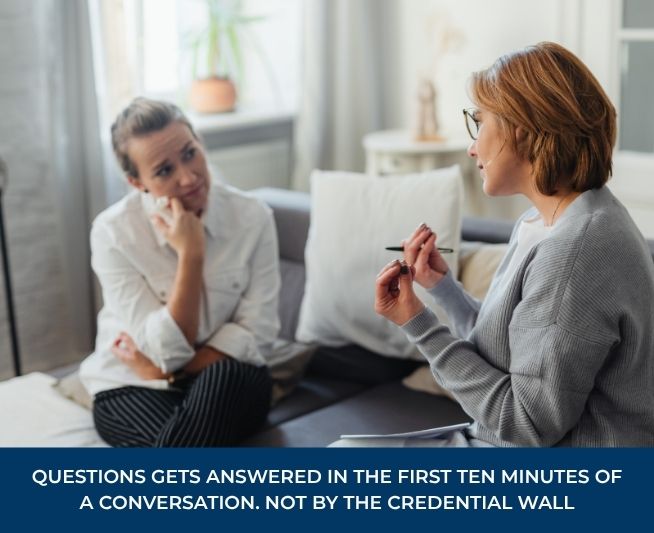
That question gets answered in the first ten minutes of a conversation. Not by the credential wall.
This is something The Perimenopause and Menopause Certificate Program addresses explicitly, because we’ve watched clinically excellent practitioners lose patients’ trust in the first session not because they lacked knowledge but because they communicated from a clinical frame that left no room for the patient’s own experience. And we’ve watched practitioners without traditional clinical backgrounds build practices full of deeply loyal clients because they had the language, the presence, the coaching skills, and the framework to make a woman with a complicated situation feel genuinely seen before they offered a single recommendation.
The credential opens the door. What happens once you’re in the room is everything.
What That Actually Sounds Like
An IWHI graduate explaining her approach to a new patient who has been around the healthcare system doesn’t say: “I’m certified in perimenopause and menopause care, so I know about hormones.” That sentence, while true, tells a skeptical patient approximately nothing.
What she might say instead is something like: “Most of my work is with women in their 40s and 50s who feel like they’re doing everything right and still can’t get their symptoms under control. The difference in how I approach this is that I’m not starting with hormones and working outward. I’m looking at the full picture, your nervous system, your gut, your sleep patterns, your stress load, the chronic conditions that were there before perimenopause started, and how all of that is interacting with the hormonal shift. My job is to figure out which piece to address first, and in what order, so we’re not just chasing symptoms.”
That description doesn’t require a credential to land. It lands because it names the exact experience this patient has been having: a system that has been addressing her symptoms in isolation, in sequence, without ever connecting the dots. The credential behind the practitioner gives her the clinical confidence to speak that way. The language is what the patient actually hears.
In fact, within the business training and weekly support, we help each of our professional students get crystal clear about exactly who her business is designed to serve and exactly what problem it’s designed to solve. So, your messaging will be even more specific, dialed in, aligned with your purpose, and meaningful to your client and you. Practicing in an aligned way, with clear messaging, is the differentiator, not just the letters behind your name.
The IWHI Perimenopause and Menopause Certificate teaches both. The clinical depth that makes the approach real, and the communication framework that makes it legible to the person sitting across from you.
“I am so inspired and have a new outlook on my life and career after taking this course. I am so grateful for all of the hard work that you put into this. It is an incredible wealth of knowledge that I am excited to share. I would highly recommend this course to any healthcare professional or anyone who might be interested. I already feel better myself having implemented several recommendations to my own routines already!”
Melissa Ommundsen
Physical Therapist and Professional Dancer
What This Means for the Credential Decision You’re Actually Trying to Make
A credential from IWHI is recognized in the field. It carries legitimate continuing education value for applicable licenses. It signals to colleagues and referral partners that you completed serious, year-long clinical training in integrative perimenopause and menopause care, not a weekend workshop. And the IWHI certification is increasingly showing up in women’s health directories as something informed patients specifically search for, because the reputation of the training has been earned in clinical practice over more than two decades.
But the credential is downstream of the training. What changes your practice is the depth of clinical preparation, the framework for navigating complexity, and the ability to walk into a room with a woman who has been failed by the system and know exactly how to start the conversation.
The letters confirm you did the work. The work is what actually matters.
If you’re trying to figure out whether the right menopause credentials are the next step in your career development, that’s exactly the kind of conversation our career coach team is good at. Your application and free career coaching clarity call is an essential discussion about what you’re seeing in your practice, what’s not working, and whether The Perimenopause and Menopause Certification Program or something else is your right next step.
The Perimenopause and Menopause Certificate Program is a 12-month integrative training built for the complex cases: the women with layered chronic illness, the histories that don't fit a standard protocol, the patients other practitioners refer out.
If you're ready to practice with that level of confidence, start with a free clarity call with our career coaching team.
No pressure. Just clarity.
Learn More About the Program
Frequently Asked Questions
Is the IWHI perimenopause certification recognized by other healthcare providers?
Yes. The IWHI certification is increasingly visible in women’s health referral networks, collaborative practice settings, and telehealth platforms serving the perimenopause population. Its recognition has been built through clinical outcomes over 20 years, not marketing, which makes it more durable than credentials that rely primarily on brand awareness.
How do I explain the IWHI certification to patients who have never heard of it?
Lead with what you can do, not the letters. Describe your approach: how you assess the full picture, why you don’t start with hormones and work outward, what you look at first and why. Patients who have been failed by the system will recognize immediately that this is different. The credential provides the clinical confidence behind the approach. The description is what the patient actually hears.
Does the IWHI program include guidance on how to communicate clinical expertise to clients?
Yes. This is embedded throughout the program rather than treated as an afterthought. Module 4 is dedicated entirely to women’s health coaching communication skills, including how to explain your approach in a way that meets patients where they are. Business training includes specific work on messaging, positioning, and articulating your specialization to prospective clients and referral partners.