Follow Us for Free:


About the episode
“Perimenopause can amplify and unmask complex chronic illnesses that were hiding in the background.” – Dr. Jessica Drummond
When we skip the chronic illness conversation with our midlife clients and patients and go straight to hormone replacement therapy (HRT), we miss helping women feel fully well and stay well into their later years. While HRT can be an important tool, it’s not the whole story.
For the majority of women, the perimenopause transition overlaps with complex chronic illnesses like endometriosis, autoimmune disease, or long COVID, that can flare or appear for the first time in midlife. If we only address hormones, we miss the root causes of symptoms. These women need more than quick fixes and generic protocols. They need skilled providers who can integrate functional nutrition, nervous system regulation, personalized coaching, and chronic illness management into a holistic care plan.
In this episode, we’re doing things a little differently. I’m being interviewed by my friend, Marnie Glavin of Pelvic Health Support, to discuss why midlife is such an important time for us as women’s health and wellness practitioners, the intersection between perimenopause and chronic illness, how we can help clients to develop their longevity plan, the tools and skills required to support this underserved population, and how we can empower women going through the transition.
Enjoy the episode, and let’s innovate and integrate together!
Highlights
- How perimenopause can highlight or trigger new or existing chronic illnesses
- Why HRT is often not a complete solution on its own
- Estrogen’s role in metabolic health
- How hormone therapy plus lifestyle changes improve resilience
- GLP-1 medications for managing metabolic and chronic illness symptoms in perimenopausal women
- My journey with long COVID and its impact on my health
- What research shows about estrogen’s protective role in relation to COVID
- Why continued masking matters and the reality of our post-COVID immune system
- COVID’s persistence in the body, ovarian damage, and potential for early menopause
- The importance of slow, comprehensive assessment for perimenopausal women
- Why nervous system regulation should precede hormone therapy
- A stepwise, individualized approach to layering treatments based on symptoms and goals
- How to find practitioners who are skilled in integrative perimenopausal care
- Practical strategies to build resilience and support healing
- How foundational practices enhance the effectiveness of medications and therapies
- The role of mental health professionals in perimenopausal support
Mentioned in this episode
- Perimenopause and Menopause Certificate Program
- Marnie Glavin’s Website | PelvicHealthSupport.org
- Book a free clarity call with Kelsea Cannon, PT, WHC, our expert Career Coach
- FREE Webinar | How to Build a Thriving Perimenopause & Menopause Health Coaching Practice
Ready to revolutionize your career and grow your practice?
- The Integrative Women’s Health Membership
- What is the next step in your career in women’s health and wellness? Start here: https://integrativewomenshealthinstitute.com/start-here/
- Integrative Women’s Health Institute on Instagram | @integrativewomenshealth
- Integrative Women’s Health Institute on YouTube
Learn more about The Integrative Women’s Health Institute’s Programs.
Click here for a full transcript of the episode.
Dr. Jessica Drummond 00:00:03 Hi and welcome to the Integrative Women’s Health Podcast. I’m your host, Doctor Jessica Drummond, and I am so thrilled to have you here. As we dive into today’s episode, as always innovating and integrating in the world of women’s health. And just as a reminder, the content in this podcast episode is no substitute for medical advice, diagnosis, or treatment from your medical or licensed health care team. While myself and many of my guests are licensed healthcare professionals, we are not your licensed healthcare professionals, so you want to get advice on your unique circumstances. Diagnostic recommendations treatment recommendations from your home medical team. Enjoy the episode. Let’s innovate and integrate together.
Dr. Jessica Drummond 00:01:02 Hi, and welcome back to the Integrative Women’s Health Podcast. I’m your host, Doctor Jessica Drummond. And today we have a unique episode here at the Integrative Women’s Health Institute. Behind the scenes we have been upgrading up, leveling, optimizing our perimenopause and menopause certificate program because what we are seeing is that this is an underserved population of women, women generally ages 35 to 55 and beyond who are not getting adequate menopause care.
Dr. Jessica Drummond 00:01:39 Now, this is a sound bite you’ve probably heard all over Instagram in the last few years about perimenopausal and menopausal women need hormone therapies, and this is, by and large, true, although not 100% of the time. But I think there’s a very important piece of the puzzle that is currently being missed by the conversations that we’re having on Instagram, primarily and in the media, you know, in social media and in traditional media that not everything that happens to women in their late 30s to late 50s has to do with the menopause transition from a hormone perspective only. In fact, perimenopause and menopause is a time where other chronic illnesses that may have been more managed, more under control, or not even yet triggered were absolutely fine. And then a person transitions into the perimenopausal transition, which is actually, in most cases, more challenging than even the menopausal transition. And then because of the hormone shifts, that becomes a trigger and amplifier, something that exacerbates or interacts with other underlying conditions. Things like endometriosis. Post viral illnesses, autoimmune disease, even things like migraines, chronic concussions, other chronic pain and fatigue conditions.
Dr. Jessica Drummond 00:03:11 Marcus Potts hypermobility syndromes even. I mean, the list is quite long. And so in our program, we are now really expanding that training for health and wellness professionals, because I found that as people were going through that program, we’ve had nearly 300 people already go through that program, 300 professionals. But we decided it needed more. It needs a stronger foundation of functional nutrition skills, of health coaching, communication skills, because the woman involved in the program is the one who has to be actively involved to reduce burnout among professionals. Also, we have to really work on all levels of healing. Mind, body and spirit. Plus, we need to think about the underlying complex chronic illnesses that literally about 80 to 85% of women are dealing with in this phase, everything from infertility to all of the other conditions. I was explaining to, you know, what birth control should they use now, if any? There are so many questions. And in your practice, you’re often dealing with women who maybe already had like a pretty good midlife appointment with a gynecologist or other prescribing practitioner who did recommend the appropriate hormone therapies.
Dr. Jessica Drummond 00:04:34 But that is almost always not enough. It’s not the whole picture, the whole solution. So I sat down for an interview with my friend Marnie Glavin of Pelvic Health Support. And so in this interview, you’re going to hear my perspective on why perimenopause and midlife in general. Literally anywhere from the late 30s to 60s and beyond is such an important time for us as women’s health and wellness practitioners to not just be thinking about perimenopause and menopause, but to be thinking about how those transitions interact with everything from pregnancy and postpartum to chronic illness, and then also helping women in that time frame develop their longevity plan. Right. How are their bones, their musculoskeletal health, their energy, their mitochondrial health for literally the next 30 years? And one of the things that’s most exciting to me about this new program that we’re going to have coming out in October, is that we begin to talk about and think about the reality that this is the first time in history that midlife and older women have gotten the opportunity financially and from a perspective of like having control over their own lives to literally just decide what they want the next 30 years to look like.
Dr. Jessica Drummond 00:06:02 Often, they’ve already hit some peaks in their career. They might even want a brand new career. They may have already at least partially raised their children. They may have chosen not to have children. There are so many things that can be happening in this age, and it’s like your clients need another guidance counselor, right? They need someone to sit down with them and help them navigate the space at their highest level of optimal health. And that is not just with hormone therapies. So listen to the episode and join my conversation with Mani and I’ll chat with you on the other side.
Marnie Glavin 00:06:45 All right. Welcome. Today we’ll be diving into a topic that’s impacting many hurry menopause and complex chronic illness and help us explore what’s really happening in the body, why these symptoms persist, and what practical, evidence based strategies can help break the cycle. We have Doctor Jessica Drummond. She’s a clinical nutritionist, physical therapist and founder of the Integrative Women’s Health Institute. She’s dedicated her career to helping women manage hormonal imbalances, chronic pelvic pain and post viral conditions, and brings the unique lens of both a clinician and a patient.
Marnie Glavin 00:07:22 Welcome, Jessica. Thank you so much for being here today. Thanks for having me. Let’s get started and talk about the perimenopausal population and how they’ve been struggling more with complex chronic illness than many other populations.
Dr. Jessica Drummond 00:07:38 Yeah. So I think one of the things to kind of bring awareness to is that we’ve had a lot of increase in conversation about Perimenopause and menopause, which is really important. And women are struggling with like symptoms simply related to that perimenopause to menopause transition. Everything from. Mental health symptoms like depression, anxiety. Rage. Mood swings to. Weight loss resistance. Weight gain. Sleep problems are among the most frustrating for my patients. And things like musculoskeletal syndrome of menopause. Chronic joint pain. Frozen shoulder. We also see sexual health issues, bulbar vaginal dryness, bulbar atrophy, pelvic pain with sex. All of that, and even low libido can be directly related to the hormone shifts that are a normal part of perimenopause and menopause. But one of the things that I think is missing from this conversation Ation is that roughly 80% of women.
Dr. Jessica Drummond 00:08:47 Maybe a little more at this point. Have some kind of complex underlying chronic illness, you know, endometriosis, dysautonomia, Potts, chronic concussion syndrome, post viral illness, autoimmune disease, Hashimoto’s, things like that are very, very common in women in general. By the time they reach age 40. So what we’re seeing is that women may be quite stable with their chronic illness if they know they’ve had it for all of these years, and they have good management systems in place. But then the hormonal shifts either trigger exacerbations or their management tools aren’t working as well, or they didn’t even know they had these issues until they’re triggered in perimenopause or. And I think long Covid is a good example of this. They are at higher risk simply because they happen to be perimenopausal of even getting these kinds of complex chronic illness. We’ve seen long Covid and a lot of its sequelae like dysautonomia, mast cell activation syndrome. And so there are underlying risk factors. There are the preexisting conditions that we come into perimenopause with.
Dr. Jessica Drummond 00:10:07 And even really skillful personalized hormone therapies then, are not a complete solution, because that’s not really the only thing that’s going on is a hormone decline or a hormone dysregulation. And so people feel women feel really frustrated. They’re like, my perimenopause is still a problem, but it may be that the perimenopause is just the environment that’s highlighting your complex chronic illness that is either new or exacerbated.
Marnie Glavin 00:10:41 So you’re finding that there’s elevations of conditions that could have already existed. So people, well, experiencing potentially chronic fatigue syndrome, they’re going into perimenopause with chronic fatigue syndrome. And then it’s worsening as a result. Is that correct?
Dr. Jessica Drummond 00:10:57 Correct. This could be anything. So we see flares in endometriosis. We see more instability in autoimmune type diseases more symptoms. The chronic fatigue syndrome Me, CFS and chronic pain syndromes again often can be exacerbated by the hormone shifts. You know a lot of times women will say my symptoms are worse right before my period or right around ovulation, and maybe they were able to manage those pretty well in the past when their cycles were more predictable.
Dr. Jessica Drummond 00:11:33 But now we’re in perimenopause, where they may have delayed ovulation to day 40, they may have an ovulatory cycle and skip ovulation altogether. They may have two estrogen peaks, and it’s varies month to month. So when shifts in estrogen, progesterone and in some cases testosterone are irritating their underlying chronic illness or again put them at risk for even getting new chronic illnesses. It’s then harder to track and manage because the hormone shifts are so variable. The good news is, is that often once we bring some awareness to this and we start to address, first of all, the underlying chronic condition, like we do everything we can to stabilize that. For example, I’ve seen more and more women be diagnosed with endometriosis when they’re in their 40s, and we do a lot of things to not just manage perimenopause, but to actually address the endometriosis, including skilled excision surgery, including nutrition and lifestyle Style strategies. And then we’ve sort of addressed that underlying syndrome or chronic issue. Some things don’t really have as direct treatments available for them.
Dr. Jessica Drummond 00:12:49 Things like MCAS, dysautonomia, long Covid. We have symptom management tools which are super effective and actually do help with recovery. Even if we can’t get sort of 100% deep cure. And even it’s the same with endometriosis, we don’t have a cure. We have really good symptom management that could get to 100% symptom free. And then these things that are exacerbated by the hormonal shifts that become inconsistent and difficult to track, people tend to do better in post menopause. Now, luckily, we do have some newer tools, things like the mirror that can help women to sort of track their hormones in real time. It’s sort of like, I think of it as a continuous glucose monitor for your ovarian hormones. You essentially pianistic. It’s kind of like a ovulation predictor, but you can look at your hormones in real time. Moment to moment. Hormone tests only give us limited information because they’re a snapshot in time and a system where the hormones are just changing a lot. So the 40s are usually the toughest decade for this.
Dr. Jessica Drummond 00:14:04 And then mid to late 50s things settle down. Some women can start as early as their 30s. So it’s a little bit both. And most of the time the issue is that the person had a pre-existing chronic illness and it either wasn’t triggered until perimenopause or it wasn’t exacerbated or flared until menopause was more under control. But perimenopause itself can also increase the risk of certain chronic illnesses.
Marnie Glavin 00:14:32 But people who have autoimmune disease. Are they more prone to worsening perimenopause or more exacerbated peri menopausal symptoms as a result of their pre-existing condition?
Dr. Jessica Drummond 00:14:46 What I would say is that because the hormone shifts are more inconsistent, people who potentially had autoimmune flares related to either low or high estrogen moments in their cycle, now those feel worse and more inconsistent because we don’t know when they’re going to happen. And sometimes they’ll happen multiple times in one month, not just once a month.
Marnie Glavin 00:15:11 And as HRT helping. Or is HRT only a partial piece of the puzzle?
Dr. Jessica Drummond 00:15:17 HRT can be helpful because it can sort of smooth those peaks and valleys. It sort of gives us more consistent level of estrogen and progesterone, but not fully consistent when we’re still in perimenopause and still producing our own hormones.
Dr. Jessica Drummond 00:15:33 This is why post-menopausal. Sometimes it’s better because then the hormones are supported and more consistent over time, so it can be helpful. But for example, about 10% of women, most women who take oral microRNAs, progesterone, for example, have better sleep, better cognitive function. Their brain is nourished by those metabolites. But about 10% of women have this sort of rebound effect, where it’s sort of like those small number of kids, you give them Benadryl and then they’re bouncing off the wall. It’s like a reactive effect. That’s the opposite. So if that happens, then we think, well, why is the body reacting in such a way? We lower the dose, we help get estrogen and progesterone ratios, more imbalance, and we help build up the resilience of the HPA axis with things like nutrition, sleep hygiene strategies, lifestyle medicine, etc. so HRT can absolutely be part of the solution. So let’s say one of your struggles with autoimmune Hashimoto’s is weight loss resistance. And now as your estrogen is declining, estrogen really helps with insulin sensitivity.
Dr. Jessica Drummond 00:16:55 So as estrogen declines, you’re going to be more metabolically unstable. Adding some estrogen in the context of a more nutrient dense, high protein, high fiber nutrition, strength training, walking, things like that will begin to improve your metabolic resilience in perimenopause, even if you have underlying Hashimoto’s or endometriosis or any other autoimmune or autoimmune like condition. Hormone therapies can be helpful, but they’re usually not the sort of root cause solution, if that makes sense.
Marnie Glavin 00:17:33 I’ve been hearing a lot about GLP one medications like osmotic and gyro. Are these playing into helping women who are struggling with chronic, complex illness along with perimenopausal symptoms?
Dr. Jessica Drummond 00:17:48 Yes, especially when there is a metabolic component at play. So women who have underlying PCOS, for example, or certain autoimmune diseases that just regulate the metabolic syndrome, the metabolic system, like we were just talking about things that make the body less insulin sensitive. But one of the things that is very common right now, especially in perimenopausal women, is a condition called mast cell activation syndrome. This can be triggered at any time.
Dr. Jessica Drummond 00:18:22 There are some genetic underlying risk factors for this and related to things like hypermobility syndrome. So if you have Ehlers-Danlos or you just know you have some hypermobility or you have hypermobility genetics, even if it’s not really being expressed, you don’t have significant hypermobility. Oftentimes these people also present with mast cell activation syndrome and or dysautonomia, which is like Pots or other forms of irregularities in the heart rate blood pressure system. So people stand up and they have vaso vagal syncope, they feel dizzy. And I hear the story over and over of like I’ve always felt a little dizzy. I was the kind of person who, like, if I skipped breakfast in the morning, I was shaky. Any stressor could make me kind of shaky and dizzy. And then it’s in the context of my whole life. I’ve had allergies or random hives sometimes, or migraines. This is the genetics of that syndrome and Covid other infections too. But Covid to a significant extent triggers those three syndromes, and mast cell activation syndrome in particular, is a syndrome where the mast cells, which released histamine and other inflammatory cytokines, they get very touchy.
Dr. Jessica Drummond 00:19:49 So you can have a histamine or cytokine response even to heat or exercise or a very mild stress. It could be anything. Foods can really irritate the part of the immune system related to the mast cells. There are GLP one receptors on the mast cells. So Doctor Afrin and his group just published a case series on using GLP one and GIP agonists to settle down that mast cell hyper reactivity. And I am seeing that that’s working helpful in a lot of the long Covid population that has that mast cell activation component, which presents as hives, burning pain, bloating after eating, bladder pain, burning, itchiness, redness. It’s sort of like a red flag to me that we’re dealing with meth cell activation syndrome. The caveat is because there are no perfect tools. The all tools are in context like never asked me is estrogen good? Is GLP one good? Like maybe depends on the patient. Depends on the situation. But the caveat for GLP ones and mast cell activation syndrome is that I do see clinically that people’s digestion is slowed a bit, which is a normal part of how they work.
Dr. Jessica Drummond 00:21:12 And if they have really unstable pots or other forms of dysautonomia, or they’re having slow digestion anyway way related to their mast cell activation that can make that worse and or can trigger tachycardia. And sometimes people don’t need the metabolic support. And so they feel like their blood sugar is being tanked too low. We don’t have randomized control data to say if that’s really true or if it’s more of a dysautonomia trigger, because it can kind of feel the same, right? That like shaky low blood sugar sort of symptoms. But those are some unanswered questions. We don’t have randomized controlled trial data and GLP one and GIP tools for mast cell activation. But I know of at least three groups around the country who are using them in context with long Covid, and particularly this mast cell activation presentation of long Covid, which again can happen in endometriosis or many other syndromes as well. So it’s a little bit off label right now, but it’s a potentially really valuable tool. I have also seen a few patients in our practice with endometriosis who went on a GLP one.
Dr. Jessica Drummond 00:22:27 Just the standard dosing, usually in long Covid and mast cell activation using very, very, very small compounded doses to the point where people don’t even necessarily lose weight, which is fine. But I have also seen some patients who were prescribed Mindoro or Mozambique or, you know, the the standard dose pharmaceutical dose and their endometriosis symptoms resolved dramatically. They were taking them for obesity, but their endometriosis symptoms resolved as a side effect.
Marnie Glavin 00:23:01 So what about you? You’ve had your own experience with chronic, complex illness long Covid specifically for you. Can you tell us a little bit about your story and how you got to be where you are today?
Dr. Jessica Drummond 00:23:16 I got Covid in 2020. No vaccines. Of course they weren’t available and I had a pretty rough case. I probably would have been hospitalized had it not been at the peak of pandemic. My oxygen was really a struggle. I had pericarditis, I had a lot of heart and lung acute symptoms. I understand now, but didn’t know why. Then. I had pretty aggressively, you know, dramatically triggered dysautonomia.
Dr. Jessica Drummond 00:23:43 I couldn’t even stand up to take a shower. I had severe, severe fatigue. I couldn’t walk down the street. I had swelling in my hands, tons of burning pain. My whole body was in burning pain for months. Initially two years. I did get vaccinated, maybe eight months post infection, which for me dramatically improved the burning pain. Which goes to show you this immune modulation piece of the puzzle right now. Before I got Covid, I was absolutely fit. I was 46 years old. Best shape of my life hiking, ski, mountains. Three weeks before going to workout classes. I’ve been lifting weights my entire life. Hadn’t eaten gluten, dairy, or sugar in like 20 years before that. Rarely drank alcohol. I was fit, so it was an abrupt shift. Now, we didn’t know any of this before, but now we know five years later that Covid long Covid is 45% more likely in women in perimenopause. And we have a few other pieces of data that point to potentially why.
Dr. Jessica Drummond 00:25:00 And that’s the fact that when estrogen drops, people are at more risk for Covid in general, acute Covid, and then also they lose that metabolic support of estrogen. And we do know that long Covid has some metabolic risks to it. So for example, you are at risk of long Covid if you’re more obese, less metabolically fit, but also if you’re very fit, high exerciser and like I said, in perimenopause, 45% more likely because those estrogen shifts are so variable if you’re between the ages of 40 and 55, but you happen to be perimenopausal, your increased risk is 45%. If you’re already postmenopausal, that increased risk is a little less at 40%. So again, when the hormone stabilizes, it seems to be a bit protective. But there was also a really interesting study done a while ago now, like 3 or 4 years ago, that showed that people who were transitioning, transgender people transitioning from female to male, so they were suppressing their estrogen and adding testosterone were about 3.5% more likely to even get acute Covid.
Dr. Jessica Drummond 00:26:16 Whereas transitioning in the other direction, where they were adding estrogen from male to female, we’re less likely to even get acute Covid. People on hormonal birth control are also less likely to get acute Covid, which is a little bit counterintuitive because hormonal birth control essentially suppresses your natural hormones. But it does sort of add back a little bit of estrogen and keeps it stable. So I’ve seen in my practice that, for example, people might have 1 or 2 Covid infections fully recover, have no residual effects. And then the third one they had when they were in luteal phase, and that triggers long Covid, which is interesting because that’s a time of low estrogen. But we also know that Covid infections are additive in terms of immune and nervous system damage. So each time you get a Covid infection, even if it’s asymptomatic, even if you fully recover, you lose a bit of the gray matter in your brain. So mask up, everybody. And then no matter what. Like whether you’re old, young, male, female, that’s the reality.
Dr. Jessica Drummond 00:27:26 But we also know from data out of Canada actually, that after your first infection, like your initial Covid acute infection, you’re about at 20% risk or so of getting long Covid. In general, no matter how old you are, old, young, male or female, after your third infection, that risk increases to 40% because Covid damages your immune system and essentially makes you more immune compromised. The infections are additive over time, and this is why vaccination reduces the risk of long Covid, but only if it prevents you from getting Covid, which it does to some extent, but not perfectly. Not even well in my opinion. But still, there is an important place for that, because the less times you get Covid, the better. Your best tool for that in the moment is a well fitted N95 mask. I still mask very regularly in indoor spaces outside of my home, less so if I’m outside. I don’t think I’ll ever get on an airplane again without wearing a mask. That seems crazy. just for anything we might have in the air.
Dr. Jessica Drummond 00:28:46 But public transportation? Absolutely. Hospital settings. You know, talking to my colleagues in healthcare, please wear a mask in a healthcare setting. It’s absolutely imperative for people who are immune compromised for any reason. And by the way, most of us are now walking around immune compromised because I don’t know anyone who has not had Covid at this point. Really. So all of us have some degree of immune compromise relative to 2019. So circling back to perimenopause. So if you get Covid and you’re perimenopausal, which I was I was 46 years old and perimenopausal. That was a risk. It wasn’t necessarily why I had such a significant acute case. I think that was just because it was so early in the pandemic.
Marnie Glavin 00:29:34 And you, as I mentioned, you were super fit. So that was.
Dr. Jessica Drummond 00:29:36 Correct. And that’s a risk factor because people who are super fit have more Ace2 receptors on their heart and their muscles, actually. We have really interesting data about how Covid kills skeletal muscle. And you have more Ace2 receptors on your heart and skeletal muscles.
Dr. Jessica Drummond 00:29:55 If you are more fit, more muscular, then Ace2 receptors are where Covid enters the body, so it can enter in more areas. And we also have data that Covid can remain in the body for as long as all of these reservoir studies have been done now. So we know how like when you get EBV or Epstein-Barr virus, 95% of the population has had it and then it doesn’t go away. It kind of hides. It kind of goes inactive in these reservoirs, which most of the time is absolutely fine, not bothered, but it can reactivate. And we now have data from about two years ago that shows that that’s probably one of the causes of Mis or multiple sclerosis is Epstein-Barr virus. Covid probably does the same thing. There’s still a lot of work going on about that, but we do have about 30 studies now, at least 15 studies of looking at kind of where these viral reservoirs are of Covid and they’re everywhere. They’re in the ovary. They can actually do direct ovarian damage. We do see premature ovarian syndrome, premature ovarian shutdown.
Dr. Jessica Drummond 00:31:09 Basically, the youngest I’ve seen in my practice is early 40s. But there are some case reports in the 30s of Covid essentially causing acute early menopause because of damages the ovary so much, we see it most in the brain, like I said, in the muscles, there’s lots of places where Covid hides the gut microbiome. And so we don’t really know yet the long term effects of sort of living with Covid in our bodies for this prolonged period of time and some of the drugs that are being tested to help kind of try to get to and clean up these viral reservoirs are repurposed HIV drugs because there is some overlap. So if you’re perimenopausal and you’re fatigued, brain foggy, having chronic pain, having burning bladder pain, having low libido and you had Covid ever in the last five years. But I do tend to take a look at the timeline because that can trigger slash exacerbate these overlapping symptoms of Covid and perimenopause. And there is a subset of people who have injury, if you will, from the vaccine.
Dr. Jessica Drummond 00:32:27 For many, many people, it’s protective, it’s helpful. But there are many people that do have immune dysregulation triggered by the vaccine. There is more research going on at Mount Sinai. It’s a different syndrome than long Covid. We call it long vax. It’s a different syndrome biochemically, but it presents with a lot of the same symptoms that chronic fatigue, chronic pain, burning pain, nerve type pain, shortness of breath, just autonomia mast cell activation, food sensitivities, etc.. And so if you think about those symptoms, you need to be working with a practitioner who really slows down and listens to the story every day in the United States. Now we’re having about 500,000 cases of Covid. So we’ll have 100,000 new cases of long Covid every day in the US. Globally, it’s roughly the same, and it’s higher if whatever 100,000 of those people are perimenopausal, 50,000 of those almost will have long Covid. So we have to go a little slower with our assessments and our evaluation, and not just expect that HRT and even an HRT, GLP one GIP combo is going to just solve the problem.
Dr. Jessica Drummond 00:33:44 We got to go a little deeper to what’s happening with the nervous system, what’s happening to the immune system, what’s happening with the digestive system so that we can really get a little deeper root cause healing, for which some of these medications are really helpful, but they’re often not a complete solution, and they may not be actually where we even need to start. Because circling back to that mast cell activation syndrome, which is a common part of this estrogen, can make mast cells more unstable. So if we just add estrogen hormone replacement on top of mast cell activation syndrome without first stabilizing the mast cells. Migraines can get worse. Sleep issues can get worse, anxiety can get worse, burning pain can get worse. Vascular issues can get worse until we address the underlying immune dysregulation first. Progesterone tends to calm mast cells again, not in every case. But often what we’ll do in our practice is get the lifestyle foundations optimized. Nervous system regulation. Immune healing from a food supplement. Lifestyle perspective. Mast cell stabilization sometimes with medications, sometimes with non-pharmacological options like relatively high dose quercetin.
Dr. Jessica Drummond 00:35:11 Antihistamine diets, things of that nature. Also, when the nervous system is more regulated, the immune system stays calmer. So we get those pieces in place. Then we support adding hormone therapies kind of one at a time. So first calm rest rest rest. So progesterone is more the hormone of that. Then estrogen helps with metabolic health, which we also do with things like continuous glucose monitors strength training depending on how much fatigue is a part of the picture or syndrome. Sort of like me CFS exercise. We have to be careful, but we kind of balance the chronic fatigue issues with the metabolic Needs, and then we can layer on estrogen and or GLP want to optimize those metabolic health issues. But we have to do this slowly over time. Because the other thing is, most of these women in their 40s and 50s and 30s have kids of all ages, work, financial pressures, relationship challenges. They’re busy. So I always lead with a coaching model, which is basically like the first thing we do is we spend an hour talking about where you are.
Dr. Jessica Drummond 00:36:33 How did we get here? What was the series of events? What were some of the risk factors diagnoses? Did you have Covid? Did you have a Covid infection? When do you think you started going to perimenopause? How are your periods like make sure you’re working with someone that slows down long enough to hear the full story. And then we do have a suite of tools that includes all the things I just mentioned, but there are about eight different underlying drivers, maybe ten, and some are much more prominent. For some people are much more painful, if you will. You know, if someone’s just not sleeping or super fatigued, we might start there. Someone’s hot flashes are terrible. We might start there. If someone’s weight loss resistance is really frustrating, we might start there. So it’s like, what are your goals? And then we think about what’s the underlying context hormonally. And then what are the other chronic illnesses that we have to deal with. I think when we skip the chronic illness conversation and go right to patch up the hormones, we miss helping women feel All fully well, and then having a plan for getting better and better and staying well into their 60s, 70s, 80s and 90s in a challenging environment.
Dr. Jessica Drummond 00:38:02 You know, we’re all under a lot of stress. Covid still here. And so I think it’s really important that we think about slowing it down, seeing where you are and where you want to go, and know that it’s going to take a little time, a little tweaking. So the most important thing is to find a practitioner who’s flexible and patient.
Marnie Glavin 00:38:26 Where would one start? I mean, everything’s so complicated and complex with perimenopause and then bringing in chronic illness. It’s just, I think overwhelming. I don’t even know where how to begin getting myself better. And I think that might be the biggest challenge is the first step in. It’s like going to the gym, right? It’s always the hardest part is always getting there.
Dr. Jessica Drummond 00:38:49 Well, and this is challenging because your average primary care doctor is just not going to be able to handle this. They don’t understand it. They don’t have time. And I think we have to be real about the fact that most health care professionals were dramatically traumatized in the pandemic and have been given zero resources to process that trauma.
Dr. Jessica Drummond 00:39:13 So they’re just like the rest of us. They’re stressed and overwhelmed, and they don’t have time. So we train health coaches that specialize in perimenopause and menopause. On our website, we have a directory which we’re always optimizing, and you can also email our support. My website is Integrative Women’s Health Institute. We train health coaches and many of them are physical therapists, occupational therapists, nurse practitioners, nutritionists, Wellness professionals, chiropractors, physicians. They have all kinds of licensure. Pas and or our wellness professionals. So depending on where they are in their scopes of practice, I think the key person that can be is to be your sort of place where even within the health care system, they have a little bit of time. Pelvic health physical therapists are really excellent resources because a lot of them have come through our program. They understand perimenopause and menopause. They understand complex chronic illness. So pelvic rehab professionals, TS, OTS, Pas, NPS, nutritionists, these are among your best places to start. And pure health coaches because sometimes you just need a place to have that first conversation.
Dr. Jessica Drummond 00:40:44 Here’s the timeline. Here’s what’s most bothersome to me. Here’s what happened to me through my life. Here are some of my genetic vulnerabilities. Like you want to have someone kind of on your team that helps you navigate care. For the vast majority of my clients, where we have to begin step one of our protocol or our system is nervous system regulation, but kind of like the gym. Understanding it is very different from doing it. So one thing to know. Sleep is the ultimate meditation. So like if you’re feeling like I don’t have time to rest or meditate or breathwork or yoga, what could you do in your life now? Some people can’t sleep because of their hormones, because of their pain, because of physiologic symptoms. We’ll deal with that. That’s important. But if you can take a moment, sit down with yourself, sit down with your partner, sit down with your family. What can you stop doing so that for the next month you could prioritize nothing but deep rest? So I have a client I was working with this morning and she uses an aura ring.
Dr. Jessica Drummond 00:41:57 A lot of my clients have fitness trackers and things like that, and they spend almost zero time in calm, restorative recovery. And yet for 30 years, maybe more, they’ve been doing for others high achieving, getting good grades, getting the next good job, being really committed moms and partners and daughters. They just haven’t ever stopped to fill their tank. One way to do it is that your body crashes and you sleep for the next year. That’s what we want to avoid. There are various reasons that the body is not a robot, and at some point it will give up if we’re not quite there yet, even if we’re on the dangling edge, we can pull it back by changing how we do our day, and it’s just start in the morning. You know, a lot of times. So step one is nervous system regulation. But what does that really mean? That simply means changing your thoughts and your body’s reactivity. We can kind of change the nervous system from the outside in to be in that restorative moment.
Dr. Jessica Drummond 00:43:14 From a nervous system standpoint, your Garmin will be in the blue, your aura ring will say you’re covered or something like that, or restorative. You can also just feel it like it’s sort of what happens like ten minutes into a good, calm meditation audio where you either finally feel just a little more relaxed or you just fall asleep because you’re so burnt out, right? Either way, we get to that moment where there’s just this peacefulness and it can start with ten minutes a day of practice. But also you don’t even have to sort of carve out special time for it. So think about lunch. And this is where food can become a nervous system regulator rather than worrying about like, don’t eat this, don’t eat that. This is going to trigger me. Like we have to reframe what we’re afraid of eating. So imagine two different people feeling exhausted, overwhelmed in pain, stress, etc. have all the things, all the symptoms of perimenopause, all the symptoms of chronic illness. They somehow drag themselves to work.
Dr. Jessica Drummond 00:44:18 It’s lunchtime. They have 30 minutes Sunday, their teenager or one that they hired meal prepped for them lunch each day for work, which included, you know, let’s say, a grilled protein and some lightly cooked vegetables and a little bit of whole grain, something like that. Whatever. They brought it with them. They shut off their computer. They shut off their phone. They sat outside, ate that lunch, and drank a full glass of water and slowed their breath and just took that few minutes, versus someone who ran downstairs to fast food place, sat in front of their computer, scarfed it down while answering. Answering emails was also had CNN things popping up or, you know, news, scary things popping up on their phone the whole time. Those are two wildly different experiences that took the exact same amount of time and sort of effort. That’s the foundation. When we get those foundations in place, then our other tools like supplements, hormone therapies, medications for muscle issues or dysautonomia issues or autoimmune issues, you know, pharmacologic options, GLP ones, those work so much better, and sometimes it’s a little bit of a feedback loop.
Dr. Jessica Drummond 00:45:40 Like if we get a little bit of hormone support, it’s a heck of a lot easier to eat lunch like that. So it’s both and and it depends on where people are, what tools are most available to them, what resources they have, what support networks they have. But rather than maybe starting with your primary care physician, start with a nurse practitioner, a PA and allied health professional, nutritionist, PT acupuncturist, whatever who is skilled in health coaching because the most important thing you need first is nervous system regulation. So you can start mapping the plan for that deeper healing. And I would say that we are also training a lot of mental health professionals as well, because a lot of times by optimizing the health of the body, some of these mood symptoms really calm down when we heal the brain, when we heal have the immune system. So a mental health professional could also be a good part of that. Who’s trained in coaching, who’s trained in functional nutrition can also be a really valuable member of that team.
Dr. Jessica Drummond 00:46:45 You want to find those people who have the space to give you at least 30 minutes per session, depending on where you are and if they’ve been trained by us in this real holistic thinking. Those are great places to start, especially if your symptoms are very mental health related, which is super, super common in perimenopause. Anyone wants to just send me a message or has any questions? The best way to do that is our Instagram at Integrative Women’s Health or through the website. We have a support email. We’re here to help. What a fun conversation with my friend Marnie Glavin. Thank you.
Dr. Jessica Drummond 00:47:24 So.
Dr. Jessica Drummond 00:47:24 Much, Marnie for that interview.
Dr. Jessica Drummond 00:47:26 Go follow her and.
Dr. Jessica Drummond 00:47:27 See all the work she’s doing at pelvic Health Support. We’ll list her links in the show. Notes. Here’s your homework for this week. Take a deep breath. I know that was a lot of information. Think about how the midlife women in your practice are really being tossed around the system right now, right? Think about how your work, your practice, could evolve to be so much more burnout proof for you.
Dr. Jessica Drummond 00:47:57 If you start being that safe space for women in their midlife transition to really optimize their whole health on all levels. Women are looking for this. They’re hungry for this. Billions of women literally are looking for this. And right now, the answers they’re getting are either kind of like three step checklists on Instagram, supplement stacks or being smelled like all kinds of protein powders or whatever Without slowing down and having a coaching centered conversation with a skilled provider who can help her navigate what is her unique nutrition and lifestyle plan, what is her unique supplement stack that will optimize her longevity for her unique goals, but will also work in concert with what hormone challenges she has, what hormone support she needs through this transition and beyond, and helps her to really feel well. To get that deep sense of health and wellness back if she ever had it right for some of her clients, this might be the first time they’ve slowed down and had this conversation. It’s such an exciting time for midlife women, and I want you to be the practitioner, be the provider, be the health and wellness coach that the women in your community absolutely need.
Dr. Jessica Drummond 00:49:27 And the resources are just not available yet. So if you want to join us in the Perimenopause and Menopause certificate program, now is a great time to jump in. There’s so much depth and breadth and support that I’ve added to that program. If you have any questions, I’ll also put a link in our show notes to Kelsey, who’s our career coach. She can help you navigate what’s your best next step. But the opportunity here is huge, because absolutely no one is talking about the fact that in perimenopause and menopause, when women have symptoms, they’re not always related to having low estrogen or low progesterone or low testosterone. But those hormone shifts do change, you know, impact chronic conditions that might have been well controlled for the 20 years prior. There is such an important opportunity here to have this conversation, and so few practitioners are thinking this way. we have to change this paradigm. So join me. It’s time. Women are searching for you. Please send us any questions you have about this. You can always email me at support at Integrative Women’s Health Institute.
Dr. Jessica Drummond 00:50:42 Com and I hope you enjoyed this episode where the tables were turned and I was interviewed. I’ll see you next week.
Dr. Jessica Drummond 00:50:53 Thank you so much for joining me today for this episode of the Integrative Women’s Health Podcast. Please share this episode with a colleague and if you loved it, hit that subscribe or follow button on your favorite podcast streaming service so that we can do even more to make this podcast better for you and your clients. Let’s innovate and integrate in the world of women’s health.
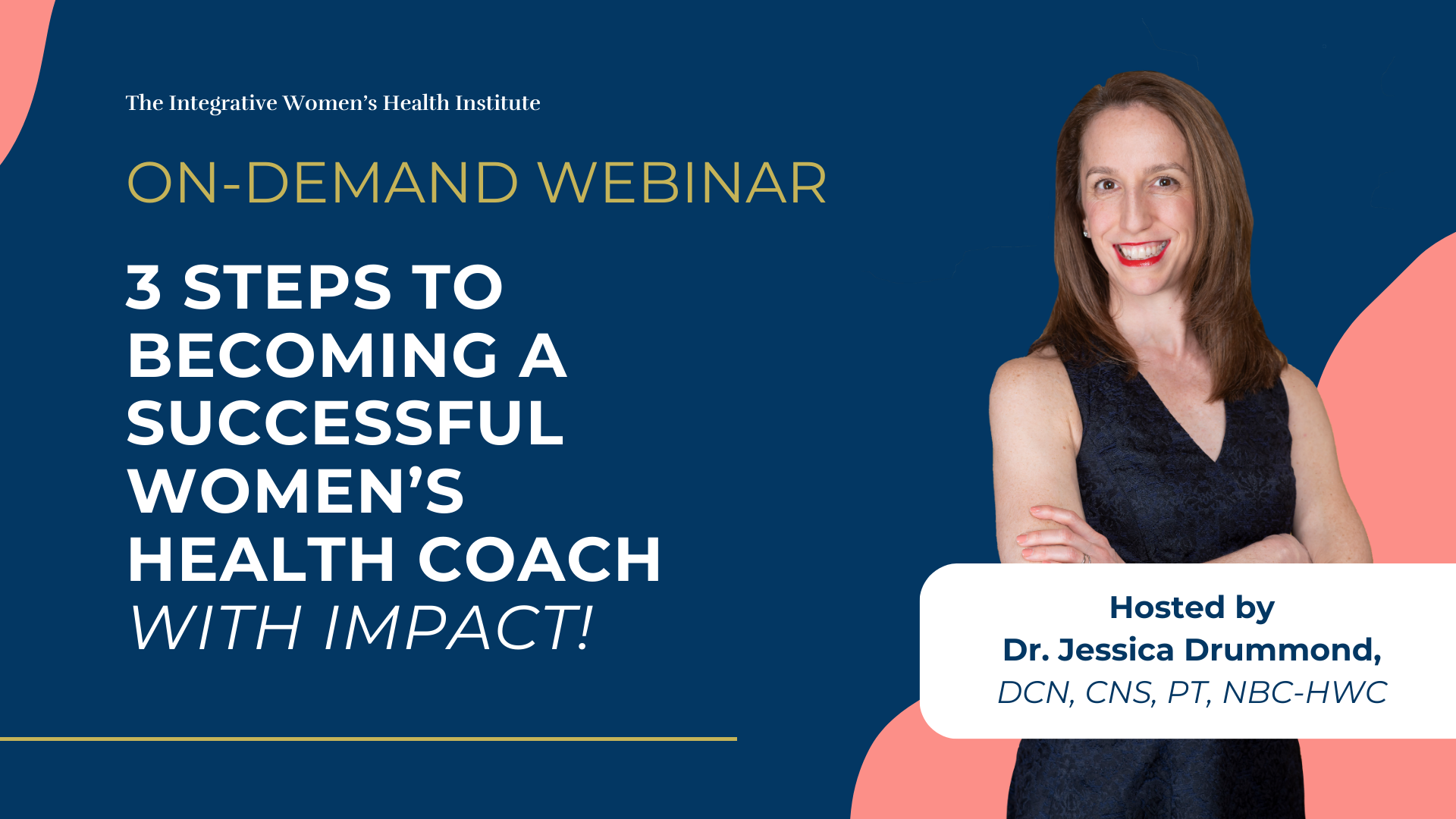
Join Dr. Jessica Drummond to learn the three key steps to becoming a successful, board-certified Women’s Health Coach who leaves a lasting positive impact on their clients.
Learn how utilizing health coaching skills in your practice is crucial to your success, leaving a lasting impact on your clients, and shifting the paradigm of women’s healthcare.

Dr. Jessica Drummond
Founder & CEO
The Integrative Women’s Health Institute
At the Integrative Women’s Health Institute, we’ve dedicated 17 years to crafting evidence-driven, cutting-edge programs that empower practitioners like you to address the complexities of women’s health.
Dr. Jessica Drummond’s unique approach focuses on functional nutrition, lifestyle medicine, movement therapies, nervous system dysregulation, trauma, and mindset – essential elements often overlooked in traditional health education.
In addition, your training will be fully evidence based, personalized, and nuanced (this is not a cookie cutter approach) in functional nutrition, exercise, recovery, cellular health, and all other lifestyle medicine tools.
You’ll learn to support your clients with cutting edge tools safely and effectively.