New from IWHI2 hours2 IWHI CEUs
The Triad to The Decad+: MCAS,POTS, hHEDS, Endo & More
Your client is in her 40s, has endometriosis symptoms, gets dizzy when she stands, flushes after meals, and her ferritin is in the low teens. Where would you start?
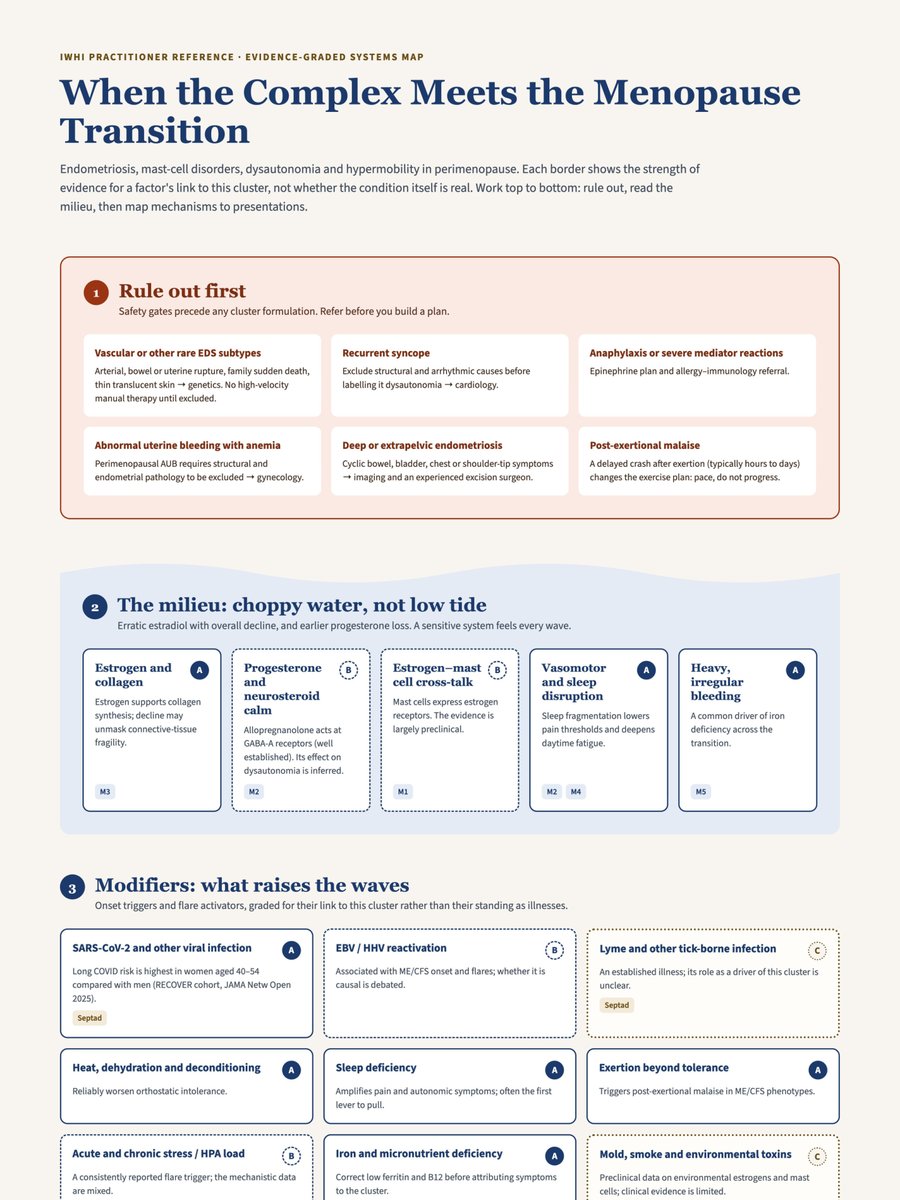
An evidence-graded systems map for MCAS, POTS, hEDS, endometriosis and related conditions in perimenopause. Know what to rule out first, what the research actually supports, and what to do Monday morning.
You know her.
She’s 46. Surgically confirmed endometriosis at 31. She was “the flexible kid.” Since COVID, standing up makes her heart race. The bloating and flushing after meals have been there for a decade, but lately they’re worse. Night sweats in the second half of her cycle. Ferritin in the low teens.
Cardiology sees the heart rate. Gynecology sees the bleeding. Allergy sees the flushing. She’s dealing with all of it at once, and so she’s desperate for you to help her, but you’re feeling confused and overwhelmed too.
And at 2 AM, she’s finding plenty of confident answers online. Most of them are not evidence-based, and some of them are flat-out wrong.
The problem with most of what’s out there
Here’s what the research actually says. Some links between these conditions are well supported. Some are emerging. Some are still hypotheses. And the MCAS link to hEDS and POTS gets weaker the stricter the diagnostic criteria get.
Most content treats every connection as equally proven. That’s how you end up pulling the wrong lever first.
Grade the link, not the condition.
A condition can be real and well characterized while its place in this cluster is still unproven. So every connection in this course carries one of four labels.
A · Consistent
Repeated observational evidence. Association, not causation.
B · Emerging
Preclinical, small or conflicting studies.
C · Hypothesis
Case series, mechanism or expert opinion. An open question.
Contested
Credible evidence on both sides.
You’ll always know what kind of claim you’re working with. So will your client.
What’s inside
- The five-layer map: safety gates, the perimenopausal hormone milieu, modifiers, five shared mechanisms, and the conditions themselves
- Rule out first: six red flags that change the plan, plus the common mimics and their first tests
- What to test and when for this complexity: why testing on a “bad day” matters, when to assess her dysautonomia, mast cell activation, and menstrual cycle related symptoms
- The core cluster: hypermobility (hEDS and HSD), POTS, MCAS and gut dysmotility, with criteria, pitfalls and what helps
- Estrogen-sensitive tissue: endometriosis, adenomyosis, heavy bleeding and iron, lipedema, and hormone therapy in this population
- Neuroimmune and energy: small fiber neuropathy, ME/CFS and post-exertional malaise, autoimmunity, and the open questions that your clients need to understand
- What you can start using now to help her feel better: nutrition, movement, medications, recovery strategies, supplements and nervous system work, and the evidence, risk, and benefit for each
- Putting it together: a six-step order of operations, who does what across disciplines, and exactly how to navigate complex cases
What you’ll use this week
- A red-flag list for what gets referred before anything else
- A side-by-side for telling a hot flash from a mast-cell flush
- A movement progression that screens for post-exertional malaise before any exercise plan
- A clear picture of your lane: what coaches, dietitians, PTs, mental health clinicians and prescribers each lead on
- How to navigate any complex case step by step
Who it’s for
This is for health coaches, dietitians and nutritionists, PTs, OTs, PAs, nurses, fitness professionals, midwives, NPs, DOs, MDs, and all other health and wellness practitioners seeing midlife clients who aren’t the simple cases.
You don’t need to be a prescriber. The course is explicit about scope, including when to refer and to whom.
This is professional education for practitioners. It isn’t medical advice for your own care.
The details
- Recorded video course, 2 hours
- A one-page reference map: every condition, modifier and shared mechanism, with its evidence grade, to keep beside you in sessions
- 2 IWHI CEUs
- $49, one time
- All sales are final.
Already an IWHI member? This course is in your membership library. Nothing to buy.

About Jessica
Dr. Jessica Drummond, DCN, CNS, PT, NBC-HWC, has spent more than 25 years as a clinician, coach, educator and business owner. She holds a Doctorate in Clinical Nutrition and is a Certified Nutrition Specialist, a licensed physical therapist and a National Board-Certified Health & Wellness Coach.
She founded the Integrative Women’s Health Institute in 2006 to help practitioners care for women in perimenopause and menopause, especially those also living with endometriosis, long COVID, autoimmune disease, hypermobility, POTS, MCAS or metabolic conditions. Her approach brings together functional testing, personalized nutrition and nervous system regulation.
Through IWHI’s certification programs in perimenopause, menopause and endometriosis, she has trained 4,000+ women’s health practitioners in 62 countries. She hosts The Integrative Women’s Health Podcast and mentors practitioners on building practices that don’t burn them out.
These are the cases practitioners bring to IWHI’s Wednesday case calls. This course is the map she uses to sort them out.
She doesn’t need another diagnosis. She needs a map and an order of operations.
COPYRIGHT © 2026 | THE INTEGRATIVE WOMEN'S HEALTH INSTITUTE & JDRHC, LLC - ALL RIGHTS RESERVED | LEGAL TERMS & CONDITIONS